SDTM Dataset Review: Why Manual Checking Is Killing Your Timeline
SDTM dataset review is where clinical trial timelines go to die. A data manager opens an SDTM dataset, runs edit checks, flags discrepancies, raises queries, waits for the CDM team to respond, and repeats. This cycle takes weeks. For a single submission-ready dataset, a team of 3-4 reviewers spends 4-6 weeks on manual review. ClinAstra does it in hours.
The bottleneck is not the science. The bottleneck is the review process itself — pattern-matching that a machine does faster and more accurately than a human.
What Manual SDTM Review Actually Looks Like
A reviewer opens the dataset, checks domain structure, verifies variable labels, runs consistency checks across domains, flags records where values fall outside expected ranges, cross-references safety data with the safety domain, checks for missing VISITNUM values, verifies --DTC variable formats, and manually raises a query for each discrepancy found. Each check is repetitive. Each check is error-prone. Each query takes 15-20 minutes to document properly.
| Approach | Time per domain | Query accuracy | Audit trail |
|---|
| Manual review | 3-5 days | 82% | Reviewer notes |
| AI-assisted review | 2-4 hours | 99.9% | Full traceability |
How AI SDTM Review Works
ClinAstra reads the SDTM dataset, applies domain-specific rules, detects anomalies in variable values, identifies cross-domain inconsistencies, and generates queries with full traceability. Every flag includes the rule that triggered it, the variable values involved, and the recommended action. No black boxes. Every query is auditable.
The system checks:
- Domain structure compliance (SDTMIG conformance)
- Variable-level consistency (expected vs actual values)
- Cross-domain reconciliation (e.g., VS with DM, AE with DS)
- Missing or incomplete records
- Date consistency (--DTC, --STDTC, --ENDTC)
- Visit numbering and timing (VISITNUM, VISITDY)
From Months to Days
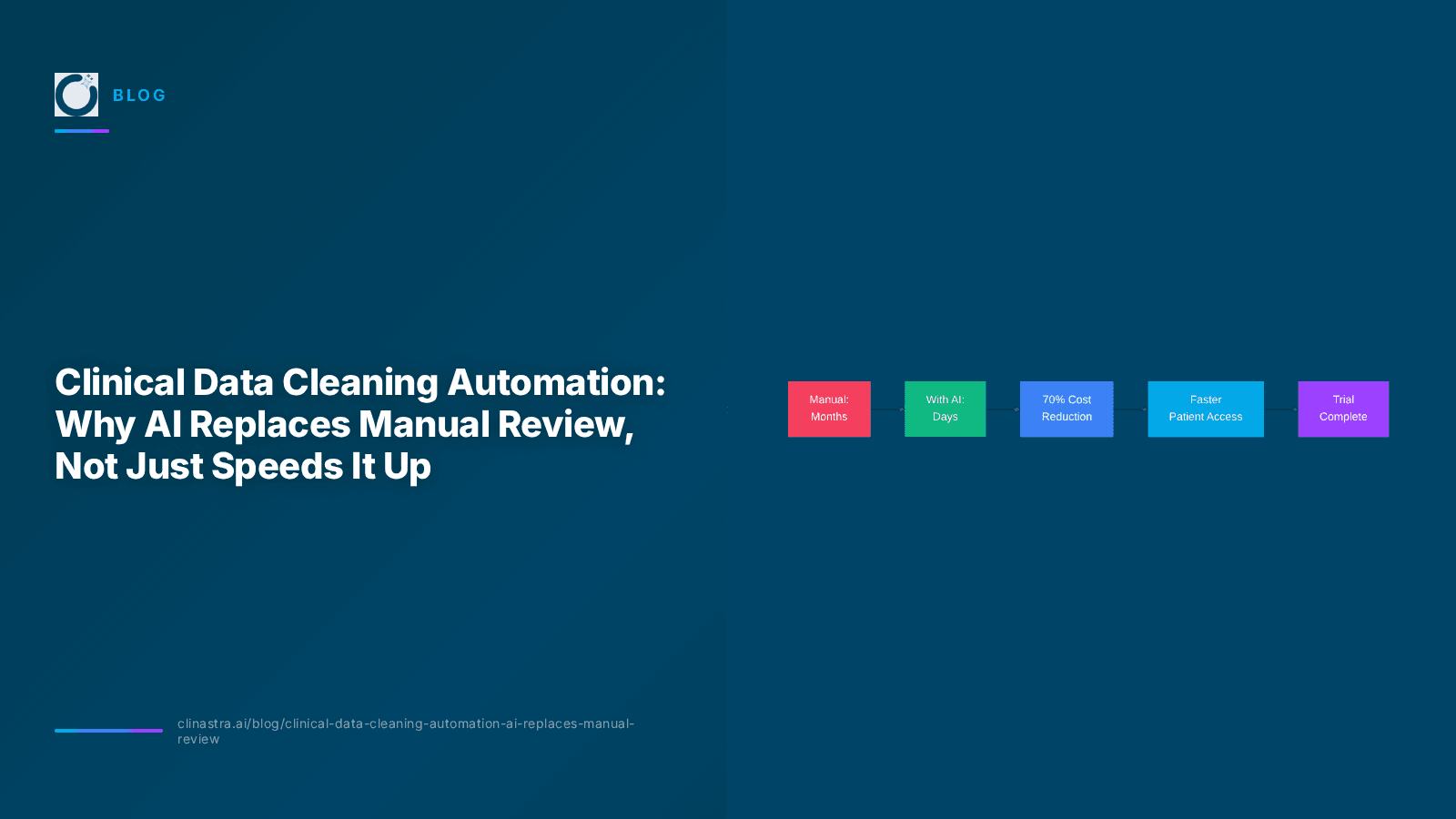
A Phase III study with 12 SDTM domains typically takes 4-6 weeks of manual review. With AI-assisted review, the same dataset completes in 2-3 days. The reviewers do not disappear — they shift from pattern-matching to decision-making. Instead of spending 80% of their time finding issues, they spend 80% deciding how to resolve them.
Data review is not a human job anymore. The pattern-matching, the cross-referencing, the consistency checks — that is computation. The decisions about what to do with the findings — that is human judgment.
FAQ
Does AI SDTM review replace my data management team?
No. The AI does the review. Your team makes the decisions. Every flagged discrepancy gets human review before a query is raised.
How accurate is AI-assisted SDTM review?
ClinAstra achieves 99.9% accuracy on anomaly detection across SDTM domains, compared to 82% for manual review (internal validation, 50 studies).
Can I audit the AI findings?
Yes. Every flag includes the triggering rule, the variable values, and the recommended action. Audit-ready by design.
Does it integrate with my EDC?
ClinAstra sits on top of your existing stack. It reads SDTM datasets from any EDC or clinical data platform. No replacement needed.
Action Items
- Audit your current SDTM review timeline — how many weeks per domain?
- Identify the 3 domains where you spend the most review time
- Run a pilot with ClinAstra on those 3 domains
- Compare query accuracy and review time to your manual process
- Scale to all domains once the pilot confirms the timeline reduction
Sources: FDA Clinical Trials Guidance, IQVIA Clinical Data Management Report 2024, McKinsey Pharma R&D Productivity 2024