Key Takeaways:- The clinical data review tools market splits into two camps: AI-bolted-on tools that help humans review faster, and AI-native tools that review data instead of humans. Only the second category delivers months-to-days timelines.
- Manual data review still consumes 60-70% of a clinical data manager's working hours, according to Tufts CSDD research — a bottleneck that has barely improved in two decades.
- The right tool doesn't just flag anomalies. It generates traceable queries, runs edit checks across SDTM and ADaM datasets, reconciles external data, and produces audit-ready documentation without human pattern-matching.
- Selection criteria that matter: AI-native architecture, 99.9% accuracy with explainability, EDC integration, CDISC compliance, and measurable timeline compression.
- Every day shaved off the review cycle is a day a patient waits less for therapy. Tool selection is not a procurement decision — it's a timeline and patient-access decision.
Clinical Data Review Tools: The Speed Thesis That Vendors Won't Tell You
The clinical data review tools market is crowded, noisy, and built on a shared lie. Nearly every vendor sells you a tool that helps humans review data faster. ClinAstra was built on a different premise: data review is not a human job anymore. The tool you choose determines whether your trial closes in months or in weeks — and whether your PhDs spend their time making decisions or pattern-matching spreadsheets.
Here is the number the industry doesn't want you to focus on: Tufts CSDD research shows that clinical trial cycle times have increased 32% over the past decade, with data review and reconciliation absorbing 60-70% of clinical data managers' working hours. That's not a tooling problem solved by a nicer dashboard. That's a structural bottleneck that requires a category shift — from tools that assist review to tools that perform review.
This article breaks down what clinical data review tools actually do, why most of them extend the bottleneck instead of eliminating it, and how to evaluate a tool against the only metric that matters: how fast it gets you to a clean, locked database.
What Clinical Data Review Tools Actually Do
Clinical data review tools are software systems that evaluate trial data for accuracy, completeness, consistency, and clinical relevance. They sit across the data lifecycle — from eCRF entry through SDTM and ADaM dataset construction to database lock. The functions they perform include:
- Edit checks and validation: Automated rules that flag out-of-range values, missing fields, logical inconsistencies, and protocol deviations as data lands in the EDC.
- Anomaly detection: Statistical and machine-learning methods that surface outliers, unexpected distributions, and potential safety signals across lab data, adverse events, and patient-reported outcomes.
- Query management: Generating, routing, tracking, and resolving data queries between sites, sponsors, and CROs.
- Reconciliation: Cross-checking data across sources — EDC vs. external labs, ePRO vs. clinical assessments, safety database vs. trial database.
- SDTM and ADaM dataset review: Validating that submitted datasets conform to CDISC standards, with traceability from source to analysis.
- Reporting and visualization: Listings, tables, figures, and patient profiles that support medical review and regulatory submission.
Every tool on the market performs some subset of these functions. The question is not whether a tool has these features. The question is who performs the review — the human or the AI.
The Two Categories of Clinical Data Review Tools
The market divides into two fundamentally different architectures. Confusing them is the most expensive mistake a clinical operations leader can make.
Category 1: AI-Bolted-On Tools (Assistants)
These are traditional EDC, CTMS, and data review platforms — Veeva Vault Clinical, Medidata Rave and Clinical Data Studio, Oracle InForm, JReview — that have added AI or ML features on top of a human-centric workflow. The AI flags potential issues. The human confirms. The human reviews. The human resolves. The human remains the bottleneck.
These tools improve reviewer productivity by 15-30%. They do not change the fundamental equation: a human is still reviewing every data point. The timeline compression is incremental, not transformational. You go from six months of review to five. You do not go from months to days.
Category 2: AI-Native Tools (Replacements)
AI-native tools are built from the ground up to perform the review itself. The AI runs edit checks, detects anomalies, generates queries with traceable evidence, reconciles external data, and produces audit-ready documentation. Humans don't review data — they review the AI's output and make decisions on flagged items. The human role shifts from pattern-matching to decision-making.
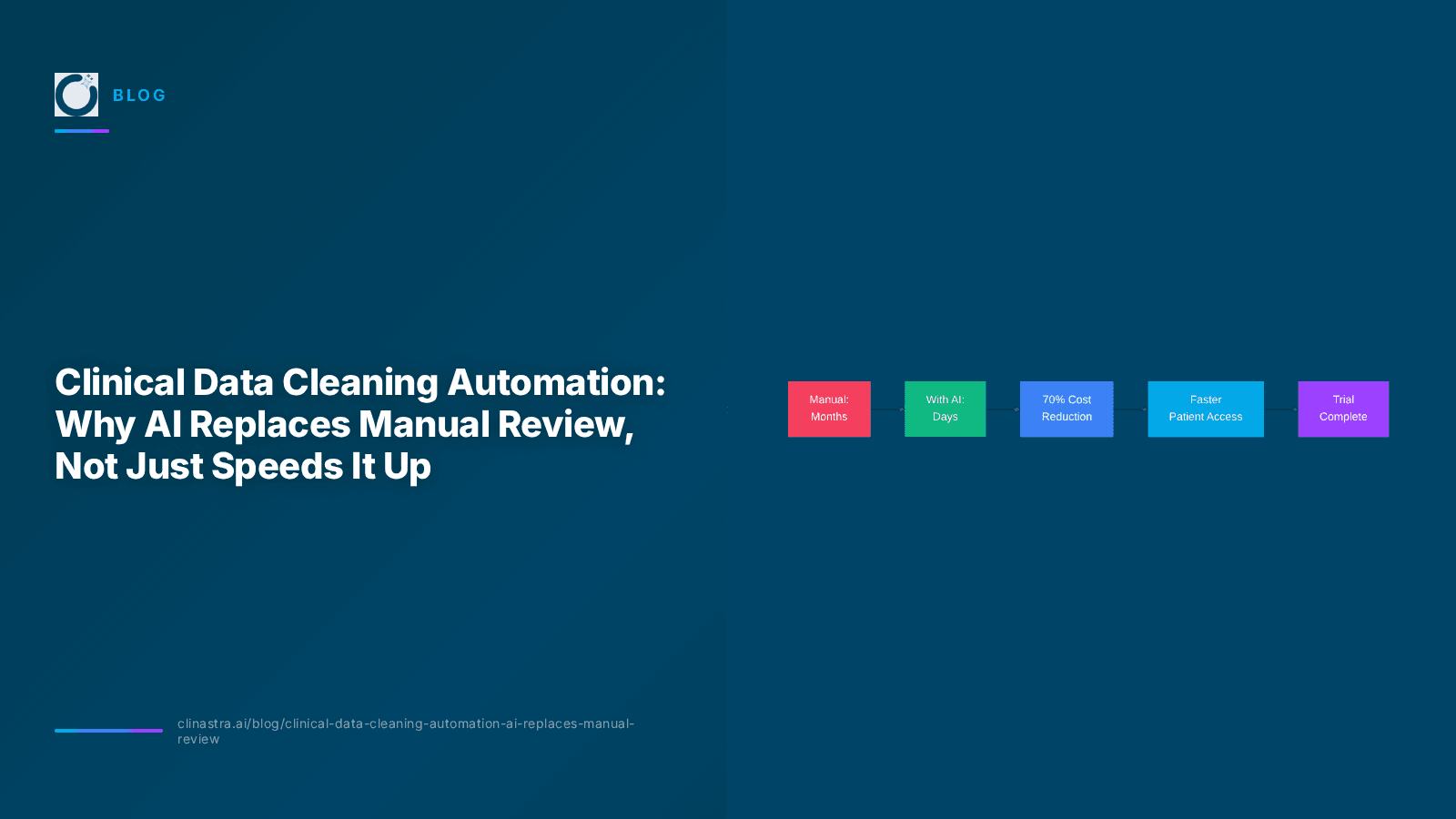
This is the category ClinAstra belongs to. The speed difference is not incremental. It's structural. When the AI performs the review at 99.9% accuracy, the timeline compresses from months to days — because the bottleneck was never the tooling. It was the human in the loop.
Manual Review vs. AI-Bolted-On vs. AI-Native: Side-by-Side
| Capability | Manual Review | AI-Bolted-On | AI-Native (ClinAstra) |
|---|
| Who performs the review | Human | Human (AI flags) | AI (human decides) |
| Edit checks execution | Manual, batch | Automated, human-confirmed | Automated, traceable, real-time |
| Anomaly detection | Visual scan of listings | ML flags, human reviews | AI detects with 99.9% accuracy, shows evidence |
| Query generation | Manual authoring | Suggested queries | Auto-generated, traceable, audit-ready |
| SDTM/ADaM validation | Manual SAS scripts | Validation reports, human reviews | AI validates, flags, documents |
| Reconciliation | Manual cross-reference | Automated matching, human resolves | AI reconciles, resolves, escalates exceptions |
| Timeline to database lock | 4-6 months | 3-5 months | Days to weeks |
| Reviewer hours per study | 800-1,200 | 600-900 | 100-200 (decision-only) |
| Audit readiness | Retrospective documentation | Partial audit trail | Audit-ready by design |
Why Speed Is the Only Metric That Matters
Clinical trial data review tools are evaluated on feature checklists, integration compatibility, and vendor reputation. These matter — but they are not the metric that determines whether your trial delivers therapy to patients on time.
The metric that matters is time from last-patient-last-visit to database lock. This is the window where data review happens. It's where trials stall. And it's where the right tool makes a discontinuous difference.
According to Tufts CSDD, the average Phase III trial spends 4-6 months in this window. A Tufts CSDD analysis of AI clinical monitoring found that AI-driven monitoring can generate expected Net Present Value gains of $21 million for a Phase III trial — not from doing the same work faster, but from compressing the timeline so the drug reaches market sooner.
Every day saved in this window has a quantifiable value:
- Revenue: A blockbuster drug generates $3-5 million per day in revenue at peak. Every day of delay is money lost forever — not deferred.
- Cost: Running a Phase III trial costs $40,000-50,000 per day in operational expenses. A 75% reduction in review time saves $3-4 million per trial in operational costs alone.
- Patient access: Every day saved is a day a patient waits less for therapy. For oncology, cardiovascular, and rare disease trials, this is not a financial metric. It's a human one.
Expert Insight: "The clinical data review tools market has been selling productivity gains for 20 years. Productivity gains don't change timelines. A 30% productivity improvement on a 6-month review cycle gives you 4.2 months. You're still in months. The only way to get to days is to remove the human from the review loop — not partially, not with assistance, but structurally. That's what AI-native architecture does." — Karthik Nadakuditi, Co-Founder, ClinAstra
How to Evaluate Clinical Data Review Tools: A Step-by-Step Guide
Most evaluation frameworks compare tools on features. The right framework compares them on outcomes — specifically, how fast each tool gets you to a clean, locked, submission-ready database.
- Audit your current review timeline. Measure the actual days from last-patient-last-visit to database lock across your last three trials. Break it down by phase: edit check execution, query resolution, reconciliation, SDTM/ADaM validation, medical review. This baseline is your benchmark. Any tool that can't compress it by at least 50% isn't worth evaluating further.
- Determine whether the tool assists or replaces. Ask the vendor one question: "Does your AI perform the review, or does it flag issues for a human to review?" If the answer involves a human confirming, reviewing, or resolving — it's an assistant, not a replacement. Assistants give you 15-30% improvement. Replacements give you months-to-days.
- Demand accuracy numbers with proof. A tool that claims "AI-powered" without publishing accuracy rates is selling marketing, not methodology. ClinAstra publishes 99.9% accuracy because the methodology is traceable — every flag, every query, every anomaly comes with the evidence behind it. If a vendor can't show you their accuracy rate and how it's measured, walk away.
- Test EDC and CDISC integration. The tool must sit on top of your existing stack — Veeva, Medidata, Oracle InForm — without ripping it out. It must ingest SDTM and ADaM datasets natively, run validation against CDISC standards, and output audit-ready documentation. Integration isn't a feature. It's a prerequisite.
- Evaluate traceability and audit-readiness. When the AI flags an anomaly, can it show you why? When it generates a query, is the evidence chain documented? When a regulator asks "how was this data point validated," does the tool produce a traceable record? Audit-ready by design means the documentation is generated as part of the review — not reconstructed after the fact.
- Run a benchmark on real study data. Take a completed trial's dataset. Run it through the tool. Measure: time to full review, anomalies detected (vs. known issues), false positive rate, query quality, and audit documentation completeness. Compare against your manual review baseline. The numbers will tell you everything the sales deck won't.
- Calculate the timeline and cost impact. Translate the benchmark results into days saved, reviewer hours eliminated, operational cost reduction, and accelerated time-to-market. If the tool doesn't compress your review timeline by at least 70%, it's an incremental improvement — not a category shift.
The Clinical Data Review Tool Selection Checklist
Use this checklist to pressure-test any tool before you buy:
- ☐ Does the AI perform the review, or does it assist a human reviewer?
- ☐ Is the published accuracy rate above 99%? Is the methodology transparent?
- ☐ Does the tool integrate with your existing EDC (Veeva, Medidata, Oracle InForm) without rip-and-replace?
- ☐ Does it validate SDTM and ADaM datasets against CDISC standards natively?
- ☐ Does it generate queries with traceable evidence — not just flags?
- ☐ Does it reconcile external data sources (labs, ePRO, safety database) automatically?
- ☐ Is every flag, query, and decision documented in an audit trail by design?
- ☐ Can it produce a benchmark on your real study data before you commit?
- ☐ Does it compress the last-patient-last-visit to database lock window by at least 70%?
- ☐ Does the vendor publish case studies with quantified timeline and cost results?
If a tool fails on three or more of these, it's not built for speed. It's built for incremental productivity — and incremental productivity is why trial timelines haven't improved in two decades.
The Tools Landscape: Who Does What
The current clinical data review tools landscape includes several categories of solutions. Understanding where each fits — and where each falls short — is critical to making the right selection.
EDC-Integrated Review Modules
Veeva Vault Clinical and Medidata Rave include data review modules that operate within the EDC environment. These tools handle edit checks, basic anomaly flags, and query management. They are convenient because they sit on top of your existing EDC. They are limited because they are designed for human review — the AI features flag issues, but a human still confirms and resolves every one. Timeline impact: 15-25% improvement. You stay in months.
Standalone Data Review Platforms
Tools like JReview, SAS-based review systems, and the open-source clinDataReview package provide statistical analysis, data visualization, and patient profile generation. They are powerful for medical review and regulatory submission preparation. They are not designed to replace manual review — they are designed to present data to a human reviewer more efficiently. Timeline impact: 10-20% improvement. The human remains the bottleneck.
AI-Enhanced Data Management Suites
Platforms like IQVIA's Clinical Data Review and Medidata Clinical Data Studio have added AI and ML capabilities for anomaly detection, predictive analytics, and risk-based monitoring. These represent the most advanced AI-bolted-on tools. They are significant improvements over manual review. But the architecture is still human-centric: the AI suggests, the human decides, the human reviews. Timeline impact: 25-35% improvement. You go from six months to four. Not from months to days.
AI-Native Review Systems
ClinAstra is the AI-native category. The AI performs the review — edit checks, anomaly detection, query generation, reconciliation, SDTM/ADaM validation. The human reviews flagged exceptions and makes decisions. The architecture is built around AI performing the work, not AI assisting a human. Timeline impact: 70-90% improvement. From months to days. This is the only category that eliminates the bottleneck rather than optimizing it.
Why Integration Beats Replacement of Your Stack
A common concern when evaluating AI-native tools is whether they require ripping out existing EDC, CTMS, or clinical data platforms. They don't. Or at least, they shouldn't.
ClinAstra integrates with Veeva, Medidata, and Oracle InForm. It sits on top of your existing stack and ingests data from your EDC, your external labs, your ePRO systems, and your safety database. It outputs validated SDTM and ADaM datasets, audit-ready documentation, and resolved queries back into your existing workflow. The EDC stays. The CTMS stays. What changes is the review layer — from a human bottleneck to an AI engine.
This is the integration principle: the tool that wins is the one that makes your existing stack faster, not the one that replaces it. Any vendor asking you to rip and replace your EDC to get AI review is selling you a migration project, not a speed improvement.
The Cost of Choosing the Wrong Tool
Selecting a clinical data review tool is not a reversible decision. Once a tool is integrated into your trial workflow, switching mid-study is disruptive, expensive, and regulatorily complex. The cost of choosing wrong compounds across every trial you run with that tool.
| Choice | Timeline Impact | Cost Impact | Patient Impact |
|---|
| Manual review (status quo) | 4-6 months to lock | $160,000-300,000 per month in operational costs | 4-6 months of delayed therapy access |
| AI-bolted-on tool | 3-5 months to lock | $120,000-250,000 per month + tool cost | 1-2 months saved vs. manual |
| AI-native tool (ClinAstra) | Days to weeks to lock | $40,000-80,000 total + tool cost | 3-5 months saved vs. manual |
The math is not subtle. An AI-bolted-on tool saves you 1-2 months. An AI-native tool saves you 3-5 months. On a Phase III trial with a $50,000 daily operational cost, that's $4.5-7.5 million in operational savings alone — before counting revenue acceleration from earlier market access.
Practical Action Items for Clinical Operations Leaders
If you're evaluating clinical data review tools right now, here's what to do this week:
- Measure your current review timeline. Pull the last-patient-last-visit to database lock data from your last three trials. Calculate the average. This is your baseline. Every tool evaluation should be measured against this number — not against feature lists.
- Classify your current tools. Are you using an AI-bolted-on tool or an AI-native tool? If your data managers are still spending 60%+ of their time on manual pattern-matching, you're in the AI-bolted-on category — and you're leaving months on the table.
- Demand a benchmark on real data. Any AI-native tool vendor should be willing to run your historical trial data through their system and show you: time to review, anomalies detected, accuracy rate, and audit documentation. If they won't, they're not AI-native. They're AI-marketing.
- Calculate the patient-access impact. Translate your timeline compression into days of earlier therapy access for your patient population. Bring this number to your next steering committee meeting. Tool selection decisions made on feature checklists don't survive a patient-impact reframe.
- Pilot an AI-native tool on your next study. Don't wait for a full vendor evaluation cycle. Run a parallel review on your next study — manual review alongside an AI-native tool. Compare the results. The data will make the decision for you.
Frequently Asked Questions
What are clinical data review tools?
Clinical data review tools are software systems that evaluate trial data for accuracy, completeness, consistency, and clinical relevance. They perform edit checks, anomaly detection, query management, data reconciliation, and SDTM/ADaM dataset validation. The key distinction is whether the tool assists a human reviewer (AI-bolted-on) or performs the review itself (AI-native).
What is the difference between AI-assisted and AI-native clinical data review?
AI-assisted tools flag potential issues for a human to review and confirm. The human remains the bottleneck. AI-native tools perform the review — running edit checks, detecting anomalies, generating queries, and producing audit-ready documentation. The human reviews flagged exceptions and makes decisions. AI-assisted tools compress timelines by 15-30%. AI-native tools compress timelines by 70-90%.
How fast can AI-native clinical data review tools get to database lock?
AI-native tools like ClinAstra compress the last-patient-last-visit to database lock window from 4-6 months to days or weeks. The exact timeline depends on study complexity, data volume, and the number of external data sources requiring reconciliation — but the bottleneck shifts from human review speed to decision-making speed.
Do AI-native clinical data review tools integrate with existing EDC systems?
Yes. AI-native tools like ClinAstra integrate with Veeva Vault Clinical, Medidata Rave, and Oracle InForm. They sit on top of your existing EDC and clinical data platform, ingest data from all sources, and output validated datasets and audit-ready documentation back into your workflow. No rip-and-replace required.
Can AI clinical data review tools pass regulatory audits?
AI-native tools that are audit-ready by design produce traceable documentation for every flag, query, and decision. When a regulator asks how a data point was validated, the tool produces the evidence chain. This is stronger than manual review audit trails, which are often reconstructed retrospectively. ClinAstra's 99.9% accuracy is backed by methodology that is transparent and traceable by design.
How do I evaluate clinical data review tools for my trial?
Evaluate tools on outcomes, not features. Measure your current review timeline, demand a benchmark on your real study data, verify the accuracy rate is published and methodology is transparent, confirm EDC and CDISC integration, and calculate the timeline and cost impact. If a tool doesn't compress your review window by at least 70%, it's an incremental improvement — not a category shift.
The Bottom Line
The clinical data review tools market is at an inflection point. For 20 years, vendors sold productivity gains on a human-centric workflow. The workflow didn't change. The bottleneck didn't move. Trial timelines stayed flat.
AI-native tools break that equation. When the AI performs the review at 99.9% accuracy — with traceable evidence, audit-ready documentation, and integration into your existing EDC stack — the bottleneck doesn't shrink. It disappears. From months to days. From 800 reviewer hours to 100 decision hours. From a trial that stalls at data review to a trial that moves at the speed of science.
Review less. Decide more. That's not a tagline. It's the operating principle of the only category of clinical data review tools that actually changes your timeline.
Every day saved in data review is a day a patient waits less for therapy. The tool you choose determines how many days you save. Choose accordingly.
See how ClinAstra compresses your data review timeline from months to days — book a benchmark on your real study data.