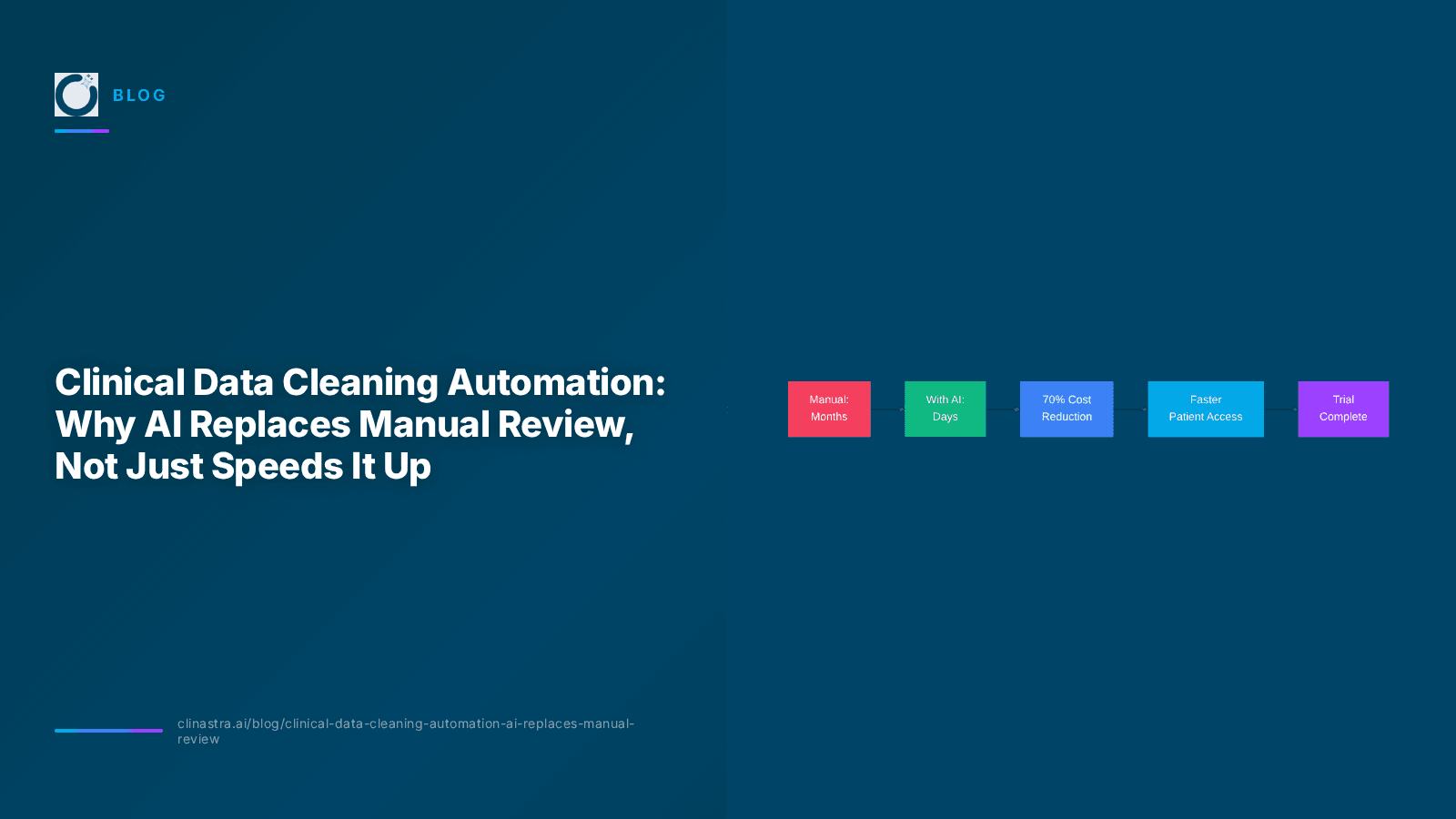
Key Takeaways:- Clinical data cleaning is the single largest bottleneck in trial timelines — consuming 20-30% of the total study timeline, yet the industry treats it as untouchable.
- AI-assisted data cleaning delivers a 6x throughput increase and reduces errors from 54.67% to 8.48%, according to controlled experimental studies.
- Manual cleaning methods have error rates ranging from 0.14% to over 6%, while AI-driven automation achieves 99.9% accuracy on flagged anomalies.
- Every day of database lock delay costs up to $500,000 in lost product revenue — manual review is burning money, not just time.
- Automation does not mean augmentation. The future is AI-native cleaning that replaces manual review, not a faster version of it.
Executive Summary: The Bottleneck No One Questions
Clinical trials generate three times more data than they did a decade ago. The processes for ensuring that data is clean? Fundamentally unchanged since the 1990s. That is the bottleneck nobody in this industry wants to talk about — and it is costing patients months of their lives.
Data cleaning is not a human job anymore. Yet clinical data managers across the industry still spend their days running SAS listings, opening discrepancy queries in EDC systems, and manually cross-referencing adverse event narratives against concomitant medication logs. A Phase III oncology trial can generate 51 separate case report form datasets across 150+ patients. Reviewing those datasets manually takes months. AI does it in hours — with 99.9% accuracy and full audit traceability.
The industry has accepted data cleaning timelines as fixed for 20 years. They are not fixed. They are a choice — a choice to keep doing review the way it was done when EDC systems were new. Clinical data cleaning automation replaces that choice entirely. Not faster manual review. Not augmented human review. Replacement. This article breaks down why manual cleaning is the bottleneck, what AI-driven automation does differently, and what it means for trial timelines, costs, and the patients waiting on the other side.
Why Clinical Data Cleaning Is the Bottleneck, Not Science
The pharmaceutical industry spends billions optimizing trial design, improving site selection, and accelerating patient enrollment. Nobody optimizes data cleaning. The result: trial timelines have not improved in two decades, and data review is the reason.
Tufts CSDD research shows that the average clinical trial takes 7.5 years from first-in-human to market approval. A significant portion of that timeline — 20 to 30% — is consumed by data cleaning, query resolution, and database lock activities. That is not science time. That is review time. The science is done. The patients are enrolled. The data is collected. And then everyone waits — sometimes months — while humans manually reconcile values, close queries, and chase sites for corrections.
This is the bottleneck the industry refuses to name. Clinical data cleaning is the dead time between data collection and database lock — and it is where timelines go to die.
The Scale of the Problem: By the Numbers
Consider a typical Phase III trial:
- Data volume: Modern trials generate 3x more data than a decade ago, including EDC data, lab results, biomarker data, imaging, ePROs, wearable device streams, and EHR integrations.
- Error rates: Manual data entry and cleaning error rates range from 0.14% with double data entry to over 6% with single-pass manual methods, according to peer-reviewed research published in PMC.
- Query volume: A single Phase III trial can generate thousands of manual queries, each requiring site response, data manager review, and resolution tracking.
- Cost of delay: Each day of database lock delay costs up to $500,000 in lost revenue across a product's lifecycle (Smith et al., 2024, Therapeutic Innovation & Regulatory Science).
- Reviewer burden: Clinical data managers spend 60-70% of their time on manual data listing review, discrepancy identification, and query management — not on clinical judgment or safety signal detection.
That last point matters most. The most expensive, most qualified people on a data management team are spending the majority of their time on tasks an AI does better. That is not a productivity problem. That is a design failure.
Manual vs. AI-Automated Clinical Data Cleaning: Side by Side
| Dimension | Manual Data Cleaning | AI-Automated Data Cleaning |
|---|
| Throughput | ~8 records per session per reviewer | 48+ records per session (6.03x improvement) |
| Error rate | 54.67% of discrepancies missed | 8.48% error rate (6.44x improvement) |
| False positive queries | High — unnecessary site burden | 15.48x reduction in false positives |
| Consistency across reviewers | Inconsistent — varies by experience | Consistent — same logic applied every time |
| Scalability | Linear with headcount | Infinitely scalable across studies |
| Clinical judgment | Human reviewers apply variable judgment | Domain-trained AI applies consistent clinical heuristics |
| Audit trail | Manual documentation, prone to gaps | Every flag, query, and decision traceable by design |
| Time to database lock | Weeks to months | Days |
| Cost per trial | $500K/day in delay costs + full-time reviewer salaries | Fraction of manual cost — no per-reviewer scaling |
Sources: Octozi AI comparative study (Purri et al., 2025); Smith et al. (2024) cost-of-delay estimates; PMC systematic reviews of clinical data error rates.
The numbers are not close. AI-assisted review does not marginally improve manual cleaning — it renders it obsolete. A 6x throughput increase is not a productivity bump. It is a paradigm shift. A 6.44x error reduction is not an incremental quality gain. It is a different category of accuracy.
What Clinical Data Cleaning Automation Actually Does
Generic AI does not work for clinical data. A GPT wrapper does not know what an SDTM dataset is. It does not understand the relationship between an adverse event onset date and a concomitant medication start date. It cannot reconcile lab values across central and local labs. Clinical data cleaning automation is purpose-built for the specific data structures, regulatory requirements, and clinical logic that govern trial data.
1. Continuous Anomaly Detection Across All Data Sources
Manual cleaning runs in batches — typically weekly or biweekly. Data managers export listings, review them, identify discrepancies, and open queries. By the time a discrepancy is caught, the site may have moved on to the next patient visit. The data is stale.
AI automation runs continuously. It ingests data from EDC systems, lab vendors, biomarker platforms, ePRO devices, and external data sources in real time. Every new data point is checked against clinical heuristics, cross-source consistency rules, and historical patterns the moment it lands. Discrepancies are flagged immediately — not next Tuesday.
2. Cross-Source Reconciliation Without Manual Cross-Referencing
The most time-consuming manual cleaning task is reconciliation: matching adverse event narratives against concomitant medication logs, verifying lab values against reference ranges, checking dosing records against visit dates. A human reviewer does this one record at a time. AI does it across the entire dataset simultaneously.
The Octozi study identified six categories of clinically meaningful discrepancies that AI catches consistently:
- Inappropriate concomitant medication to treat an adverse event
- Timing of concomitant medication administration and adverse event that do not align
- Incorrect severity score attached to an adverse event based on the event description
- Mismatched dosing changes between visit records
- Incorrect causality assessment of adverse events
- No supporting data for a documented adverse event
These are not generic data quality checks. These are clinical judgment tasks — the exact tasks that consume reviewer time and introduce inter-reviewer variability. AI applies the same clinical logic across every record, every time, without fatigue.
3. Intelligent Query Generation With Full Traceability
Manual query generation is a black box. A reviewer flags a discrepancy, writes a query, and sends it to the site. The reasoning behind the flag lives in the reviewer's head — or in a free-text comment that nobody reads again.
AI automation generates queries with full traceability. Every flag includes the data points that triggered it, the clinical rule that was violated, and the evidence trail showing why the query was raised. Audit-ready by design. When an FDA inspector asks why a query was opened, the answer is a click away — not a memory from three months ago.
4. SDTM and ADaM Dataset Validation
Automation does not stop at the raw data layer. SDTM and ADaM dataset validation — the process of ensuring submitted datasets conform to CDISC standards — is one of the most manual, error-prone steps in trial closeout. AI automation validates SDTM datasets against the CDISC SDTM Implementation Guide, checks ADaM derivation logic, and flags domain-level inconsistencies before submission. No more discovering SDTM violations two days before the submission deadline.
The Real Cost of Manual Data Cleaning
The industry talks about data cleaning costs in terms of FTE hours and query volumes. That framing misses the point. The real cost is measured in patient days.
A 2024 study by Smith, DiMasi, and Getz published in Therapeutic Innovation & Regulatory Science estimated that each day of delay in drug development costs up to $500,000 in lost revenue across a product's lifecycle. For a blockbuster therapy, that number climbs higher. But the financial cost is the lesser damage.
Every day saved in data review is a day a patient waits less for access to therapy. When we cut data cleaning from months to days, we are not optimizing a process — we are returning time to people who do not have enough of it.
Consider the math:
- A Phase III trial with a 6-month manual data cleaning and database lock phase
- AI automation reduces that to 2 weeks
- That is 5 months saved — roughly 150 days
- At $500,000/day in delay costs, that is $75 million in preserved revenue
- More importantly, it is 150 days that patients wait less for a therapy that could change their lives
The industry has spent 20 years treating data cleaning as overhead. It is not overhead. It is the gate between completed science and patient access. Every day that gate stays closed is a day someone suffers who did not have to.
Step-by-Step: How to Transition From Manual to Automated Data Cleaning
Replacing manual data cleaning with AI automation is not a rip-and-replace project. ClinAstra integrates with your existing EDC and clinical data platform — it sits on top and makes review faster within the stack you already have. Here is the transition path:
- Audit your current cleaning workflow. Map every manual review step: data listing exports, discrepancy identification, query generation, site communication, resolution tracking. Document the time each step takes and the error rates at each stage. You cannot automate what you have not measured.
- Identify high-volume, low-judgment tasks first. Start with range checks, cross-source reconciliation, duplicate detection, and consistency checks — the tasks that consume the most reviewer time and require the least clinical judgment. These are the first tasks AI replaces entirely.
- Deploy AI anomaly detection on a pilot study. Run AI automation in parallel with manual review on one study. Compare throughput, error rates, false positive query rates, and time to database lock. Use the data to build the business case for full deployment.
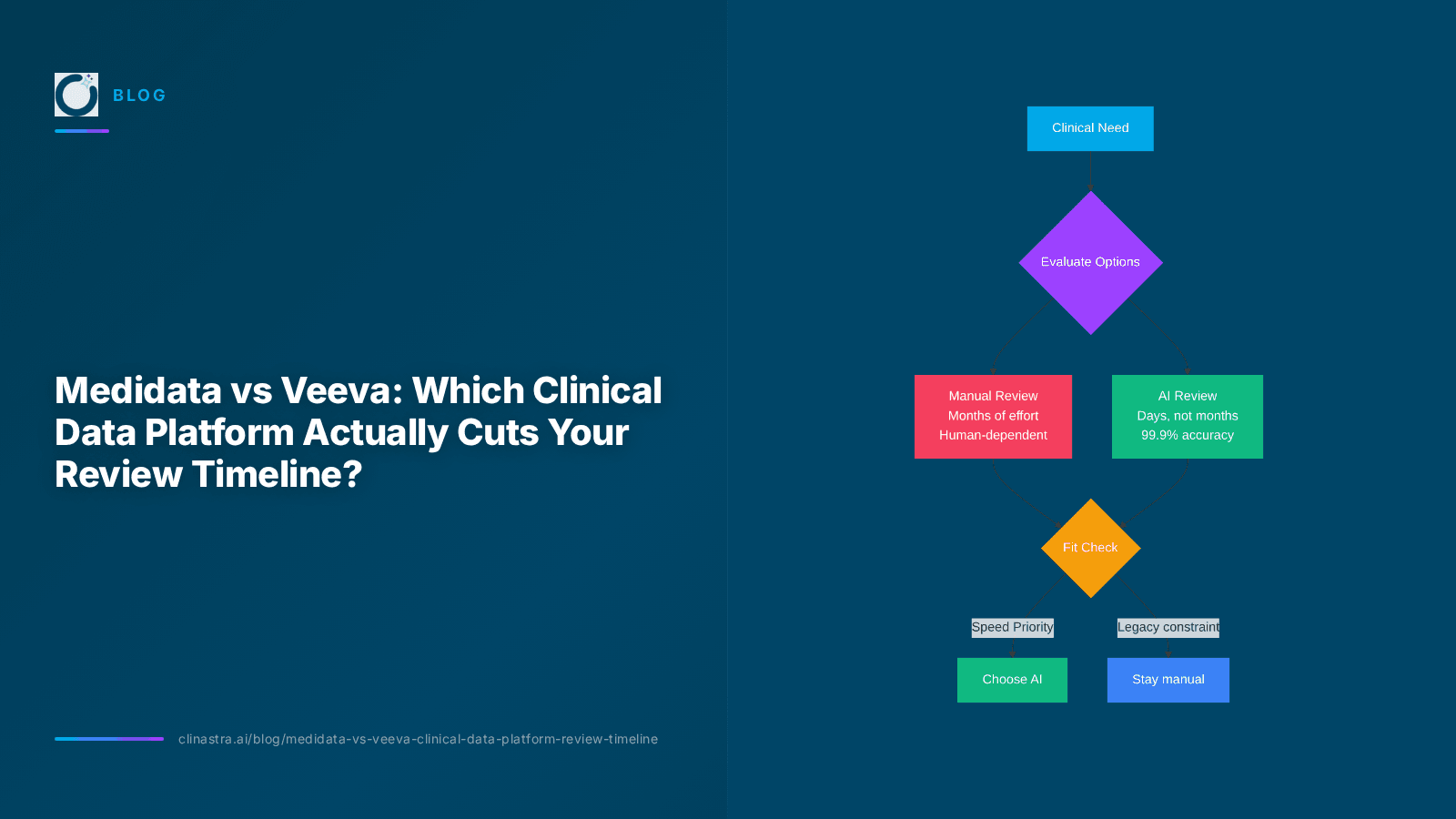
- Integrate with your EDC and data platform. Connect AI automation to your EDC system (Veeva, Medidata Rave, or equivalent) so flagged discrepancies flow directly into the query management workflow. No separate interface. No context switching.
- Scale to SDTM and ADaM validation. Once raw data cleaning is automated, extend to SDTM dataset validation and ADaM derivation checks. This closes the gap between data cleaning and submission readiness.
- Retrain reviewers for decision-making, not data entry. The goal is not to eliminate data managers. It is to free them from data entry and listing review so they can focus on safety signal detection, protocol deviations, and clinical judgment. Review less. Decide more.
Clinical Data Cleaning Automation Checklist
Before deploying AI-driven data cleaning automation, ensure your team can check off every item on this list:
- ☐ Data Management Plan (DMP) updated to include AI-driven cleaning workflows
- ☐ Edit checks mapped and prioritized — which are manual, which can be automated
- ☐ EDC integration confirmed — AI outputs flow into existing query management
- ☐ Clinical heuristics documented — the rules AI applies are written down and validated
- ☐ Audit trail validated — every AI-generated flag has a complete evidence trail
- ☐ False positive rate benchmarked — compare against manual review baseline
- ☐ Regulatory compliance confirmed — 21 CFR Part 11, ICH E6(R3), ALCOA+ principles met
- ☐ Reviewer retraining plan in place — team transitioned from data review to decision-making
- ☐ SDTM/ADaM validation integrated — submission readiness checks automated
- ☐ Patient impact metrics defined — track days saved per trial and translate to access timelines
What the SERP Gets Wrong — and Why This Article Exists
The current top-ranking content for clinical data cleaning automation falls into three categories:
- Academic papers — thorough but abstract. They describe the problem; they do not offer a solution a clinical ops leader can deploy.
- Generic vendor blogs — written by marketing teams, not clinical data managers. They describe AI-powered data cleaning without specifying what AI does, how it works, or what accuracy it achieves.
- Traditional CDM guides — comprehensive but stuck in the manual paradigm. They describe edit checks, query management, and database lock as if those processes will never change.
None of them say what needs to be said: data review is not a human job anymore. None of them quantify the replacement — 6x throughput, 6.44x error reduction, 15.48x fewer false positives. None of them connect the delay cost ($500,000/day) to patient access timelines. And none of them provide a transition path that a VP of Clinical Operations can execute without ripping out their existing stack.
That is the gap this article fills.
FAQ: Clinical Data Cleaning Automation
Can AI really replace manual clinical data cleaning?
Yes. Controlled experimental studies show AI-assisted review achieves 6x throughput improvement and reduces error rates from 54.67% to 8.48% compared to manual methods. AI does not assist manual review — it replaces the repetitive, low-judgment tasks that consume 60-70% of reviewer time. Human reviewers are then freed for safety signal detection and clinical decision-making.
How does AI handle regulatory compliance for clinical data cleaning?
ClinAstra's AI automation is audit-ready by design. Every flagged discrepancy includes the triggering data points, the clinical rule violated, and a complete evidence trail. This satisfies 21 CFR Part 11 requirements for electronic records, ICH E6(R3) good clinical practice standards, and ALCOA+ data integrity principles. Every query, every flag, every decision is traceable — no black boxes.
Does clinical data cleaning automation work with existing EDC systems?
Yes. ClinAstra integrates with Veeva, Medidata Rave, and other standard EDC platforms. AI automation sits on top of your existing stack — it does not replace your EDC or clinical data platform. Flagged discrepancies flow directly into your existing query management workflow. No separate interface, no context switching, no rip-and-replace.
What is the difference between data cleaning and central monitoring?
Data cleaning targets data elements themselves — correcting out-of-range values, resolving inconsistencies, and managing discrepancies. Central monitoring focuses on oversight processes ensuring protocol and GCP compliance. AI automates data cleaning; it does not replace the risk-based monitoring strategy. The two are complementary, not interchangeable.
How much time does AI automation save on database lock?
Manual data cleaning and database lock typically take weeks to months per Phase III trial. AI automation compresses that timeline to days. For a trial with a 6-month manual cleaning phase, AI can reduce it to 2 weeks — saving approximately 150 days. At $500,000/day in delay costs, that is $75 million in preserved revenue, plus 150 days of earlier patient access to therapy.
What types of discrepancies does AI catch that manual review misses?
AI consistently catches six categories of clinically meaningful discrepancies: inappropriate concomitant medications for adverse events, timing mismatches between medications and events, incorrect severity scores, mismatched dosing changes, incorrect causality assessments, and unsupported adverse event documentation. Manual reviewers miss these at a 54.67% error rate due to cognitive fatigue and inter-reviewer variability. AI applies the same clinical logic across every record without fatigue.
Action Items for Clinical Operations Leaders
- Measure your current cleaning timeline. Pull the last three completed trials and calculate the exact time from last-patient-last-visit to database lock. If it is more than 4 weeks, you are losing money and patient days.
- Calculate your delay cost. Multiply your average cleaning timeline (in days beyond 2 weeks) by $500,000. That number is what manual review is costing your organization per trial. Present it to your CFO.
- Pilot AI automation on one active study. Run it in parallel with manual review. Compare throughput, error rates, and false positive query rates. Use the results to build the case for full deployment.
- Audit your reviewer utilization. What percentage of your data management team's time is spent on data listing review and query management vs. clinical judgment and safety signal detection? If it is more than 50% on the former, you are wasting expert talent on tasks AI does better.
- Connect timeline savings to patient access. Every day saved in data cleaning is a day earlier a patient gets access to therapy. Make that the headline of your automation business case — not just ROI, but patient impact. Every day saved is a day a patient waits less.
Clinical data cleaning automation is not a tool upgrade. It is a decision about whether your organization continues to accept a 20-year-old bottleneck or eliminates it. The data is in. The technology exists. The only question is whether you act on it.
Data review is not a human job anymore. The teams that act on that truth will run trials in days, not months. The teams that do not will keep waiting — and their patients will keep waiting with them.
See how ClinAstra replaces manual data cleaning with AI — from months to days, audit-ready by design.