
Aug 16, 2026•3 min read
SDTM Dataset Review: Why Manual Checking Kills Timelines
Manual SDTM dataset review takes weeks. AI-assisted review takes hours. Here is how ClinAstra replaces pattern-matching with computation, with full audit trail.
55% of clinical research professionals report burnout. Manual data review — SDTM datasets, edit checks, query management — is the root cause. Here's how AI replaces the grind and saves your team.
Key Takeaways:
- 55% of clinical research professionals report burnout since 2020, with data managers carrying the heaviest manual review load.
- Tufts CSDD data shows trial data points tripled and endpoints nearly doubled from 2010 to 2020 — while review headcount stayed flat.
- The resignation rate for clinical research professionals with 5–10 years of experience is 60% higher than pre-2020 levels.
- Manual SDTM review, edit check validation, and query reconciliation are the top three tasks driving CDM burnout.
- AI-native data review replaces manual pattern-matching with 99.9% accuracy — audit-ready by design, not by overtime.
The clinical trial industry has a burnout crisis, and it's hiding in plain sight. A 2021 study by the Tufts Center for the Study of Drug Development (CSDD), surveying 344 clinical research professionals across 50+ countries, found that 55% of clinical research team members reported feeling more professionally burned out since the shift to remote operations. That number hasn't improved. If anything, the forces driving it — exploding data volumes, tightening timelines, and stagnant review processes — have intensified.
Clinical data managers sit at the epicenter. They're the ones staring at SDTM datasets at 11 PM, running manual edit checks across thousands of records, reconciling discrepancies between external data sources and the EDC, and managing query backlogs that grow faster than they shrink. The Tufts CSDD research, presented by Ken Getz at the 2024 SCOPE Summit, quantified what every CDM already feels: data points collected per trial tripled and total endpoints nearly doubled between 2010 and 2020. Protocol amendments spiked 113.3%. Dropout rates rose 105.1%. But the review process? Still manual. Still spreadsheet-driven. Still human.
This isn't a wellness initiative problem. You can't yoga-your-way out of a structural workflow failure. Clinical data manager burnout is the direct consequence of asking highly trained professionals to do what a machine does better — pattern-match, flag anomalies, validate edit checks, and reconcile datasets at scale. Data review is not a human job anymore. The burnout data proves it.
Ask any clinical data manager what their week looks like, and you'll hear the same three words: SDTM, edit checks, and queries. These aren't just tasks — they're the grinding gears of a broken process.
SDTM dataset review requires manually scanning submission-ready datasets for inconsistencies, missing variables, and domain-level errors. A single Phase III trial can generate dozens of SDTM domains with millions of records. A human reviewer scans them one domain at a time, one variable at a time, one record at a time. The cognitive load is relentless. The error rate is predictable. The burnout is inevitable.
Edit check validation means confirming that programmed checks fire correctly across the EDC — and then manually investigating every single trigger. When an edit check fires, a human reviews the flagged record, determines whether it's a true discrepancy or a false positive, drafts a query, sends it to the site, and tracks the response. Multiply that by thousands of triggers per study, and you have a job description that reads like a recipe for exhaustion.
Query management is the treadmill. Queries come in faster than they go out. A typical mid-size trial generates 5,000–15,000 manual queries. Each one requires review, routing, follow-up, and closure. The query backlog is the visible scoreboard of a broken system — and the CDM owns it.
The Tufts CSDD data is unambiguous. Between 2010 and 2020:
Meanwhile, CRO and technology vendor costs exploded from $10.4 billion to $78.6 billion between 2000 and 2020. The industry poured money into infrastructure — but the review process stayed manual. The data grew. The tools didn't. The humans absorbed the gap.
Burnout has a price tag. The Society of Clinical Research Sites (SCRS) reported that between Q1 2021 and Q1 2022, the highest resignation rates were among professionals aged 40–60 with more than 10 years of experience — the exact demographic that holds institutional knowledge. Even more alarming: the resignation rate for employees with 5–10 years of tenure was 60% higher than in 2020. These aren't junior staff leaving for a change of scenery. These are experienced data managers walking away from the profession.
When a senior CDM leaves, the cost isn't just replacement recruiting. It's the loss of study-specific knowledge — which edit checks matter, which sites are slow to respond, which domains have recurring issues. New hires take 3–6 months to reach full productivity on an active study. During that gap, query backlogs grow, review timelines slip, and database lock dates move. Every departure extends the timeline. Every extended timeline burns more budget.
| Metric | Manual Review Process | AI-Native Review (ClinAstra) |
|---|---|---|
| SDTM dataset review time | 2–4 weeks per study | Hours, not weeks |
| Edit check investigation | Manual per-trigger review | Automated anomaly detection at 99.9% accuracy |
| Query management | 5,000–15,000 manual queries per study | AI-generated queries, traceable and audit-ready |
| CDM cognitive load | Sustained mental fatigue, high burnout risk | Shifted to exception review and decision-making |
| Time to database lock | Weeks of manual cleaning | From months to days |
| Reviewer turnover risk | 55% report burnout; 60% higher resignation in 5–10 yr tenure | Reduced — CDMs focus on decisions, not data entry |
Here's what the burnout statistics don't capture: every week a data manager spends manually reviewing SDTM datasets is a week the trial timeline extends. Every extended timeline is a week patients wait for a therapy that could change or save their lives.
The Tufts CSDD data shows that enrollment duration alone increased by 36.9% from 2010 to 2020. Protocol approval to first patient visit increased by 27.2%. These aren't science delays — the science is fine. They're operational delays, and manual data review is a primary contributor. When a CDM is burned out, review slows. When review slows, queries pile up. When queries pile up, database lock moves. When database lock moves, submission moves. When submission moves, patients wait.
Every day saved is a day a patient waits less. That's not a slogan. It's the math of clinical trial timelines.
The reason most “AI for clinical data” tools fail isn't technical — it's contextual. A generic AI model doesn't know what an SDTM domain is. It doesn't understand the difference between a --SEQ variable and a --GRPID. It can't distinguish between a reconciliation discrepancy that matters and one that's a known artifact of the EDC export. It doesn't know that AE domain records need to cross-reference the DM domain for subject disposition, or that SUPPQUAL datasets require special handling for non-standard variables.
ClinAstra was built by people who spent years inside this grind. Karthik Nadakuditi worked as a clinical data manager and pharma veteran — he lived the manual review process, ran the edit checks, managed the query backlogs, and felt the burnout firsthand. Mohan Praneeth brought the AI engineering expertise to solve it. The person who knew the pain and the person who knew the solution were in the same room. That's why ClinAstra doesn't just “assist” with data review — it replaces the manual process.
Expert Insight: “The industry keeps treating burnout as a people problem — offer more PTO, hire more staff, push wellness apps. But when you triple the data volume and keep the review process manual, you're not solving burnout. You're managing the decline. The only real fix is to stop asking humans to do what AI does faster, more accurately, and without fatigue. We built ClinAstra because we lived the alternative — and it wasn't sustainable.” — Karthik Nadakuditi, Co-Founder, ClinAstra
Before you change anything, quantify what's burning your team out. Pull the data: how many manual queries were generated per study last year? How many SDTM domain reviews were completed by hand? How many edit check triggers required human investigation? How many hours did your CDMs spend on reconciliation? This isn't an academic exercise — it's the baseline that proves the problem and measures the fix.
Not all manual tasks are equal. The highest-friction tasks — the ones that consume the most hours and generate the most burnout — are typically: (1) SDTM dataset review for submission readiness, (2) manual edit check validation and false-positive triage, (3) external data reconciliation (labs, ECG, PK), and (4) query drafting and routing. These are the tasks where AI delivers the highest ROI — not just in time saved, but in cognitive load reduced.
This is where ClinAstra comes in. Instead of a human scanning SDTM domains record by record, ClinAstra's AI reviews every domain, every variable, every record — simultaneously. It flags anomalies with 99.9% accuracy. It validates edit checks across the EDC. It detects patterns that a human reviewer would miss after hour six of a ten-hour review session. And every flag is traceable — you can see exactly why the AI flagged it, what data it compared, and what rule it applied. Audit-ready by design.
Instead of a CDM manually drafting each query, ClinAstra generates queries automatically — with the evidence attached. The query goes to the site with the exact discrepancy, the source data, and the rule that triggered it. No more “can you check this?” queries. No more back-and-forth. The CDM shifts from query generator to query reviewer — approving, rejecting, and escalating. That's decision work, not data entry work. Review less. Decide more.
When the manual review grind is automated, your clinical data managers don't become redundant — they become strategic. They focus on protocol design feedback, data quality strategy, cross-study trend analysis, regulatory submission readiness, and proactive risk identification. These are the tasks that require domain expertise, clinical judgment, and institutional knowledge. These are the tasks that don't cause burnout. These are the tasks your PhDs were trained to do — not manual pattern-matching across SDTM datasets.
| Dimension | Manual Review (Status Quo) | AI-Native Review (ClinAstra) |
|---|---|---|
| Review approach | Human scans records one by one | AI reviews all domains simultaneously |
| Accuracy | Degrades after hours of manual review | 99.9% accuracy, consistent across volume |
| Cognitive load | Sustained — leads to fatigue and burnout | Minimal — shifted to exception review |
| Traceability | Manual documentation, prone to gaps | Every flag traceable to source data and rule |
| Scalability | Linear with headcount — more data, more people | Scales with compute — more data, same speed |
| Burnout risk | High — 55% of professionals report burnout | Low — humans focus on decisions, not data entry |
| Time to database lock | Weeks to months of manual cleaning | From months to days |
The current search results for “clinical data manager burnout” are telling. The top results include a Reddit thread asking what it's like to be a CDM, a Facebook group post about workload management, a Substack blog focused on CRA burnout (not CDM), and a product page for an SMS tool. None of these address the root cause: the manual review process itself is the problem.
The ACRP/Tufts CSDD study correctly identifies that 55% of professionals feel burned out — but the solutions proposed (reduce meeting frequency, improve remote work setup) treat symptoms, not causes. The real cause is structural: you're asking humans to manually review datasets that have tripled in volume while the review methodology hasn't changed in two decades.
Wellness programs don't fix structural workflow failures. Hiring more staff doesn't fix a process that doesn't scale. The only fix is to replace the manual process with one that does scale — AI-native review built by people who understand clinical data management.
The primary cause is the manual data review process itself — not workload volume in isolation. CDMs are asked to manually scan SDTM datasets, validate edit checks, reconcile external data, and manage thousands of queries per study. As trial data volume has tripled (Tufts CSDD, 2010–2020) while review methodology stayed manual, the cognitive load on individual data managers has become unsustainable. Burnout is the structural consequence of a process that doesn't scale.
AI-native review tools like ClinAstra replace the manual pattern-matching that drives burnout. Instead of a human scanning records one by one, AI reviews all SDTM domains simultaneously, flags anomalies with 99.9% accuracy, generates traceable queries automatically, and validates edit checks across the EDC. The CDM shifts from manual reviewer to decision-maker — approving, escalating, and focusing on strategic data quality work.
Yes — when it's built with clinical domain expertise. ClinAstra was founded by a clinical data manager who lived the manual review process and an AI engineer who could build the solution. The AI doesn't just flag anomalies — it provides traceable evidence for every flag, every query, and every insight. That's what makes it audit-ready by design. Generic AI wrappers can't do this; purpose-built clinical AI can.
The ROI operates on two levels. Business impact: reduced CDM turnover (the 5–10 year tenure resignation rate is 60% higher than 2020), faster database lock (from months to days), and lower operational costs (up to 70% reduction in manual review hours). Patient impact: every day shaved off a trial timeline is a day a patient gets access to therapy sooner. The Tufts CSDD data shows enrollment duration alone increased 36.9% from 2010 to 2020 — much of that driven by operational delays, not science.
Yes — and the data backs it up. The ACRP/Tufts CSDD study found 55% of clinical research professionals report increased burnout since 2020. The SCRS workforce data shows resignation rates for experienced professionals (5–10 years tenure) are 60% higher than pre-2020. The stress comes from a specific source: the mismatch between exploding data volumes and a manual review process that hasn't evolved. Fix the process, and the career becomes sustainable again.
With a purpose-built tool like ClinAstra, implementation is measured in days, not months. ClinAstra integrates with your existing EDC and clinical data platform — it doesn't replace your stack, it sits on top and makes it faster. A pilot on one active study can run in parallel with your manual process to validate accuracy and measure timeline improvement before full deployment.
Clinical data manager burnout isn't a personal failing. It's not a wellness gap. It's not a hiring problem. It's the predictable consequence of a review process that hasn't evolved while everything around it — data volume, protocol complexity, timeline pressure — has intensified dramatically.
The Tufts CSDD data is clear: data points tripled, endpoints doubled, amendments spiked 113%, and 55% of professionals are burned out. The SCRS data is clear: experienced professionals are leaving at 60% higher rates. The SERP is clear: nobody is talking about the root cause.
We're talking about it. ClinAstra was built in the trenches, not the ivory tower. We lived the manual review grind. We built the replacement. It's called AI-native clinical data review — 99.9% accuracy, audit-ready by design, and it turns months of manual cleaning into days of automated review.
Your data managers didn't sign up for a career of manual pattern-matching. They signed up to ensure clinical trial data is accurate, complete, and submission-ready. AI gives them that — without the burnout. Review less. Decide more.
See how ClinAstra replaces manual data review with AI — book a demo today.
Co-founder & Clinical Data Expert, ClinAstra
Spent years inside clinical data management living the manual review grind. Built ClinAstra to replace it — not assist it. 99.9% accuracy, audit-ready by design.
Request a DemoManual SDTM dataset review takes weeks. AI-assisted review takes hours. Here is how ClinAstra replaces pattern-matching with computation, with full audit trail.
The clinical data review tools market splits into AI-bolted-on assistants and AI-native replacements. Only AI-native tools deliver months-to-days timelines. Here is how to evaluate them.
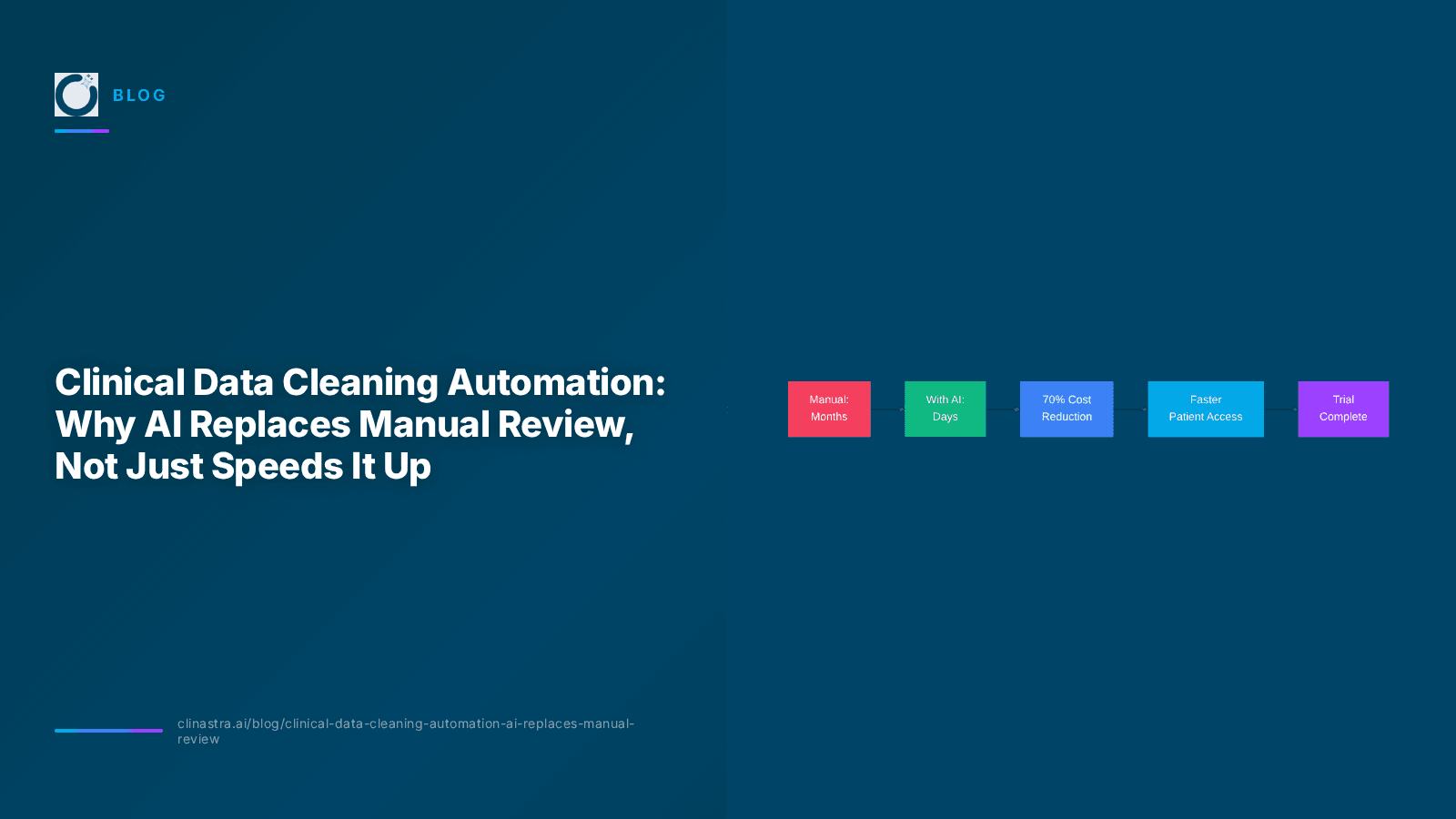
Manual clinical data cleaning is the bottleneck nobody questions. AI doesn't speed it up — it replaces it. From months to days with 99.9% accuracy and audit-ready traceability.