
Aug 16, 2026•3 min read
SDTM Dataset Review: Why Manual Checking Kills Timelines
Manual SDTM dataset review takes weeks. AI-assisted review takes hours. Here is how ClinAstra replaces pattern-matching with computation, with full audit trail.
Manual SDTM dataset review is broken. With AI-powered review automation, clinical teams move from months to days, hit 99.9% accuracy, and free their teams for decisions - not data entry.
Key Takeaways:
- Manual SDTM dataset review consumes 6-8 weeks per study, accounts for 36% of all trial queries, and costs approximately 150 euros per manual query - a bottleneck the industry has tolerated for two decades.
- AI-powered SDTM review automation replaces manual review with 99.9% accuracy, traceable flags, and audit-ready outputs - not a faster human, but a fundamentally different process.
- The bottleneck stalling trials isn't the science - it's the review. SDTM domains like AE, LB, DM, and VS can be validated by AI in hours, not weeks.
- Integration with existing EDC and clinical data platforms means no rip-and-replace. ClinAstra sits on top and makes your SDTM review 100x faster.
- Every day saved in SDTM dataset review is a day a patient waits less for therapy. Speed isn't a metric - it's an ethical imperative.
SDTM dataset review is one of the most manually intensive processes in clinical trial data management. Statistical programmers spend weeks mapping raw EDC data into CDISC-compliant SDTM domains, then data managers spend additional weeks reviewing those datasets for discrepancies, reconciliation gaps, and compliance issues. The industry has accepted this 6-8 week cycle as "just how it works" for 20 years. It's time to retire that default.
A Journal for Clinical Studies analysis quantified what this bottleneck costs: the average clinical trial generates 21,104 queries, 7,560 of which (36%) are manual. At approximately 150 euros per manual query, that's over 1.1 million euros in manual review labor per trial - labor that AI can perform in seconds with higher accuracy and complete traceability.
SDTM dataset review automation doesn't help humans review faster. It replaces manual review entirely. AI detects anomalies across SDTM domains, validates against CDISC standards, reconciles lab and safety data, and generates audit-ready query documentation - all traceable, all transparent, all at 99.9% accuracy. The question isn't whether AI can handle SDTM review. The question is why clinical teams are still doing it manually.
SDTM (Study Data Tabulation Model) is the CDISC standard that organizes clinical trial data into standardized domains for regulatory submission to the FDA and PMDA. Every clinical trial must produce SDTM-compliant datasets before submission - and every one of those datasets must be reviewed for quality, consistency, and compliance before database lock.
SDTM dataset review encompasses multiple validation activities across every domain:
Each of these activities requires a human reviewer to scan listings, compare datasets, and manually flag issues. With a Phase III trial generating dozens of SDTM domains and hundreds of thousands of records, the review burden is staggering. A Journal for Clinical Studies analysis found the average trial requires 21,104 queries - and 36% of those are manual, costing 150 euros each. That's the cost of doing it the old way.
Tufts CSDD research shows that the average clinical trial takes 7.9 years from protocol design to submission, with data management and review consuming a disproportionate share of that timeline. Manual SDTM review adds 6-8 weeks per study - weeks where PhD-level statisticians and data managers are doing pattern-matching work that an AI can do in seconds.
The cost isn't just financial. It's temporal. Every week spent on manual SDTM review is a week a patient waits for access to therapy. Every manual query is a decision point delayed. The bottleneck isn't the science - it's the review.
Manual SDTM dataset review is the most expensive, error-prone, and time-consuming step between database lock and regulatory submission. AI doesn't make it faster - it makes it obsolete.
SDTM dataset review automation uses AI models trained on CDISC standards, clinical trial data patterns, and regulatory requirements to perform the same review activities as a human data manager - but in seconds, not weeks. The difference isn't speed. It's a fundamentally different process.
Where a human reviewer scans listings one domain at a time, an AI reviews all SDTM domains simultaneously. Where a human manually reconciles AE against LB, an AI cross-references every domain against every other domain in real time. Where a human writes a query and hopes the site responds, an AI generates a traceable query with the exact discrepancy, the exact rule violated, and the exact evidence - audit-ready by design.
| Dimension | Manual SDTM Review | AI-Powered SDTM Review Automation |
|---|---|---|
| Time to complete domain validation | 6-8 weeks per study | Hours, not weeks |
| Accuracy | Subject to human fatigue, oversight | 99.9% accuracy, consistent across domains |
| Cross-domain reconciliation | Manual, sequential, error-prone | Simultaneous across all domains in real time |
| Query generation | Manual flagging, manual documentation | Automated, with traceable evidence per query |
| Audit readiness | Retroactive documentation scramble | Audit-ready by design - every flag is traceable |
| Cost per query | ~150 euros per manual query | Fraction of the cost, no manual labor |
| Scalability | Linear with study size | Constant time regardless of data volume |
| CDISC compliance checking | Manual against IG rules | Automated against CDISC controlled terminology |
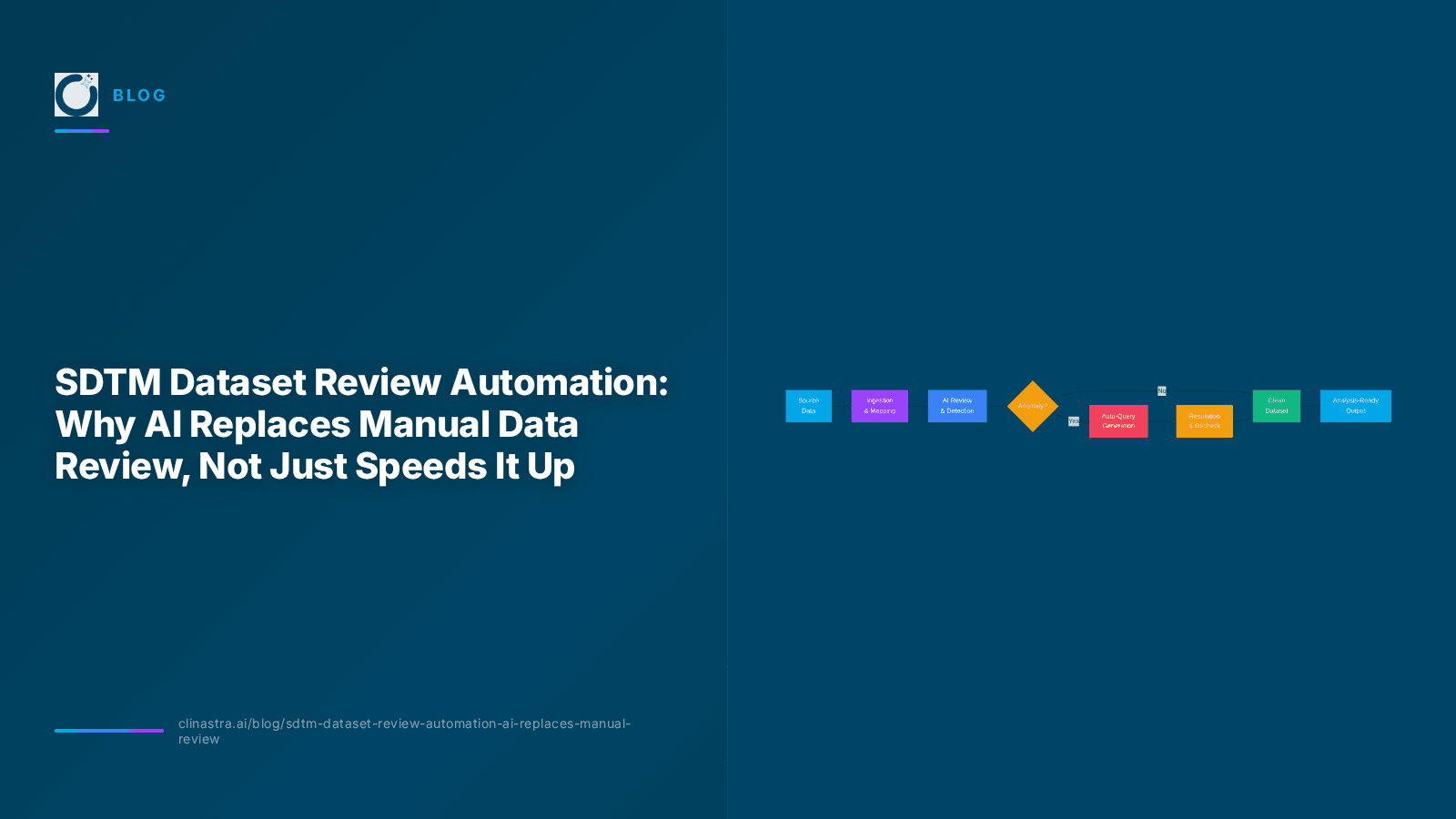
AI-powered SDTM review operates across five distinct layers, each replacing a manual activity:
Clinical trials don't fail because the science is wrong. They stall because data review is a manual relic. The industry has spent two decades optimizing study design, biomarker selection, and statistical analysis plans - and nobody questioned the review process. SDTM dataset review is the clearest example of this problem.
Consider the timeline: a Phase III trial collects data over 18-24 months. The science - the protocol, the endpoints, the statistical analysis - is designed before the first patient enrolls. But after the last patient's last visit, the trial enters data review limbo. SDTM datasets are built. Then they're reviewed. Then discrepancies are found. Then queries are raised. Then sites respond. Then datasets are rebuilt. Then they're reviewed again. This cycle repeats for 6-8 weeks, sometimes longer. The science was done months ago. The review is what's holding up submission.
This is the bottleneck the industry refuses to name. Tufts CSDD reports that data management activities account for a significant portion of clinical trial timelines, and IQVIA data shows that database lock to submission timelines haven't meaningfully improved in two decades. The reason is simple: everyone optimizes the science and nobody questions the review.
Data review is not a human job anymore. When an AI can review an SDTM dataset with 99.9% accuracy and full traceability in hours, the question isn't whether to automate - it's why we ever did it manually.
Implementing AI-powered SDTM review automation doesn't require ripping out your EDC or clinical data platform. ClinAstra integrates with your existing stack and sits on top of your data review workflow. Here's how to deploy it:
Before deploying AI-powered SDTM dataset review automation, confirm your readiness:
The evidence for SDTM review automation isn't theoretical. The data is already published:
These numbers aren't projections. They're the current state. And every one of them represents a delay in getting therapy to patients.
ClinAstra wasn't built by data scientists who read a whitepaper about clinical trials. It was built by Karthik Nadakuditi - a clinical data manager who spent years inside the manual SDTM review grind - and Mohan Praneeth - an AI engineer who looked at clinical data review and saw a computation problem hiding inside a human workflow. The person who knew the pain and the person who knew the solution were in the same room.
This matters because SDTM review isn't a generic data problem. A GPT wrapper doesn't know what an SDTM domain is. It doesn't know that AE needs to reconcile with LB. It doesn't know that EX needs to align with SV. It doesn't know the difference between a query that matters and a query that's noise. ClinAstra does - because it was built by someone who lived it.
Generic AI tools don't know what an SDTM dataset is. ClinAstra does - because it was built by someone who spent years reviewing them manually. That's the difference between a wrapper and a solution.
The biggest objection to AI in clinical data review is trust. "Can I trust AI with my trial data?" The answer isn't a claim - it's a methodology.
Every flag ClinAstra generates comes with the rule violated, the data point flagged, and the evidence behind the flag. Every query is traceable from detection to resolution. Every review activity is logged in an audit trail that meets 21 CFR Part 11 and ICH E6 GCP requirements. This isn't a black box that says "trust us." It's a transparent system that says "here's exactly why."
The ACRP literature review (June 2026) identified a critical risk in AI-powered clinical data review: models that lack auditability produce "query noises, gauged anomalies, and varying and unstable justifications, which might prove difficult to replicate at the inspection phase." ClinAstra was designed to solve exactly this problem. Versioned prompts, regression-tested models, and evidence-backed outputs ensure that every flag is reproducible at FDA inspection - not just today, but years after submission.
99.9% accuracy isn't a marketing number. It's a commitment to patients whose lives depend on trial data being right. And it's backed by a methodology you can audit.
SDTM dataset review automation isn't just an operational improvement. It's a patient impact strategy. When SDTM review drops from 6-8 weeks to hours, the trial moves faster toward submission. Faster submission means faster approval. Faster approval means therapy reaches patients sooner.
The math is simple: if AI-powered SDTM review saves 6 weeks per trial, and the average therapy serves 50,000 patients in its first year on market, those 6 weeks translate to 42 days of earlier access. For a patient with a progressive disease, 42 days isn't a number - it's the difference between deterioration and treatment.
This is why speed isn't just a business metric for ClinAstra. It's an ethical one. Every day saved in data review is a day a patient waits less. Every manual query eliminated is a decision point accelerated. The bottleneck isn't the science - it's the review. And the review is not a human job anymore.
SDTM dataset review automation uses AI to perform the review activities that data managers traditionally do manually - domain validation, cross-domain reconciliation, discrepancy detection, query generation, and CDISC compliance checking. Instead of a human scanning listings for weeks, an AI reviews all SDTM domains simultaneously with 99.9% accuracy and generates traceable, audit-ready documentation.
Manual SDTM review takes 6-8 weeks per study, costs approximately 150 euros per manual query, and is subject to human fatigue and oversight. AI-powered review completes the same activities in hours, with 99.9% accuracy, simultaneous cross-domain reconciliation, and audit-ready query documentation. The difference isn't speed - it's a fundamentally different process.
Yes. ClinAstra doesn't replace your EDC system (Veeva, Medidata) or your clinical data platform. It integrates with your existing stack and sits on top of the data review workflow. SDTM datasets are ingested directly - no data migration, no format conversion. The AI reads CDISC-standard datasets natively.
Every query ClinAstra generates includes the rule violated, the data point flagged, and the evidence behind the flag. The system is audit-ready by design, meeting 21 CFR Part 11 and ICH E6 GCP requirements. Versioned prompts and regression-tested models ensure every flag is reproducible at FDA inspection - not just today, but years after submission.
Manual SDTM review consumes 6-8 weeks per study. AI-powered review completes the same validation in hours. For a Phase III trial with 21,104 queries (7,560 manual), the time and cost savings are substantial - freeing PhD-level data managers and biostatisticians for decisions, not data entry.
AI-powered review covers all CDISC SDTM domains - AE, LB, DM, VS, EX, SV, MH, CM, and others - with domain-level validation, cross-domain reconciliation (AE-LB, EX-SV, DM-VS), anomaly detection, and CDISC controlled terminology compliance. The AI applies CDISC IG rules consistently across every domain in a single pass.
If you're a Director, VP, or Head of Clinical Operations managing trial timelines and data quality, here's what to do next:
SDTM dataset review automation isn't a future capability. It's available today. The question isn't whether your competitors will adopt it - it's whether you'll be first or last. Every day you wait is a day a patient waits longer.
From months to days. Audit-ready by design. Data review is not a human job anymore.
Ready to see how fast your SDTM review can move? Book a review automation assessment with ClinAstra and find out what your timeline compression looks like.
Explore more on SDTM and clinical data review: ClinAstra | Clinical Data Reconciliation Automation | Database Lock Automation | Anomaly Detection
Co-founder & Clinical Data Expert, ClinAstra
Spent years inside clinical data management living the manual review grind. Built ClinAstra to replace it — not assist it. 99.9% accuracy, audit-ready by design.
Request a DemoManual SDTM dataset review takes weeks. AI-assisted review takes hours. Here is how ClinAstra replaces pattern-matching with computation, with full audit trail.
The clinical data review tools market splits into AI-bolted-on assistants and AI-native replacements. Only AI-native tools deliver months-to-days timelines. Here is how to evaluate them.
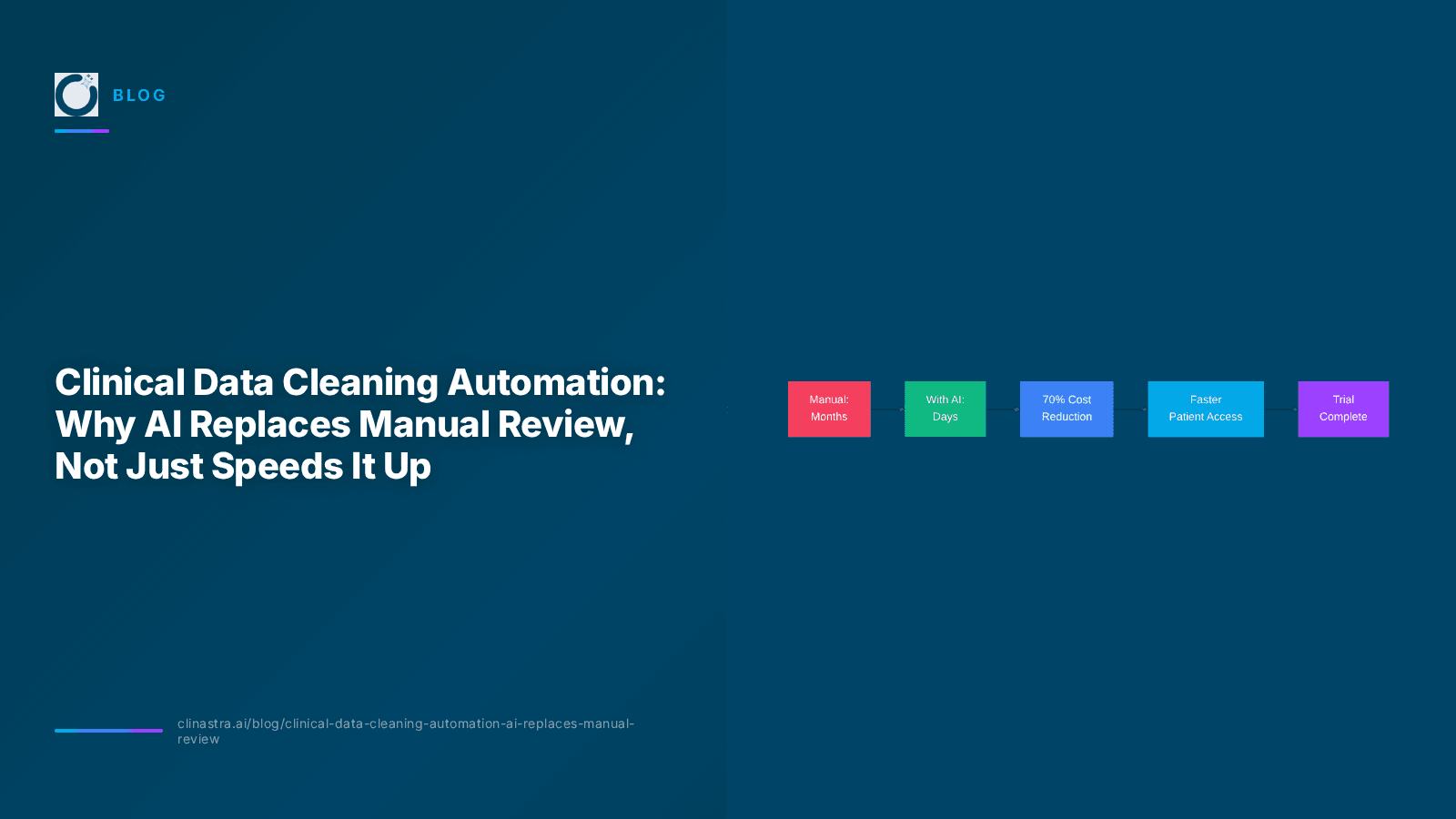
Manual clinical data cleaning is the bottleneck nobody questions. AI doesn't speed it up — it replaces it. From months to days with 99.9% accuracy and audit-ready traceability.