
Aug 16, 2026•3 min read
SDTM Dataset Review: Why Manual Checking Kills Timelines
Manual SDTM dataset review takes weeks. AI-assisted review takes hours. Here is how ClinAstra replaces pattern-matching with computation, with full audit trail.
Medidata Rave and Veeva Vault EDC both capture clinical trial data — but neither solves the manual review bottleneck. Compare them on review speed and learn how AI cuts LPLV-to-database lock from months to days.
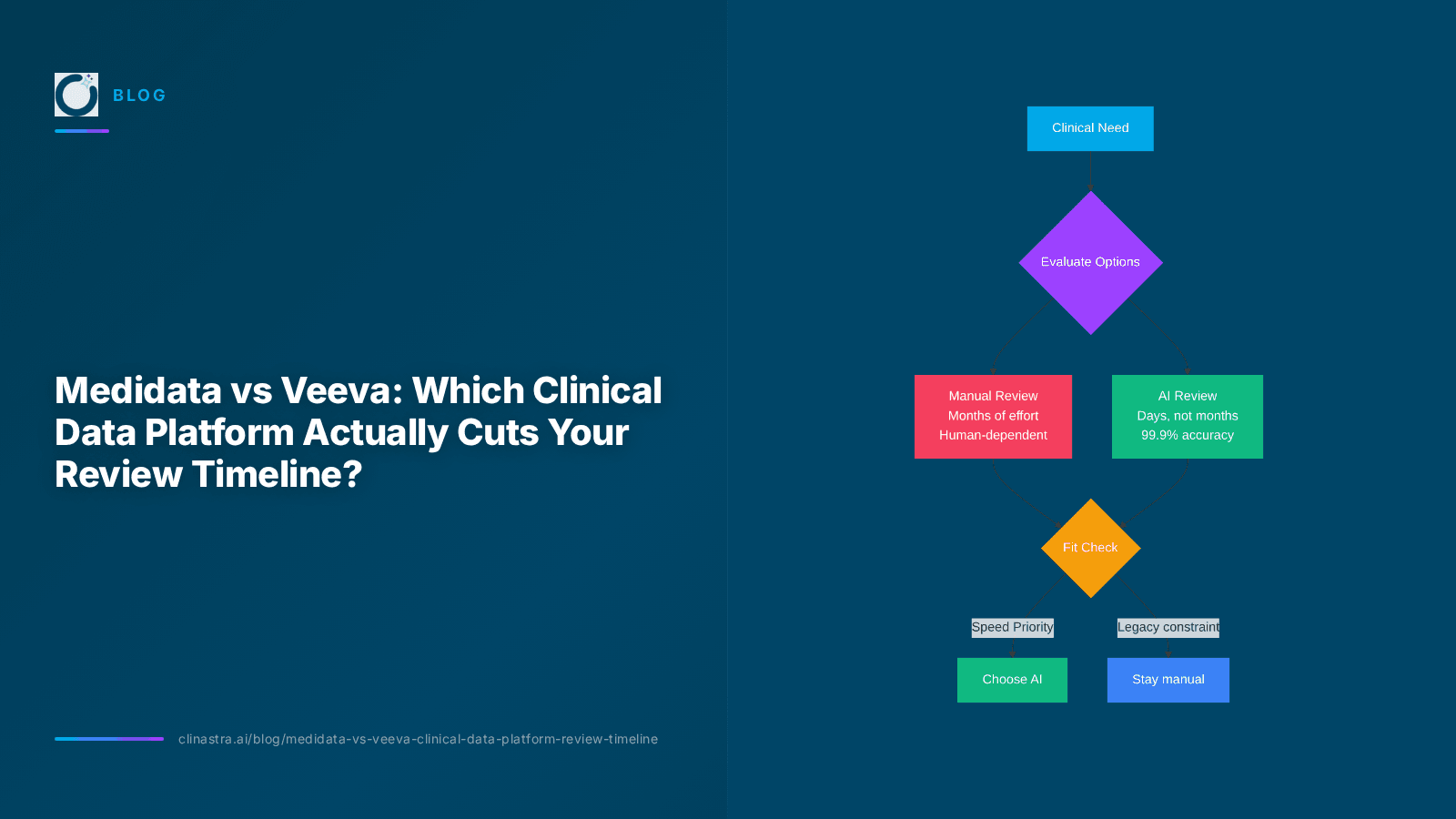
Clinical operations leaders spend months evaluating Medidata Rave vs Veeva Vault EDC. They compare features, pricing, integration depth, and user reviews. They run RFP processes, sit through demos, and debate which platform will serve their portfolio better. And then — regardless of which one they pick — they hit the same wall: manual data review that hasn't gotten faster in two decades.
Tufts CSDD measured the LPLV-to-database lock cycle at 36.1 days in 2017 — up from 33.4 days a decade earlier. By 2024, large pharmaceutical companies saw a 32% increase in that same metric, with cycle times growing by six days in just two years for companies using five or more data sources. The platforms got better. The review process didn't. That's because Medidata and Veeva are both extraordinary data capture systems — and neither one was built to replace the human review bottleneck that sits between data collection and database lock.
This comparison reframes the Medidata vs Veeva decision around what actually matters for trial timelines: how fast can you get from last patient last visit to a clean, locked database? We evaluate both platforms on data review speed, identify where each falls short, and show how an AI-native review layer eliminates the bottleneck regardless of which EDC you've already invested in. Data review is not a human job anymore — and the platform you choose for capture shouldn't dictate how slowly you review.
The clinical trial ecosystem has spent twenty years optimizing data capture. Medidata Rave has been deployed in over 34,000 trials covering more than 10 million patients across roughly 2,200 customers. Veeva Vault EDC surpassed 1,000 study starts and reported fiscal year 2026 revenue of $3.2 billion, up 16% year over year. Both platforms are FDA 21 CFR Part 11 compliant, both support CDISC CDASH-to-SDTM mappings, and both offer audit trails that satisfy regulatory inspectors.
But here's what neither platform's feature sheet mentions: the time from LPLV to database lock has gotten worse, not better, even as EDC adoption hit 95%+ in industry-sponsored trials.
Tufts CSDD's research makes the bottleneck unmistakable:
| Metric | 2007 | 2017 | 2024 Trend |
|---|---|---|---|
| LPLV to DB Lock (days) | 33.4 | 36.1 | 32% increase for large pharma |
| Cycle time change (2-year) | — | — | +6 days for multi-source companies |
| Data sources per trial | 2-3 | 5+ | Growing complexity, slower review |
The platforms captured data faster. The review process — manual edit checks, human-driven query resolution, sequential reconciliation, line-by-line listing review — stayed stuck in 2005. Every Gartner Peer Insights review, every G2 comparison, every LinkedIn post about Medidata vs Veeva focuses on capture features, eCRF design flexibility, and pricing. Nobody asks the question that determines your timeline: how long does review take, and can it be automated?
Every day between LPLV and database lock costs money. Tufts CSDD estimates approximately $500,000 in unrealized prescription sales per delay day for a mid-size drug, plus $40,000 in direct trial costs. For a blockbuster therapy generating $2 billion annually, that's roughly $5.5 million per day in lost revenue — not from a failed trial, but from a review process that hasn't been questioned.
The industry accepted this bottleneck as fixed. It isn't. The bottleneck is review, not science — and review is a computation problem, not a human one.
Medidata Rave (a Dassault Systèmes brand) is the most widely deployed EDC in clinical research. Its strengths are well documented:
Clinical Data Studio is a genuine improvement over the fragmented review workflows that preceded it. Teams can see data freshness, review assignments, and issues across teams in one environment. But the fundamental model hasn't changed: a human still reviews the data. Clinical Data Studio organizes the review work — it doesn't replace the reviewer.
Here's what that means in practice:
"Medidata Clinical Data Studio is the best environment for organizing manual data review. But organizing manual review and replacing it are two different things. If your team is still triaging queries by hand, you're still operating at the speed of a spreadsheet — regardless of how good the spreadsheet looks." — Karthik Nadakuditi, Co-Founder, ClinAstra
Veeva Systems has aggressively captured EDC market share, with eight of the top 20 biopharmaceutical companies switching to Veeva EDC. The Vault platform's strengths include:
Veeva's CDR module follows the same fundamental model as Medidata: it gives humans better tools to review data manually. The dashboards are cleaner. The workflows are more integrated. The review experience is more modern. But the bottleneck persists:
The hard truth: switching from Medidata to Veeva doesn't cut your review timeline. It changes where you do the review, not how fast it happens.
Most comparisons evaluate Medidata and Veeva on capture features, pricing, and user satisfaction. This one evaluates them on what determines your timeline: data review speed.
| Dimension | Medidata Rave + Clinical Data Studio | Veeva Vault EDC + CDR | ClinAstra (AI Review Layer) |
|---|---|---|---|
| Data capture | Industry-leading, 34K+ trials | Modern, object-based, rapid build | N/A — sits on top of either |
| Review model | Manual, human-driven | Manual, human-driven | AI-driven, 99.9% accuracy |
| Edit check triage | Human triages each query | Human triages each query | AI triages, prioritizes, resolves |
| Anomaly detection | Rules-based + alerts | Rules-based + dashboards | AI pattern detection across domains |
| Reconciliation | Manual report-and-compare | Manual report-and-compare | Automated cross-source matching |
| SDTM review | Human scans domains | Human scans domains | AI reviews SDTM conformance |
| LPLV to DB Lock | 36+ days (industry avg) | 36+ days (industry avg) | Days, not months |
| Query resolution | Sequential, human-paced | Sequential, human-paced | Parallel, AI-paced |
| Audit trail | Built into Rave | Built into Vault | Full traceability, audit-ready by design |
| Integration | Native EDC + add-on modules | Unified Vault platform | Integrates with both |
The pattern is clear: Medidata and Veeva compete on capture architecture, study build speed, and platform integration. Neither competes on review speed — because neither solves it. That's not a flaw in their products; it's a gap in their category. EDC systems were built to capture data, not to review it at machine speed.
Here's what the Medidata vs Veeva debate ignores: you don't need to switch platforms to fix review. ClinAstra was built to integrate with the EDC and clinical data platform you already have — not to replace it.
ClinAstra sits on top of Medidata Rave or Veeva Vault EDC and replaces the manual review layer with AI. Your EDC continues to capture data. Your clinical data platform continues to store it. ClinAstra reviews it — at machine speed, with 99.9% accuracy, and with full traceability for every flag, query, and insight it generates.
The integration model works because the bottleneck isn't capture or storage. The bottleneck is the human review layer that both Medidata and Veeva leave intact. ClinAstra replaces that layer without touching the systems your team already knows.
When ClinAstra handles data review on top of your existing EDC:
If you're running Medidata Rave or Veeva Vault EDC, here's how to eliminate the review bottleneck without rip-and-replace:
Measure your actual LPLV-to-database lock cycle across your last three studies. Break it down: how many days on edit check triage, how many on reconciliation, how many on SDTM review, how many on query resolution. The breakdown reveals where the human bottleneck is thickest.
Document every data source flowing into your EDC — lab vendor, PK vendor, ePRO, imaging, central labs, local labs, SAE reconciliation sources. For each source, document the current review workflow: who reviews, how long it takes, and what tools they use. This map becomes the integration spec for AI-driven review.
ClinAstra connects to your EDC via API — whether that's Medidata Rave or Veeva Vault. No data migration, no platform switch. ClinAstra reads the data your EDC has captured and begins reviewing it against clinical logic, SDTM conformance rules, and cross-domain consistency checks.
Define what ClinAstra should flag: edit check violations, cross-domain anomalies, reconciliation discrepancies, safety signal patterns, and SDTM conformance issues. Set severity thresholds so low-priority noise is filtered automatically and high-priority findings surface immediately.
For your next study approaching LPLV, run ClinAstra in parallel with your manual review team. Compare: time to complete review, number of anomalies detected, query accuracy, and audit readiness. The numbers speak for themselves.
Once the parallel cycle validates accuracy and speed, transition to AI-primary review with human oversight. ClinAstra handles first-pass review, anomaly detection, reconciliation, and query generation. Your data managers shift from reviewing data to reviewing AI findings and making clinical decisions — from months to days, from data entry to decision-making.
If you checked three or more, your EDC platform — whether Medidata or Veeva — is organizing a bottleneck, not eliminating one. The fix isn't another module. The fix is replacing the manual review layer with AI.
Every day between LPLV and database lock is a day a patient waits for access to therapy. For oncology patients enrolled in a Phase III trial, that's a day of waiting for a treatment that might extend their life. For rare disease patients, it's a day closer to disease progression with no intervention. For every patient in every trial, it's a day of uncertainty.
Tufts CSDD puts the cost of a delay day at approximately $500,000 in unrealized prescription sales and $40,000 in direct trial costs. Those are business numbers. The human number is harder to calculate: how many patients die waiting for a drug that's already proven but stuck behind a manual review process?
The Medidata vs Veeva debate is, at its core, a debate about capture infrastructure. But the question that matters for patients is simpler: how fast can you get from trial completion to therapy delivery? And the answer, for every team still reviewing data with humans, is: too slow.
Every day saved is a day a patient waits less. That's not a marketing line — it's the reason ClinAstra exists. Review less. Decide more. Get therapies to patients faster.
Measure your review timeline today. Pull LPLV-to-database lock data for your last five studies. If the average exceeds 30 days, you have a review bottleneck — not a capture problem.
Stop evaluating EDC platforms on review features. Medidata Clinical Data Studio and Veeva CDR both organize manual review. Neither replaces it. Evaluate them on capture, integration, and compliance — then solve review separately.
Pilot AI-driven review on your next study. Deploy ClinAstra in parallel with your manual review team. Measure time, accuracy, and audit readiness. The data will make the case for you.
Reallocate your data managers to decisions, not data entry. When AI handles first-pass review, your PhD-level data managers shift from scanning listings to making clinical judgments. That's what they were hired for.
Set a review timeline target. If your current LPLV-to-lock cycle is 36 days, set a target of 7 days within six months. The technology exists. The only barrier is the decision to deploy it.
No. ClinAstra integrates with both. Your EDC continues to capture data. ClinAstra replaces the manual review layer that sits on top — the edit check triage, anomaly detection, reconciliation, and SDTM review that currently consume weeks of human time.
Both offer review workflows — Medidata Clinical Data Studio and Veeva Vault CDR. Both organize manual review in a unified environment. Neither replaces the human reviewer. If review speed is your priority, the EDC choice matters less than whether you add an AI review layer on top.
ClinAstra's AI is trained on clinical data structures — SDTM domains, ADaM datasets, edit check logic, reconciliation patterns, and safety signal detection. Every flag includes the data point, the rule violated, the clinical context, and the recommended action. Every finding is traceable. Audit-ready by design.
Yes. ClinAstra generates a full audit trail for every flag, query, and insight. Inspectors can trace any finding back to the source data, the rule that triggered it, and the clinical logic behind it. No black boxes. No "trust us." Every output is traceable.
Deployment depends on study complexity and data source count, but most teams are operational within 2-4 weeks. No data migration, no EDC switch. ClinAstra connects via API and begins reviewing data your EDC has already captured.
At industry averages, every day between LPLV and database lock costs approximately $500,000 in unrealized revenue and $40,000 in direct costs. If your review cycle is 36 days, that's $18 million in unrealized revenue per study — for a bottleneck that AI eliminates.
Ready to cut your review timeline from months to days? Whether you're on Medidata Rave or Veeva Vault EDC, ClinAstra replaces the manual review bottleneck with AI at 99.9% accuracy — audit-ready, traceable, and integrated with the stack you already have. Book a review timeline assessment at clinastra.ai/#cta.
Built in the trenches, not the ivory tower. Data review is not a human job anymore.
Co-founder & Clinical Data Expert, ClinAstra
Spent years inside clinical data management living the manual review grind. Built ClinAstra to replace it — not assist it. 99.9% accuracy, audit-ready by design.
Request a DemoManual SDTM dataset review takes weeks. AI-assisted review takes hours. Here is how ClinAstra replaces pattern-matching with computation, with full audit trail.
The clinical data review tools market splits into AI-bolted-on assistants and AI-native replacements. Only AI-native tools deliver months-to-days timelines. Here is how to evaluate them.
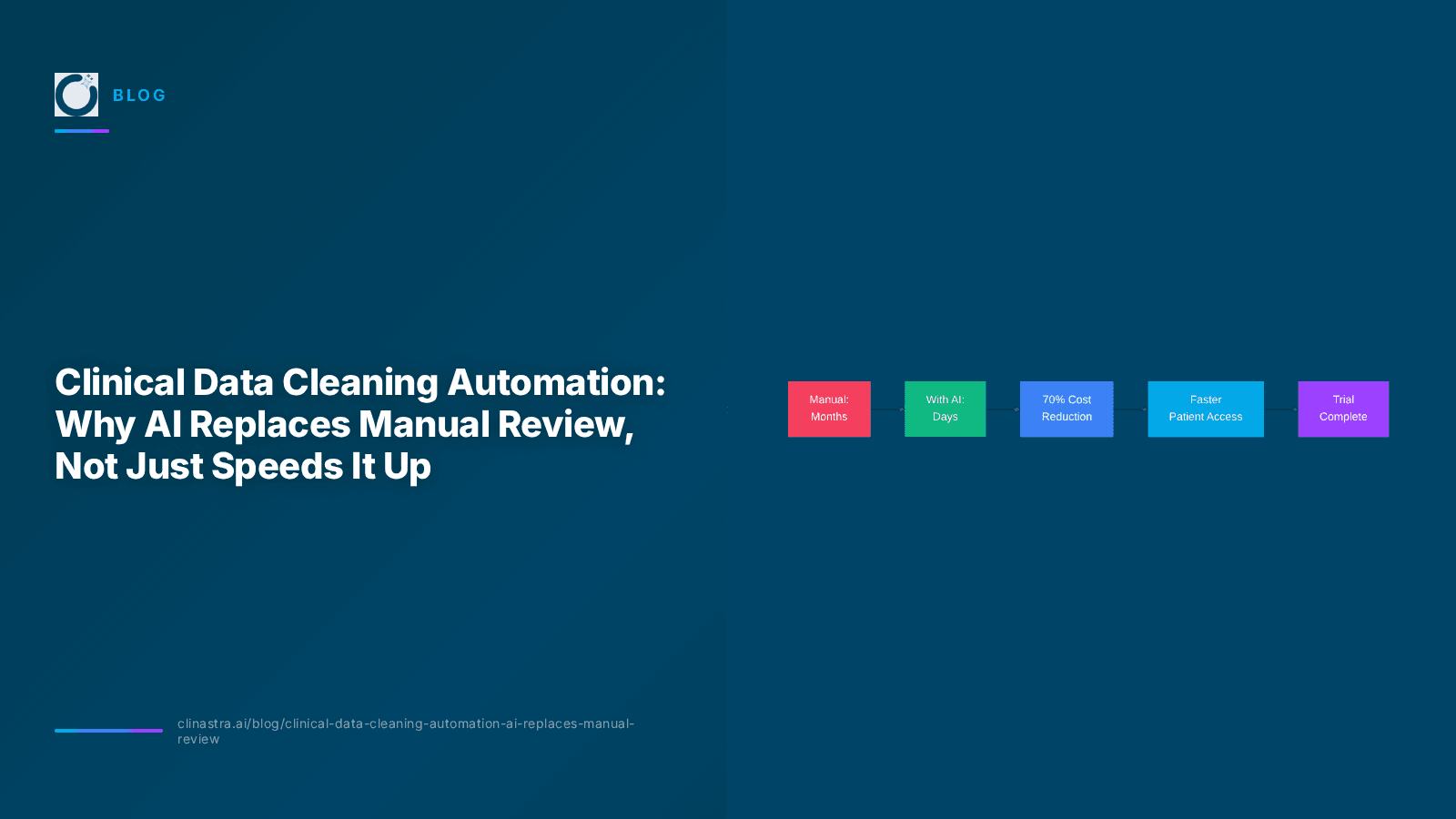
Manual clinical data cleaning is the bottleneck nobody questions. AI doesn't speed it up — it replaces it. From months to days with 99.9% accuracy and audit-ready traceability.