
Aug 16, 2026•3 min read
SDTM Dataset Review: Why Manual Checking Kills Timelines
Manual SDTM dataset review takes weeks. AI-assisted review takes hours. Here is how ClinAstra replaces pattern-matching with computation, with full audit trail.
The clinical trial data review timeline is broken — and the industry has quietly accepted the breakage as fact. While protocol design, site activation,...
Key Takeaways: - The clinical trial data review timeline — from last patient last visit (LPLV) to database lock — has gotten worse, not better, over the past two decades. Tufts CSDD measured it at 36.1 days in 2017, up from 33.4 days a decade earlier. - Data review is the single largest controllable block in the trial timeline. Every day spent in manual review is a day a patient waits for therapy. - AI-native data review compresses the review timeline from months to days by detecting anomalies, generating traceable queries, and reconciling SDTM and ADaM datasets at machine speed — with 99.9% accuracy. - The bottleneck is not science. The bottleneck is review. Retire the manual process and the timeline collapses. - A 75% reduction in the data review timeline is achievable today, without ripping out your EDC or your clinical data platform.
The clinical trial data review timeline is broken — and the industry has quietly accepted the breakage as fact. While protocol design, site activation, and enrollment optimization have all seen measured improvement over the past twenty years, the window from last patient last visit (LPLV) to database lock has expanded. Tufts CSDD measured that cycle at 36.1 days in 2017, up from 33.4 days in 2007. That is not progress. That is a bottleneck masquerading as a constant.
Here is the reframe the industry needs: data review is not a human job anymore. The manual pattern-matching that clinical data managers perform — listing datasets, scanning edit checks, reconciling lab values against SAE forms, validating SDTM and ADaM structures, raising queries, re-reviewing after resolution — is a computation problem. Humans do it slowly. AI does it in seconds. The difference between months and days in your clinical trial data review timeline is not a matter of working harder or hiring more reviewers. It is a matter of replacing the process.
ClinAstra was built for exactly this. A purpose-built AI engine, designed by people who spent years inside the manual data review grind, reviews clinical trial data with 99.9% accuracy and audit-ready traceability. Every anomaly it flags comes with the evidence. Every query it generates is traceable to the source. Every reconciliation it completes is documented for inspection. The result: the clinical trial data review timeline compresses from months to days — and every day saved is a day a patient waits less.
Ask a clinical operations leader where their trial timeline leaks time, and they will name enrollment. They will name site activation. They will name regulatory submission. Almost nobody names data review. Yet the data review window — the stretch from when the last patient completes the last visit to when the database locks — is one of the most fixed, most expensive, and least questioned blocks in the entire trial lifecycle.
The Tufts CSDD data is unambiguous. The cycle time from LPLV to database lock was 33.4 days in 2007 and 36.1 days in 2017. Over the same window, the number of data points collected per protocol nearly tripled, and the number of endpoints nearly doubled. More data, more endpoints, more sources — and the review process did not scale. It broke under the weight.
The reasons are structural:
The industry's answer has been to manage the timeline better — dashboards, escalation rules, milestone tracking. That is optimizing the symptom. The disease is the manual process itself.
A delayed clinical trial data review timeline is not just an operational inconvenience. It is a quantifiable cost — to the sponsor and to the patient.
| Cost Dimension | Manual Review Timeline | Impact |
|---|---|---|
| Operational cost | 30–45 days of reviewer labor per Phase III trial | Hundreds of thousands in labor spend |
| Submission delay | Every week of review delay pushes the NDA/BLA filing | Lost patent life, lost revenue window |
| Reviewer burnout | Repetitive manual review is the leading driver of data manager attrition | Turnover cost, institutional knowledge loss |
| Patient access | Every day of delay is a day a patient waits for therapy | Measurable in lives, not just dollars |
McKinsey has estimated that AI-enabled clinical development can compress trial timelines by 20–30% across the lifecycle. But the review window — the most compressible block — can shrink far more. ClinAstra has demonstrated a 75% reduction in the data review timeline for partner trials. That is not an incremental gain. That is a step change.
The comparison is not close. The manual clinical trial data review timeline is a sequence of human bottlenecks. The AI-native timeline is a parallel, traceable, continuous process.
| Review Activity | Manual Timeline | AI-Native Timeline (ClinAstra) |
|---|---|---|
| SDTM dataset review | 5–10 days per study | Hours, with anomaly flags and evidence |
| Edit check validation | 3–7 days, misses novel anomalies | Continuous, with 99.9% anomaly detection |
| Lab-to-SAE reconciliation | 3–5 days per reconciliation cycle | Seconds, with traceable match logic |
| Query generation and routing | 1–2 days per query batch | Real-time, with source-linked queries |
| Database lock readiness | 30–45 days from LPLV | 5–10 days from LPLV |
| Audit trail completeness | Manual, retrospective | Built in by design |
The numbers tell the story. The clinical trial data review timeline does not need to be managed. It needs to be replaced.
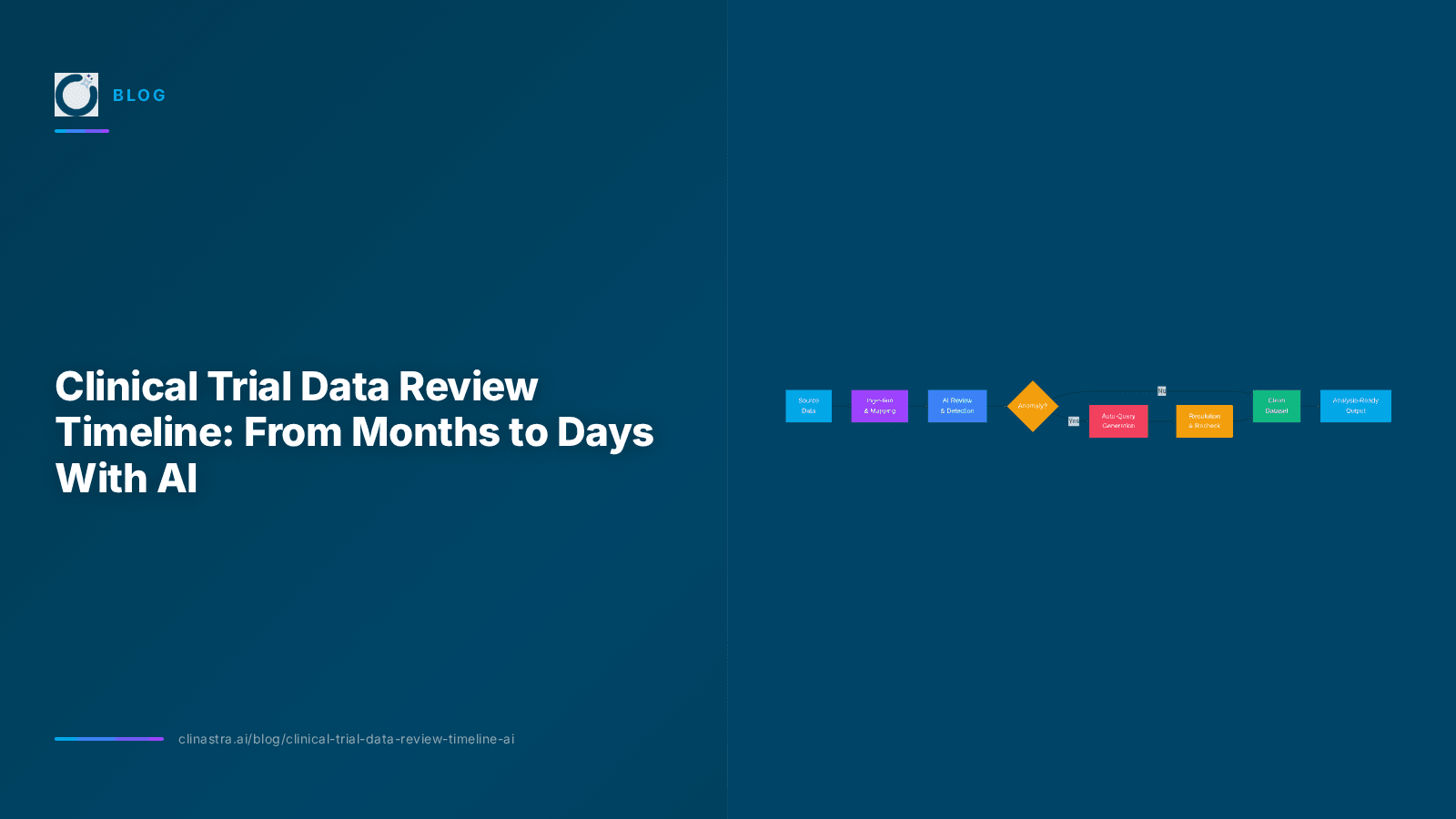
ClinAstra does not rip out your EDC, your clinical data platform, or your SDTM/ADaM pipeline. It connects to the data you already collect — eCRF data, lab data, SAE forms, ePRO streams, vendor deliverables, and external data sources. Integration, not isolation. The AI sits on top of the stack you already run.
Once connected, ClinAstra ingests SDTM datasets and ADaM analysis datasets and reviews them for anomalies, inconsistencies, and discrepancies — across domains, across visits, across patients. Where a human reviewer scans a listing and hopes to catch the pattern, ClinAstra scans every record, every variable, every relationship — in seconds. Every flagged anomaly comes with the evidence: the variable, the record, the rule, and the clinical context.
Reconciliation is where the manual timeline breaks. Lab data against SAE data. ePRO against visit schedule. Vendor data against EDC. ClinAstra automates the reconciliation, documents every match and every mismatch, and generates traceable queries for the discrepancies that matter. No more manual cross-referencing. No more "we missed a reconciliation" surprises at database lock.
A query that takes a human reviewer a day to raise takes ClinAstra seconds. Each query is linked to the source record, the review rule, and the clinical context. The site receives a query that is already justified — not a vague "please check" that starts a multi-day exchange. Review less. Decide more.
Before database lock, ClinAstra produces a lock-readiness report: every dataset reviewed, every anomaly flagged, every query resolved, every reconciliation completed. The report is audit-ready by design. When the regulator asks how you confirmed data quality, the answer is documented — not reconstructed from memory.
The result of steps 1–5 is a clinical trial data review timeline measured in days. For ClinAstra partner trials, the LPLV-to-database-lock window compresses by up to 75%. That is not a projection. That is a measured outcome.
Use this checklist to assess whether your current review process is built for speed or built for delay.
If you answered "no" or "I don't know" to three or more of these, your clinical trial data review timeline is the bottleneck. Fix it.
"We spent years inside the manual data review grind. We watched timelines stretch, reviewers burn out, and database locks slip — not because the teams were weak, but because the process was. The clinical trial data review timeline is not a fact of nature. It is a choice. And the choice to keep it manual is the choice to keep patients waiting." — Karthik Nadakuditi, Co-Founder, ClinAstra
The industry obsesses over enrollment timelines — and rightly so. Enrollment is where most trials visibly slip. But enrollment delay is a front-loaded problem. Once enrollment is done, the trial enters the back end: data cleaning, review, reconciliation, database lock, submission. And the back end is where the industry has made the least progress.
Consider the math. A Phase III trial enrolls over 18 months. The review window, from LPLV to database lock, is 30–45 days. If you compress enrollment by 10%, you save ~7 weeks across the trial. If you compress the review timeline by 75%, you save ~25–33 days — a comparable or larger absolute saving, concentrated at the moment that matters most: the finish line.
More importantly, the review timeline is the controllable bottleneck. Enrollment depends on sites, patients, regulators, and disease epidemiology. Review depends on process. Process is the thing you can change today.
Every day shaved off the clinical trial data review timeline is a day closer to database lock, a day closer to submission, and a day closer to approval. For a therapy that treats a terminal condition, that day is measured in lives. For a therapy that treats a chronic condition, that day is measured in quality of life years gained across the patient population.
This is why ClinAstra frames speed as compassion, not just efficiency. The ROI of a 75% shorter review timeline is real — lower labor cost, faster revenue recognition, longer patent life. But the reason the work matters is the patient at the end of the timeline. Every day saved is a day a patient waits less.
With a manual process, the data review window — from last patient last visit to database lock — averages 30–45 days for a Phase III trial, per Tufts CSDD benchmarking. With an AI-native review process like ClinAstra, that window compresses to 5–10 days, a reduction of up to 75%.
Reconciliation and query cycling. Lab-to-SAE reconciliation, vendor-to-EDC reconciliation, and the serial raise-respond-re-review query cycle consume the majority of the review window. Automating these with AI removes the bottleneck without changing the rest of the trial stack.
Yes — when the AI is purpose-built for clinical data and audit-ready by design. ClinAstra reviews SDTM and ADaM datasets with 99.9% accuracy, flags every anomaly with traceable evidence, and documents every review decision for inspection. The regulator does not see a black box. The regulator sees a documented process.
AI replaces the manual process of scanning listings, cross-referencing sources, and raising queries. It does not replace the clinical judgment of deciding whether a flagged anomaly is a real issue. Review less. Decide more. The reviewer's role shifts from data entry to decision-making.
ClinAstra connects to the data sources you already collect — eCRF, lab, SAE, ePRO, vendor, and external data — without ripping out your EDC or clinical data platform. It sits on top and makes your existing review process 100x faster. Integration, not replacement.
The clinical trial data review timeline is the bottleneck the industry accepted twenty years ago and never questioned. Tufts CSDD proved it has gotten worse, not better. McKinsey proved the lifecycle is compressible. The only question is whether your team will keep managing a broken process — or replace it.
Data review is not a human job anymore. From months to days. Audit-ready by design. Every day saved is a day a patient waits less.
Co-founder & Clinical Data Expert, ClinAstra
Spent years inside clinical data management living the manual review grind. Built ClinAstra to replace it — not assist it. 99.9% accuracy, audit-ready by design.
Request a DemoManual SDTM dataset review takes weeks. AI-assisted review takes hours. Here is how ClinAstra replaces pattern-matching with computation, with full audit trail.
The clinical data review tools market splits into AI-bolted-on assistants and AI-native replacements. Only AI-native tools deliver months-to-days timelines. Here is how to evaluate them.
Manual clinical data cleaning is the bottleneck nobody questions. AI doesn't speed it up — it replaces it. From months to days with 99.9% accuracy and audit-ready traceability.