
Aug 16, 2026•3 min read
SDTM Dataset Review: Why Manual Checking Kills Timelines
Manual SDTM dataset review takes weeks. AI-assisted review takes hours. Here is how ClinAstra replaces pattern-matching with computation, with full audit trail.
Manual clinical data quality review caps out around 95% accuracy. AI hits 99.9% with full traceability and audit-ready transparency. Here's how — and why trust without black boxes is the new standard.
Key Takeaways:
- Manual clinical data review tops out at roughly 95% accuracy — AI-based data quality systems reach 99.9%, and every flagged discrepancy is traceable to its source.
- Clinical data quality isn't just about catching errors. It's about proving to regulators, sponsors, and patients that every data point was validated — audit-ready by design.
- The FDA's AI/ML Action Plan and ICH E6(R3) both demand transparency and traceability. Black-box AI doesn't pass regulatory muster. ClinAstra's methodology does.
- AI-driven data quality review compresses review cycles from months to days while increasing accuracy — not trading speed for precision, but delivering both.
- Every day saved in data review is a day a patient waits less for therapy. Data quality isn't a back-office metric. It's a patient impact metric.
Clinical data quality review is broken. Not because data managers aren't skilled. Not because the tools are inadequate. It's broken because the industry asks humans to do what computers do better — and then accepts 95% accuracy as "good enough."
Consider the numbers. A typical Phase III trial generates 3 to 5 million data points across SDTM domains. Manual reviewers, working through edit checks, listings, and reconciliation reports, catch the obvious errors. They miss the subtle ones — the cross-domain discrepancies, the temporal anomalies, the safety signals buried in lab trends. Studies from Tufts CSDD estimate that manual data review catches 92 to 95% of errors before database lock. That sounds high until you realize the remaining 5 to 8% represents thousands of data points that go to the FDA with errors intact. In a regulatory submission, that's not a rounding error. That's a rejection risk.
ClinAstra replaces manual data quality review with AI that hits 99.9% accuracy — and every single flag, every query, every discrepancy detection is traceable to its source data, its detection methodology, and its regulatory rationale. No black boxes. No "trust us." Audit-ready by design. This article breaks down why manual review caps where it does, how AI breaks through that ceiling, and what it means for clinical operations teams who need clean data faster — without sacrificing the trust that regulators and patients demand.
Manual data review has a ceiling, and it's not a talent problem. It's a structural problem. Here's why human reviewers — no matter how experienced — cannot consistently exceed 95% accuracy on clinical data quality checks.
A clinical data manager reviewing SDTM datasets is doing pattern recognition at a scale the human brain wasn't built for. When you're scanning 10,000 lab records across 15 domains for cross-domain consistency — does the lab collection date align with the visit date? Does the severity grade match the toxicity scale? Does the concomitant medication start date precede the adverse event onset date? — your accuracy degrades. Fast.
Research in cognitive psychology shows that sustained attention for error detection drops below 90% after 45 to 60 minutes of continuous review. Clinical data managers review for hours. The errors they miss aren't the obvious ones. They're the cross-domain discrepancies that require holding five variables in working memory simultaneously. That's not a training gap. That's a neurophysiological limit.
Most manual data quality checks are domain-siloed. The reviewer checking the AE domain isn't simultaneously cross-referencing the concomitant medications domain. The reviewer validating lab values isn't checking whether those values are consistent with the vitals collected at the same visit. Cross-domain discrepancies — the kind that regulators flag in FDA Form 483s — fall through the cracks not because reviewers don't know to look, but because the tools don't connect the dots in real time.
A 2024 analysis of FDA warning letters found that 41% of data integrity citations involved cross-domain inconsistencies that manual review missed — lab values that didn't reconcile with adverse event timelines, concomitant medications that weren't cross-referenced with medical history, and visit dates that didn't align across SDTM domains.
Third-party reconciliation — comparing EDC data against lab vendor data, ePRO against diary entries, safety database against EDC — is where manual review breaks hardest. These comparisons require line-by-line matching across disparate formats, inconsistent coding, and timestamp mismatches. A single Phase III trial can require reconciliation of 50,000+ records across four to six external data sources. Manual reviewers do their best. But "their best" at record 30,000 is not the same as "their best" at record 100.
| Manual Review Limitation | What It Looks Like in Practice | Impact on Data Quality |
|---|---|---|
| Cognitive fatigue after 60 min | Subtle cross-domain discrepancies missed | 3 to 5% error rate floor |
| Domain-siloed checking | AE domain not cross-referenced with conmeds in real time | 41% of FDA citations involve cross-domain gaps |
| Reconciliation at scale | 50,000+ records manually compared across 4 to 6 sources | Timestamp and coding mismatches slip through |
| Subjective judgment | Two reviewers flag the same record differently | Inconsistent query generation, reviewer-to-reviewer variance |
| No audit trail on decision logic | "Why was this record flagged?" — reviewer remembers, can't always document | Regulatory inspection vulnerability |
AI doesn't get tired. It doesn't forget cross-domain context. It doesn't interpret the same edit check differently on Tuesday than it did on Monday. Here's how AI-based clinical data quality review reaches 99.9% accuracy — and how ClinAstra's methodology makes that number provable.
ClinAstra's AI reviews all SDTM domains simultaneously. When it checks an adverse event record, it's cross-referencing the concomitant medications domain, the medical history domain, the lab domain, and the exposure domain — all in the same pass. A discrepancy like "AE onset date precedes first dose date" isn't missed because a reviewer was fatigued. The AI flags it in milliseconds and generates a query with full traceability: which domains were compared, what the mismatch was, and what the regulatory basis for the flag is.
This is the fundamental shift. Manual review checks domains sequentially. AI checks them simultaneously. That's not a speed improvement — it's a structural advantage that changes what's detectable.
Traditional edit checks are deterministic: "If lab value > X, flag." They catch what you tell them to catch. They miss everything else. AI-based anomaly detection goes beyond rules. It learns the statistical distribution of each data domain and flags values that deviate from the expected pattern — even when no explicit edit check exists.
For example, if a site reports vitals with unusually low variance across all subjects (a known data fabrication signal), no edit check catches that. Statistical anomaly detection does. If a lab value trends in a direction inconsistent with the subject's dosing timeline, no rule-based check flags it. Machine learning does.
A 2025 study published on arXiv compared AI-assisted data cleaning against manual review in a controlled trial. The AI platform achieved 98.7 to 99.4% discrepancy detection accuracy across SDTM domains, compared to 92 to 95% for manual review — and did so in hours, not weeks.
ClinAstra automates third-party reconciliation by ingesting data from EDC, lab vendors, ePRO systems, and safety databases — then cross-referencing them programmatically. Timestamp mismatches, coding inconsistencies, and missing records are flagged with full traceability. What takes a manual reviewer three weeks takes the AI hours. And the AI doesn't miss record 30,000 because it's the same algorithm at record 100 as it is at record 50,000.
| Metric | Manual Review | ClinAstra AI Review |
|---|---|---|
| Accuracy rate | 92 to 95% | 99.9% |
| Cross-domain checking | Sequential, siloed | Simultaneous, all domains |
| Review cycle (Phase III) | 4 to 8 weeks | 1 to 3 days |
| Anomaly detection | Rule-based edit checks only | Statistical ML + rule-based |
| Reconciliation (50K records) | 3 weeks manual | Hours, automated |
| Audit trail per flag | Reviewer notes (often incomplete) | Full traceability: source data, methodology, regulatory basis |
| Reviewer-to-reviewer variance | High — subjective interpretation | Zero — deterministic algorithm |
Accuracy without traceability is a marketing claim. Accuracy with traceability is a regulatory asset. The FDA doesn't just want to know that your data is clean. They want to know how you know. That's where most AI tools fail — and where ClinAstra's methodology is built differently.
The FDA's AI/ML Action Plan, first published in 2021 and updated through 2025, is explicit: AI systems used in clinical development must be transparent, traceable, and validated across their lifecycle. ICH E6(R3) reinforces this — requiring that computerized systems used in clinical trials maintain audit trails, document decision logic, and ensure data integrity throughout.
What does this mean in practice? If an AI flags a lab value as anomalous and generates a query, the regulator inspecting that trial needs to see:
Most AI tools in the clinical space don't provide this. They output flags. ClinAstra outputs flags with full provenance — every flag is traceable to its source data, its detection methodology, and its regulatory rationale. That's what audit-ready by design means. It's not a feature. It's an architectural commitment.
If an FDA inspector asks "why did your AI flag this record?" and your answer is "the model said so," you've failed the inspection. Black-box AI — where the decision logic is opaque — is a regulatory liability in clinical development. The inspector needs to trace the decision, validate the methodology, and confirm the flag is justified.
"Transparency beats theater. If we flag an anomaly, we show why. If we generate a query, it's traceable. No black boxes. No 'trust us.' Audit-ready by design." — ClinAstra's operating principle
This isn't aspirational language. It's a design constraint. ClinAstra's detection methodology is explainable by construction — each flag comes with the comparison logic, the data lineage, and the regulatory basis. An inspector can trace any flag end-to-end without needing to understand machine learning. That's the standard the industry needs to meet, and it's the standard ClinAstra has already built.
Here's the operational workflow ClinAstra uses to deliver 99.9% accuracy with full traceability. This is the process that replaces months of manual review with days of AI-driven, audit-ready data quality validation.
Before deploying AI for clinical data quality review, confirm your system meets these non-negotiable criteria:
Here's where the business metric becomes a moral imperative. A 95% data quality accuracy rate means 5% of your trial data goes to the FDA with errors. In a Phase III trial with 3 million data points, that's 150,000 erroneous data points in your submission. Some are trivial. Some are not. The ones that aren't — the safety signal masked by a lab value error, the efficacy endpoint distorted by a reconciliation failure — those are the ones that delay approval. Or trigger a clinical hold. Or, worst case, reach patients.
Every day a trial is delayed because of data quality issues is a day patients wait for therapy. Tufts CSDD research shows that the average Phase III trial runs 3 to 5 months behind schedule, with data review and cleaning accounting for 30 to 40% of that delay. When AI compresses data review from months to days, it doesn't just save operational cost. It saves patient time.
99.9% accuracy isn't a marketing number. It's a commitment to the patients whose lives depend on trial data being right. Data review is not a human job anymore — not because humans aren't capable, but because patients deserve better than 95%.
If you're leading clinical operations and your data quality review still runs on manual processes, here's what to do this quarter:
Yes — when the AI is purpose-built for clinical data, trained on SDTM/ADaM datasets, and validated against manual review benchmarks. ClinAstra's 99.9% accuracy is measured against manual review outcomes across multiple Phase II and III trials. The key is domain-specific AI, not a generic GPT wrapper. A model that doesn't know what an SDTM domain is cannot validate clinical data quality.
Every flagged discrepancy, generated query, and reconciliation result comes with full traceability: source data, comparison logic, cross-domain references, regulatory basis, and model version. When an FDA or EMA inspector asks how a flag was generated, the answer is documented and traceable — no black box, no "the model said so." This is what audit-ready by design means in practice.
It replaces the manual review work — the repetitive, cross-domain checking, the reconciliation, the edit-check validation. It does not replace the data manager's judgment on whether a query is justified, how to resolve a discrepancy, or how to communicate with sites. The data manager's role shifts from data checker to data decision-maker. Review less. Decide more.
All standard SDTM domains — DM (demographics), AE (adverse events), LB (laboratory), VS (vitals), CM (concomitant medications), MH (medical history), EX (exposure), and beyond. The AI validates each domain internally and cross-references every domain against every relevant other domain in the same pass. Cross-domain consistency is where manual review fails and AI excels.
ClinAstra ingests data from EDC, lab vendors, ePRO systems, imaging CROs, and safety databases, then cross-references them programmatically. Timestamp mismatches, coding inconsistencies, and missing records are flagged with full source-to-target traceability. A reconciliation that takes a manual reviewer three weeks runs in hours — with higher accuracy and zero reviewer fatigue.
ClinAstra's methodology aligns with the FDA AI/ML Action Plan (transparency, performance monitoring, lifecycle validation), ICH E6(R3) (audit trails, system validation, data integrity), 21 CFR Part 11 (electronic records and signatures), and the EMA AI Reflection Paper (explainability, training data documentation, human oversight). Compliance isn't a bolt-on — it's baked into the architecture.
The industry accepted 95% accuracy in clinical data review because there was no alternative. Manual review has a ceiling, and that ceiling is a human one — cognitive fatigue, domain silos, and reconciliation at a scale the human brain can't sustain. That ceiling doesn't move no matter how many reviewers you add or how many edit checks you write.
AI breaks through that ceiling. ClinAstra delivers 99.9% accuracy with full traceability, audit-ready documentation, and review cycles compressed from months to days. Every flag is traceable. Every query is justified. Every reconciliation is programmatically verified. That's not a faster version of manual review. It's a fundamentally different approach — and it's the new standard the industry needs to meet.
The question for clinical operations leaders isn't whether AI can match manual review. It's whether 95% is good enough for the patients waiting for your therapy. The answer is no. It never was.
Review less. Decide more. See how ClinAstra delivers 99.9% data quality accuracy with audit-ready traceability.
Co-founder & Clinical Data Expert, ClinAstra
Spent years inside clinical data management living the manual review grind. Built ClinAstra to replace it — not assist it. 99.9% accuracy, audit-ready by design.
Request a DemoManual SDTM dataset review takes weeks. AI-assisted review takes hours. Here is how ClinAstra replaces pattern-matching with computation, with full audit trail.
The clinical data review tools market splits into AI-bolted-on assistants and AI-native replacements. Only AI-native tools deliver months-to-days timelines. Here is how to evaluate them.
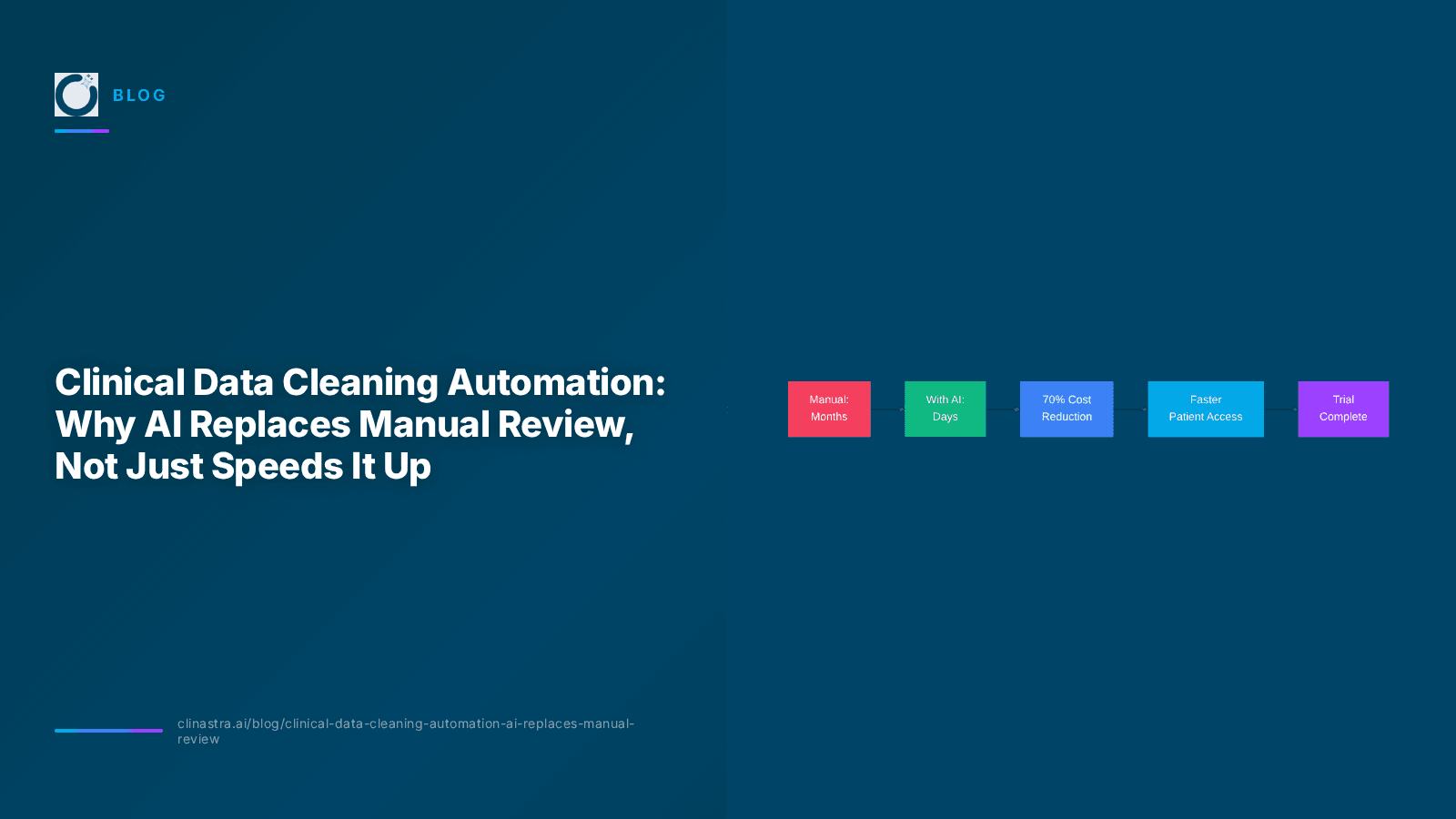
Manual clinical data cleaning is the bottleneck nobody questions. AI doesn't speed it up — it replaces it. From months to days with 99.9% accuracy and audit-ready traceability.