
Aug 16, 2026•3 min read
SDTM Dataset Review: Why Manual Checking Kills Timelines
Manual SDTM dataset review takes weeks. AI-assisted review takes hours. Here is how ClinAstra replaces pattern-matching with computation, with full audit trail.
The 7 clinical data management challenges slowing trials to a crawl — and why AI replaces manual review to fix them. Built by people who lived the pain.
Key Takeaways:
- Clinical data management challenges cost the industry billions annually — 80% of trials miss enrollment deadlines and 74% of data managers cite excessive manual steps as their top inefficiency.
- The biggest challenge isn't data collection, regulation, or integration — it's manual review, the bottleneck nobody questions.
- Modern Phase III trials generate 3.6 million data points per patient, up from 500,000 a decade ago — human review cannot scale to this volume.
- AI-native review replaces manual pattern-matching with 99.9% accuracy, audit-ready traceability, and months-to-days timeline compression.
- Every day saved in data review is a day a patient waits less for therapy — speed is a clinical and ethical imperative, not just an ROI metric.
Clinical data management challenges are not a technology problem. They are a human-limit problem. The industry has spent two decades bolting new tools onto a review process that was never designed to handle the data volumes modern trials generate. Phase III trials now produce 3.6 million data points per patient — a sevenfold increase from 500,000 a decade ago. Yet the dominant review model remains a data manager staring at listings, running edit checks by hand, and raising queries one at a time. That model is broken.
Every major clinical data management challenge — data quality, regulatory compliance, source integration, real-time monitoring, reviewer burnout — traces back to one root cause: humans doing work that computation does better. The industry treats this as a staffing problem. It is a design problem. When 74% of data managers identify excessive manual steps as their primary source of inefficiency, the answer is not more managers. The answer is to stop assigning humans to pattern-matching work that AI performs with 99.9% accuracy and full traceability.
This article is written from the trenches. ClinAstra was built by Karthik Nadakuditi, a clinical data manager who spent years inside the manual review grind, and Mohan Praneeth, an AI engineer who recognized a computation problem hiding inside a human workflow. We lived these challenges. We did not read about them in a whitepaper. Below is what the industry won't admit about clinical data management challenges — and how AI replaces manual review to fix them.
Modern clinical trials are data factories. A single Phase III trial with wearable sensors, electronic patient-reported outcomes, lab panels, imaging, genomics, and EHR integration generates millions of data points across dozens of domains in SDTM and ADaM formats. The industry benchmark for manual Source Data Verification (SDV) covers roughly 2-5% of data points through on-site monitoring — a sampling rate that guarantees the vast majority of anomalies go undetected until database lock approaches.
The challenge is not that data managers lack skill. It is that the review method lacks scale. No team of human reviewers can visually inspect 3.6 million data points per patient across hundreds of patients. Manual review was designed for an era when trials produced thousands of data points, not millions. The method has not changed; the data volume has multiplied sevenfold. That gap is the single largest source of review bottlenecks, missed anomalies, and last-minute database lock scrambles.
The traditional query lifecycle is a serial process: a data manager spots a discrepancy, drafts a query in the EDC, the site coordinator receives it, investigates the source document, responds, and the data manager re-checks and closes. Each query takes days to weeks to resolve. Multiply that by thousands of queries per trial, and the query backlog becomes the critical path to database lock.
Industry data shows manual query resolution consumes 30-50% of clinical data management team hours on a typical trial. The queries themselves are often predictable — range checks, missing visits, inconsistent dates, lab units that don't match the protocol. A model trained on thousands of trials identifies these patterns instantly. It drafts the query with the supporting evidence attached. The site coordinator receives a precise, pre-justified query and can close it in one pass. Queries that took two weeks now take two hours. That is not optimization. That is replacement.
Safety data lives in a safety database. Lab data lives in a central lab system. EDC data lives in Medidata or Veeva. SAE reconciliation, lab reconciliation, and vendor reconciliation require cross-referencing records that were never designed to talk to each other. A human reviewer manually compares SAE listings against the safety database, flags mismatches, and raises queries. This is painstaking, repetitive work with a high error rate — not because the reviewer is careless, but because the human eye is not built for row-by-row comparison across millions of records.
AI-native reconciliation ingests all sources, maps them to a common model, and flags discrepancies with 99.9% accuracy. Every flagged mismatch comes with the source records, the rule that triggered the flag, and a traceable audit trail. Reviewers do not compare rows. They adjudicate flagged exceptions. The work shifts from comparison to judgment — which is what human reviewers should have been doing all along.
Edit checks are the backbone of data quality in clinical trials — predefined rules that flag out-of-range values, missing fields, and logical inconsistencies. The problem is that traditional edit checks are static. They are hard-coded at trial startup based on the protocol, and they do not adapt as the trial generates new patterns. A site that starts reporting lab values in different units mid-trial, or a patient population that shows an unexpected safety signal, will not be caught by static rules written six months ago.
AI-native review does not rely on static rules alone. It learns the data distribution for each domain, each site, and each patient, and flags anomalies that deviate from the expected pattern — even when no edit check was written for that scenario. This is anomaly detection, not edit checking. The distinction matters: edit checks catch known errors. Anomaly detection catches unknown errors. In a trial generating 3.6 million data points per patient, the unknown errors are where the risk lives.
Clinical data manager burnout is not a wellness issue. It is a workflow design defect. When a role consists of repetitive, high-volume, low-judgment tasks — comparing listings, running the same checks across domains, raising the same queries trial after trial — burnout is the predictable outcome, not an individual failure. Work overload triples the risk of burnout in healthcare settings, and clinical data management is among the most overloaded roles in the trial lifecycle.
The fix is not better self-care. The fix is to remove the repetitive work from the human role and reserve human judgment for what it is uniquely suited for: adjudicating complex discrepancies, making safety decisions, and interpreting ambiguous signals. When AI handles the pattern-matching, the data manager becomes a decision-maker, not a checker. The role gets more interesting, the reviewer gets more productive, and the trial gets cleaner data faster.
Database lock is supposed to be a clean handoff from data management to biostatistics. In practice, it is a bottleneck. Teams spend the final weeks of a trial firefighting — running last-minute queries, reconciling final lab shipments, resolving open discrepancies, and racing to meet the lock date. The pressure to lock on time pushes teams to accept data that is not fully clean, which creates downstream risk in the submission.
AI-native review changes the shape of the database lock. Instead of a backlog that compresses into the final weeks, review happens continuously throughout the trial. Anomalies are flagged as data arrives. Queries are raised in real time. Reconciliation runs in the background. By the time the trial reaches database lock, the data is already clean — because it was reviewed continuously, not in a final scramble. The lock becomes a formality, not a crisis.
Regulatory inspections demand traceability: every data point, every query, every change must have an audit trail that an FDA or EMA inspector can follow. Traditional systems produce audit trails, but reconstructing the review narrative for an inspection is a manual, time-consuming exercise. Reviewers pull listings, document decisions, and build the story after the fact. This is audit preparation as a separate workstream — not audit-readiness as a design principle.
Audit-ready by design means every flagged anomaly, every generated query, every reconciliation result carries its own traceability record: the rule that triggered it, the data that was evaluated, the decision that was made, and the timestamp. When an inspector asks why a query was raised, the answer is not a reconstruction. It is a click. That is the difference between audit-prepared and audit-ready.
| Dimension | Manual Review | AI-Native Review (ClinAstra) |
|---|---|---|
| Data volume capacity | 2-5% sampled via SDV | 100% of data points reviewed |
| Query resolution time | Days to weeks per query | Hours, with pre-justified evidence |
| Anomaly detection | Static edit checks only | Adaptive anomaly detection across all domains |
| Reconciliation | Manual cross-referencing, high error rate | Automated cross-source mapping, 99.9% accuracy |
| Database lock | Weeks of firefighting at trial end | Continuous review, lock is a formality |
| Audit trail | Reconstructed after the fact | Every flag and query traceable by design |
| Reviewer workload | 70%+ on repetitive pattern-matching | Reviewers adjudicate exceptions, not rows |
| Cost | $2.6B+ industry spend on manual review annually | Up to 70% reduction in operational review cost |
Replacing manual review with AI-native review is not a rip-and-replace event. ClinAstra integrates with your existing EDC and clinical data platform. The transition follows a structured path:
This is not a vendor pitch written by a marketing team that discovered clinical trials last quarter. ClinAstra was built by Karthik Nadakuditi, who spent years as a clinical data manager inside pharma — running SDV, raising queries, reconciling safety data, and fighting to make database lock dates. He knows the pain because it was his pain. Mohan Praneeth, the AI engineer who co-founded ClinAstra, looked at the same workflow and saw a computation problem dressed up as a human process.
The person who knew the pain and the person who knew the solution were in the same room. That is when ClinAstra was born. Built in the trenches, not the ivory tower. Every feature in ClinAstra traces back to a specific bottleneck that a real data manager hit on a real trial — not a hypothetical use case invented for a demo.
A GPT wrapper does not know what an SDTM dataset is. It does not know the difference between a planned visit and an unplanned visit, or why a lab unit mismatch between sites matters for the analysis population. ClinAstra was purpose-built for clinical data review because domain expertise beats generic AI — every time, without exception.
The clinical trial timeline has not meaningfully improved in two decades. Everyone optimizes the science — protocol design, adaptive trials, biomarker-driven enrollment. Nobody questions the review process. The result: trials still take months longer than they should, data managers still burn out, and patients still wait.
The cost is not abstract. Tufts CSDD research shows that the average Phase III trial costs $50,000 to $100,000+ per day in operational expense. A two-month delay in database lock — a common outcome of manual review bottlenecks — costs $3 million to $6 million per trial. Across the industry, that is billions annually, spent on a bottleneck that AI eliminates.
And the patient cost is greater. Every day a trial is delayed is a day a patient who needs that therapy waits. Every day saved in data review is a day a patient waits less. Speed is not just an ROI metric. It is a clinical and ethical imperative.
The biggest challenge is manual review. Every other challenge — data volume, query backlog, reconciliation, burnout — stems from the fact that human reviewers are doing pattern-matching work that AI performs faster, more accurately, and with full traceability. The industry has not improved trial timelines in two decades because it optimizes everything except the review process.
AI can replace the pattern-matching, comparison, and rule-checking components of data review — which account for 70%+ of reviewer hours. Human reviewers are still essential for adjudicating complex discrepancies, making safety decisions, and interpreting ambiguous signals. The shift is from reviewer-as-checker to reviewer-as-decision-maker.
ClinAstra achieves 99.9% accuracy in anomaly detection and reconciliation, validated against manual review baselines. Every flagged anomaly is traceable to the rule and data that triggered it — audit-ready by design, not black-box inference.
Yes. ClinAstra sits on top of your existing stack — Veeva, Medidata, or any EDC that exports SDTM and ADaM datasets. No rip-and-replace. AI review reads your standard data exports and generates queries, flags, and reconciliation results within your existing query management workflow.
Continuous AI review eliminates the end-of-trial review scramble and compresses database lock preparation from weeks to days. Query resolution time drops from days-to-weeks to hours. Operational review costs drop by up to 70%. The net effect: months to days on the review critical path.
Yes. ClinAstra is built with 21 CFR Part 11 alignment, full audit trails, and traceable decision records for every flagged anomaly. The system is audit-ready by design — inspectors can retrieve the complete review narrative for any data point on demand, without manual reconstruction.
Clinical data management challenges are not unsolvable. They are unaddressed — because the industry accepted manual review as a fixed constraint instead of questioning it. Data review is not a human job anymore. The tools exist. The accuracy is proven. The traceability is built in. The only question is whether your team will be the one that moves first — or the one that waits while competitors lock their databases in days instead of months.
Every day saved is a day a patient waits less. The technology is ready. See how ClinAstra replaces manual review with AI-native accuracy.
Co-founder & Clinical Data Expert, ClinAstra
Spent years inside clinical data management living the manual review grind. Built ClinAstra to replace it — not assist it. 99.9% accuracy, audit-ready by design.
Request a DemoManual SDTM dataset review takes weeks. AI-assisted review takes hours. Here is how ClinAstra replaces pattern-matching with computation, with full audit trail.
The clinical data review tools market splits into AI-bolted-on assistants and AI-native replacements. Only AI-native tools deliver months-to-days timelines. Here is how to evaluate them.
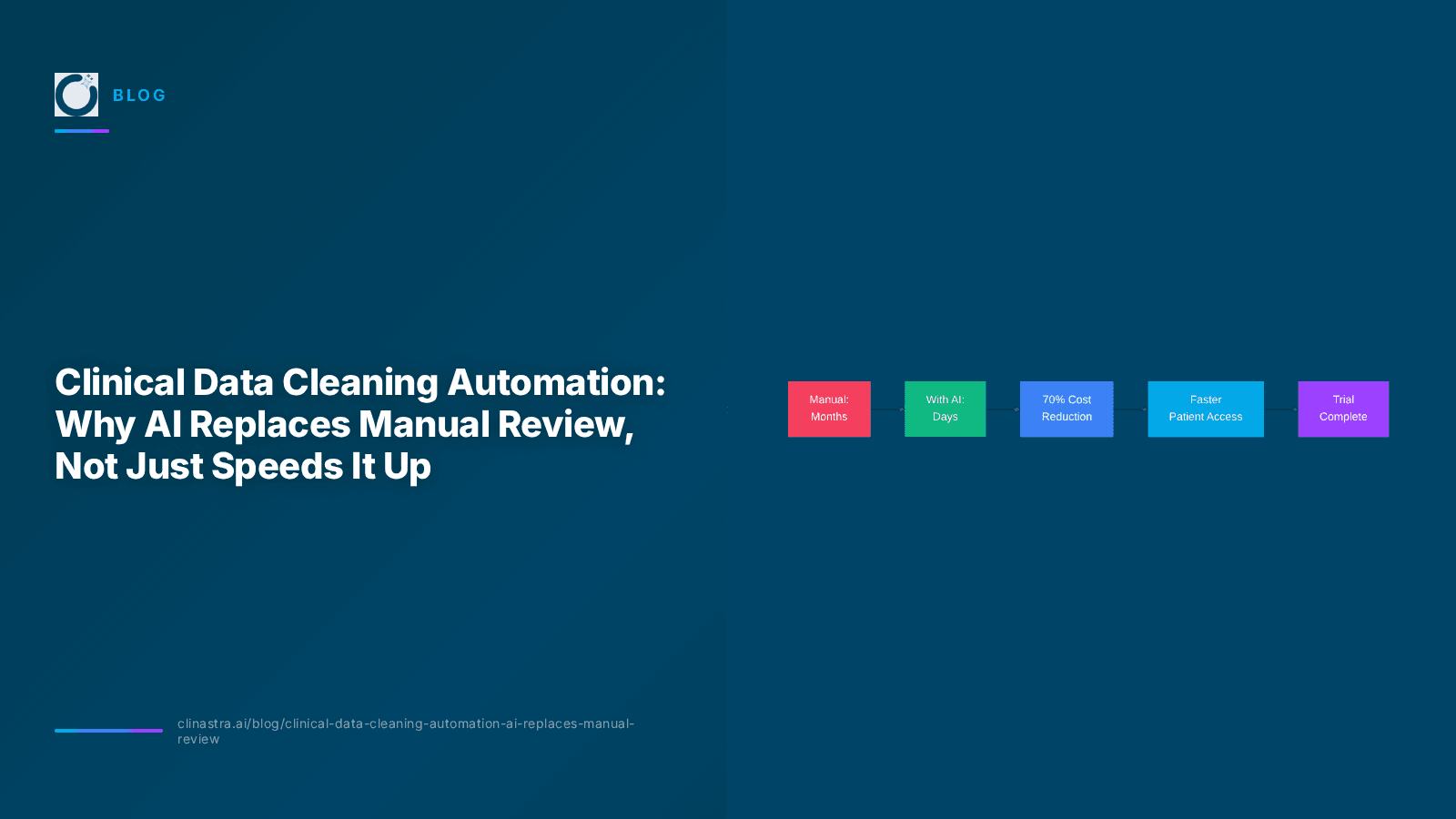
Manual clinical data cleaning is the bottleneck nobody questions. AI doesn't speed it up — it replaces it. From months to days with 99.9% accuracy and audit-ready traceability.