
Aug 16, 2026•3 min read
SDTM Dataset Review: Why Manual Checking Kills Timelines
Manual SDTM dataset review takes weeks. AI-assisted review takes hours. Here is how ClinAstra replaces pattern-matching with computation, with full audit trail.
Manual edit check configuration in clinical trials is the hidden bottleneck stalling timelines. Clinical data edit checks automation replaces weeks of human pattern-matching with AI-driven validation that runs in seconds — audit-ready by design.
Key Takeaways:
- Manual edit check configuration consumes 20–30% of a clinical data manager's time before the first patient is even enrolled — and the industry accepts this as normal.
- Clinical data edit checks automation compresses edit check design, validation, and execution from weeks to days using AI that learns protocol logic and flags anomalies with 99.9% accuracy.
- Edit checks are the first line of defense against dirty data, but manual configuration introduces its own errors — logic gaps, missed cross-form dependencies, and inconsistent query logic across studies.
- The real cost of manual edit checks isn't just reviewer hours. It's the weeks between database lock and submission, the queries that never get raised, and the patients who wait longer for therapy.
- Automation doesn't assist your data managers. It replaces the manual configuration work so your team reviews less and decides more.
Clinical trials don't stall because the science is hard. They stall because the data review process — starting with edit checks — is a manual relic that the industry has tolerated for two decades. Edit checks are the automated validation rules embedded in your eCRF that flag data entry errors before they propagate. They are the first line of defense against dirty data. And right now, building them is a human job that shouldn't be a human job anymore.
Consider what happens today. A data manager reads the protocol, identifies every data field that needs validation, writes logic for range checks, consistency checks, cross-form dependencies, and safety signal thresholds — then tests each rule against sample data, documents it for regulatory review, and repeats the process when the protocol amendments land. Manual mapping of data fields to SDTM standards alone increases statistical programming resources by approximately 20%, according to research published by SDC Clinical. That's before a single patient enrolls. The edit check configuration phase alone can consume weeks of a clinical data manager's time on a Phase III trial — and every protocol amendment resets the clock.
Clinical data edit checks automation replaces this manual grind with AI-driven validation that learns protocol logic, generates edit checks across your EDC system, and flags anomalies with 99.9% accuracy — audit-ready by design. The bottleneck isn't the science. It's the review. And the fix isn't faster humans. It's removing humans from the configuration work entirely.
Edit checks are small programs embedded in your eCRF that validate data as it's entered. They enforce the rules your protocol demands: range checks confirm a patient's age falls within eligibility criteria, logic checks prevent a male patient from having a pregnancy status, consistency checks verify that recorded BMI aligns with height and weight, and cross-visit checks catch longitudinal inconsistencies that no single-form validation can detect. When an edit check fires, it generates a query — a flag that tells the site to review and correct the data.
The problem isn't the checks themselves. It's how they're built.
Here's what manual edit check configuration looks like on a typical Phase III trial:
This process takes weeks. It introduces human error at every step — a missed cross-form dependency, an inconsistent severity assignment, a logic gap that lets a safety signal slip through. And it scales linearly with trial complexity, which is why timelines haven't improved in two decades. Data error rates range from 0.14% with rigorous double data entry to over 6% with manual methods, as documented in peer-reviewed literature. The edit checks are supposed to catch those errors. But when the checks themselves are built manually, the error rate compounds.
| Dimension | Manual Edit Check Configuration | AI-Driven Edit Check Automation |
|---|---|---|
| Configuration time (Phase III) | 3–6 weeks | 1–2 days |
| Edit check accuracy | Dependent on data manager experience; logic gaps common | 99.9% accuracy with traceable logic |
| Cross-form dependency detection | Manual — frequently missed | Automatic — learned from protocol and historical study data |
| Amendment response time | Days to weeks per amendment | Hours — logic regenerated automatically |
| Query false-positive rate | High — inconsistent severity logic | Low — learned from resolved query patterns |
| Audit readiness | Manual documentation, gap-prone | Audit-ready by design — every check traceable |
| Scalability | Linear with trial complexity | Constant — AI handles complexity at no marginal cost |
| Cost to sponsor | 20–30% of data manager FTE per study | One-time integration, marginal cost per study |
The ASPREE trial demonstrated what happens when validation moves upstream: real-time edit checks reduced data entry errors from 0.3% to 0.01% — a 30x improvement. That was with conventional EDC validation. Now imagine what AI-driven checks achieve when the logic itself is generated, tested, and documented without human bottleneck.
The industry has accepted manual edit check configuration as "just how it works" for 20 years. The reasoning goes: edit checks require clinical judgment, clinical judgment requires humans, therefore humans must configure edit checks. This logic is wrong, and it's costing patients.
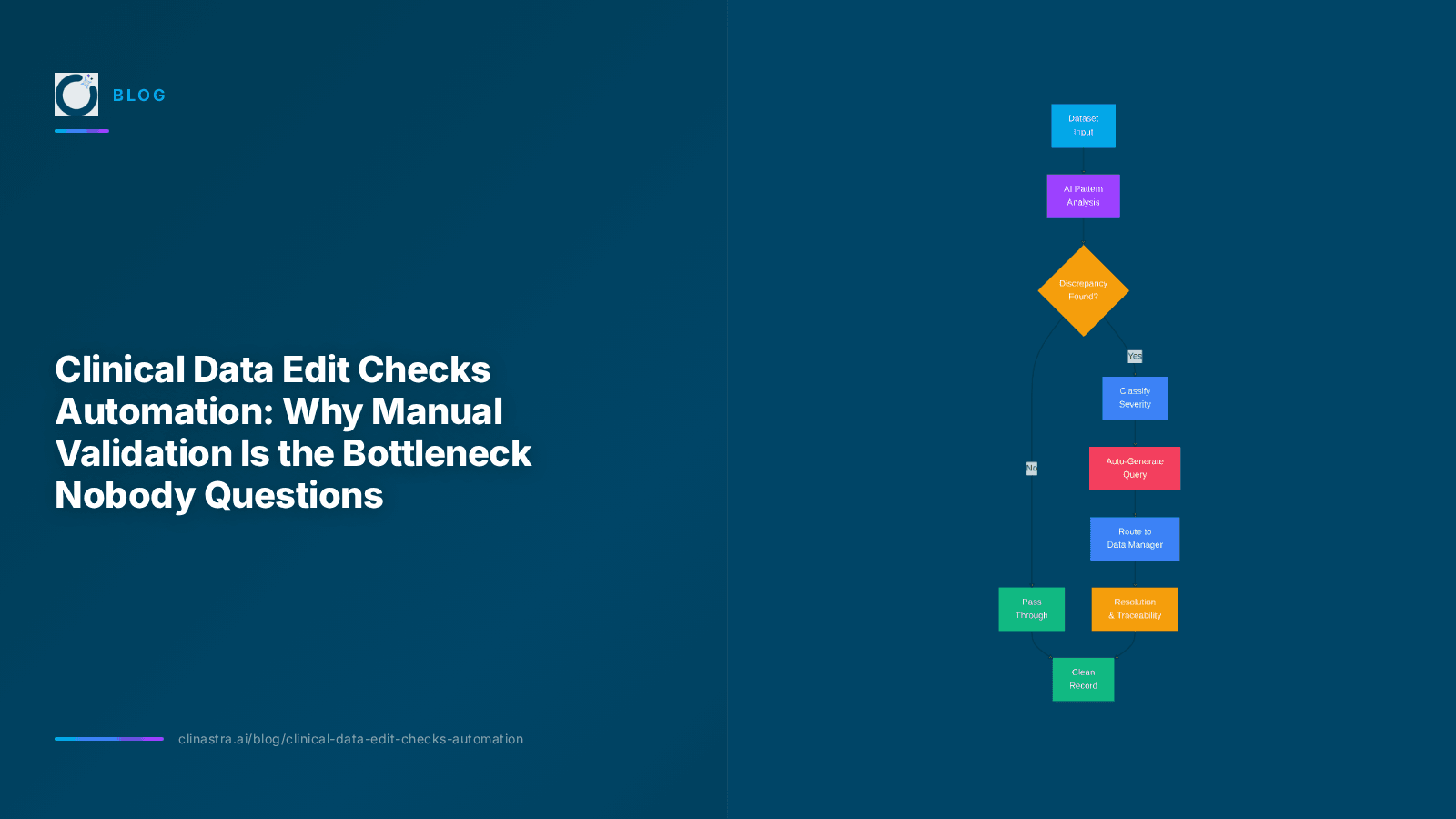
Here's what clinical data edit checks automation actually does: it learns the protocol logic the same way a data manager does — by reading the protocol, identifying fields requiring validation, and generating checks that enforce the rules. The difference is speed, consistency, and coverage. An AI doesn't miss a cross-form dependency because it's fatigued on a Friday afternoon. It doesn't assign inconsistent query severity across studies because it learned from a different protocol last month. It doesn't take three weeks to rebuild checks after a protocol amendment.
The TCS ADD white paper on simplifying edit check configuration found that NLP and generative AI can reduce configuration time from weeks to minutes or hours. That's not incremental improvement. That's a categorical shift — the same shift that happened when EDC replaced paper CRFs. The difference is that this shift eliminates the human from the configuration loop entirely.
The bottleneck isn't designing edit checks. It's the human hours between reading a protocol and having validated, tested, documented checks running in your EDC. Every hour in that gap is an hour a patient waits for therapy. Clinical data edit checks automation collapses that gap from weeks to days — not by helping your data manager work faster, but by removing the manual configuration work from their plate entirely.
Effective edit check automation isn't a single feature. It's a five-layer system that replaces the entire manual workflow:
The AI reads the protocol — eligibility criteria, visit schedule, safety thresholds, dosing rules — and extracts the validation logic. This is where domain expertise matters. A generic LLM doesn't know that a creatinine clearance range should adjust for pediatric vs. geriatric populations. ClinAstra was built by people who spent years inside clinical data management. The protocol logic extraction is clinically precise, not generic.
From the extracted logic, the system generates edit checks: range checks, logic checks, consistency checks, missing data checks, and cross-visit longitudinal checks. Each check includes the field, the condition, the error message, and the query severity — the same components a data manager would specify, generated in seconds instead of weeks.
ClinAstra doesn't rip out your EDC. It integrates with Veeva, Medidata, Oracle InForm, and other systems, pushing generated edit checks directly into the rule builder. Your EDC stays. Your data gets validated faster.
Edit checks catch what you defined. AI anomaly detection catches what you didn't. The system learns from historical study data and flags patterns that no pre-defined edit check would catch — a site with systematically elevated lab values, a patient whose visit dates don't align with the schedule, a safety signal that emerges across forms. This is the layer that turns edit checks from a defensive tool into a proactive data quality engine.
Every edit check, every anomaly flag, every generated query is traceable. The system documents the logic, the trigger, the resolution path, and the data source — audit-ready by design. When the FDA asks why a check was configured a certain way, the answer is a click away, not a search through three months of email threads.
For clinical operations leaders ready to move from manual configuration to AI-driven validation, here's the implementation path:
Before implementing clinical data edit checks automation, confirm your team has these elements in place:
The business case for clinical data edit checks automation is straightforward. A Phase III trial with 500–1,000 edit checks requires 3–6 weeks of data manager time for initial configuration, plus days per amendment. At a loaded cost of $150–200/hour for an experienced clinical data manager, that's $18,000–48,000 per study in configuration labor alone — before counting the opportunity cost of your PhDs doing manual logic specification instead of clinical decision-making.
But the real cost isn't labor. It's time. Tufts CSDD research consistently shows that clinical trials cost $2–4 billion per approved drug, and timelines haven't improved in two decades. Every week spent configuring edit checks manually is a week added to the timeline. Every week added to the timeline is a week patients wait for therapy.
The industry frames edit check configuration as a necessary evil — the price of data quality. That framing is backwards. Manual configuration is the enemy of data quality. It introduces logic gaps, misses cross-form dependencies, and produces inconsistent query severity across studies. AI-driven automation doesn't just save time. It improves the quality of the checks themselves — because a system that learns from every resolved query across your portfolio generates better checks than a data manager who starts fresh on every study.
Edit checks are automated validation rules embedded in electronic case report forms (eCRFs) that flag data entry errors in real time. They enforce protocol requirements — range checks, logic checks, consistency checks, and cross-visit validations — and generate queries when data violates a rule. They are the first line of defense against dirty data in clinical trials.
Automation uses AI to read the clinical trial protocol, extract the validation logic, generate edit checks, and integrate them directly into your EDC system. The AI learns from historical query resolution data to refine check accuracy and reduce false positives. The result: edit checks that would take a data manager 3–6 weeks to configure manually are generated, tested, and documented in 1–2 days.
Yes. The logic that a data manager applies when reading a protocol and writing edit check specifications is pattern-based — identify the field, define the condition, set the error message, assign severity. AI performs this pattern-matching faster, more consistently, and with broader coverage than manual configuration. Clinical data edit checks automation replaces the configuration work so data managers focus on reviewing flagged anomalies and making clinical decisions, not writing validation logic.
ClinAstra integrates with major EDC systems including Veeva, Medidata, and Oracle InForm. It pushes generated edit checks directly into your EDC rule builder — no rip-and-replace. Your EDC stays. Your data gets validated faster. This is integration, not replacement.
ClinAstra generates edit checks with 99.9% accuracy, with every check fully traceable — the logic, the trigger, the resolution path, and the data source are documented for regulatory audit. The system learns from resolved query data across your portfolio, so check accuracy improves with every study.
Protocol amendments trigger a re-generation cycle. The AI reads the amendment, identifies affected edit checks, regenerates the logic, and pushes updated checks to your EDC — in hours, not the days or weeks manual reconfiguration requires. Every change is documented for audit.
Manual edit check configuration is the bottleneck hiding in plain sight. The industry has accepted it for 20 years because no one questioned whether building validation rules was actually a human job. It isn't anymore. Clinical data edit checks automation replaces weeks of manual pattern-matching with AI-driven validation that runs in days — with 99.9% accuracy, full traceability, and zero logic gaps.
The question isn't whether you can afford to automate edit checks. The question is whether you can afford to keep paying for manual configuration in weeks of data manager time, delayed database locks, and patients waiting longer for therapy. Every day saved in the review cycle is a day a patient waits less. From months to days. That's not a marketing claim. That's the operational reality of removing the human bottleneck from edit check configuration.
Built in the trenches, not the ivory tower. ClinAstra was built by a clinical data manager who lived the manual configuration grind and an AI engineer who saw the computation problem hiding inside it. The result is a system that doesn't assist your data managers — it replaces the manual work that shouldn't have been their job in the first place.
See how ClinAstra automates edit checks from protocol to validated EDC rules in days. Book a demo →
Co-founder & Clinical Data Expert, ClinAstra
Spent years inside clinical data management living the manual review grind. Built ClinAstra to replace it — not assist it. 99.9% accuracy, audit-ready by design.
Request a DemoManual SDTM dataset review takes weeks. AI-assisted review takes hours. Here is how ClinAstra replaces pattern-matching with computation, with full audit trail.
The clinical data review tools market splits into AI-bolted-on assistants and AI-native replacements. Only AI-native tools deliver months-to-days timelines. Here is how to evaluate them.
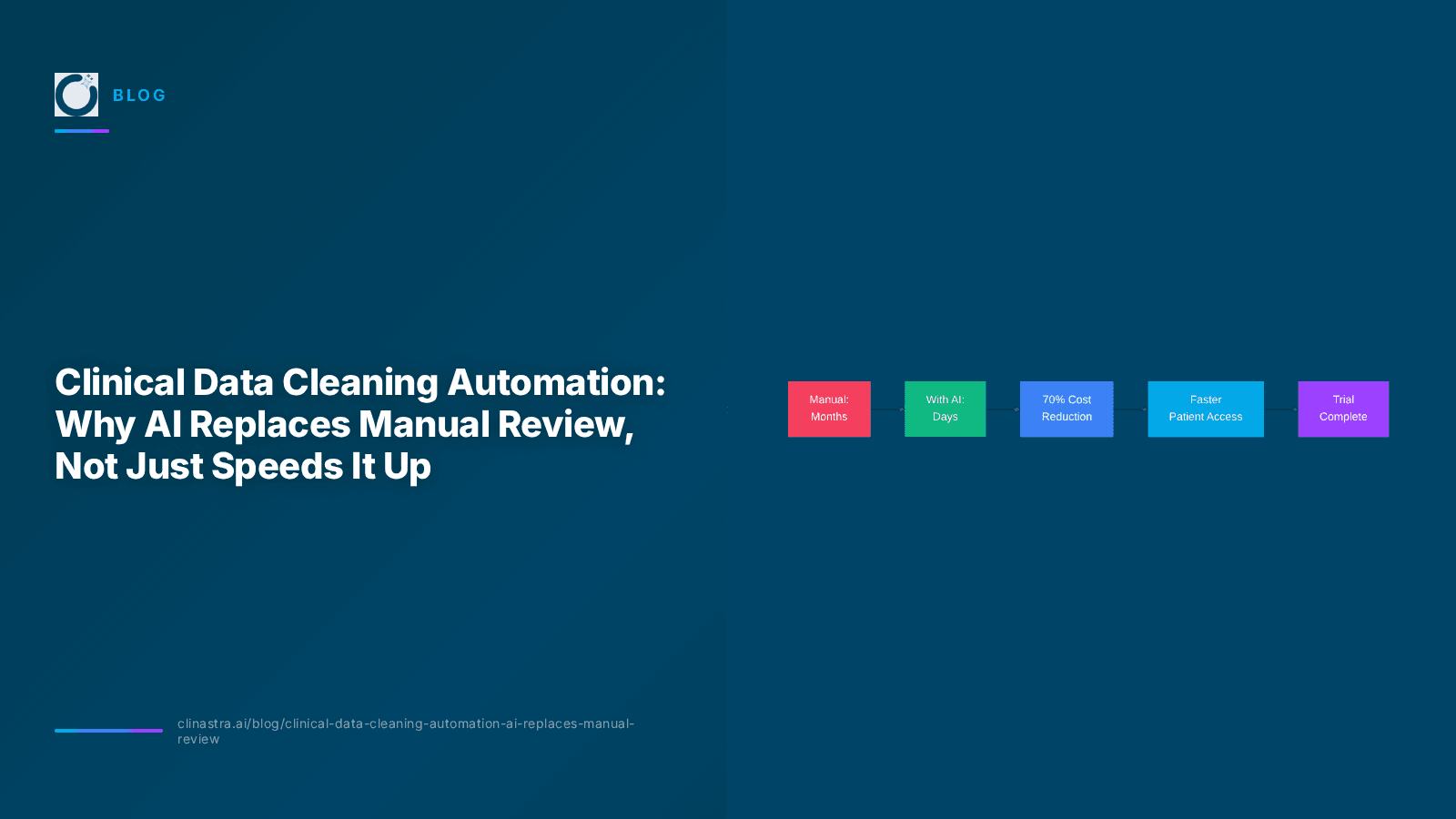
Manual clinical data cleaning is the bottleneck nobody questions. AI doesn't speed it up — it replaces it. From months to days with 99.9% accuracy and audit-ready traceability.