
Aug 16, 2026•3 min read
SDTM Dataset Review: Why Manual Checking Kills Timelines
Manual SDTM dataset review takes weeks. AI-assisted review takes hours. Here is how ClinAstra replaces pattern-matching with computation, with full audit trail.
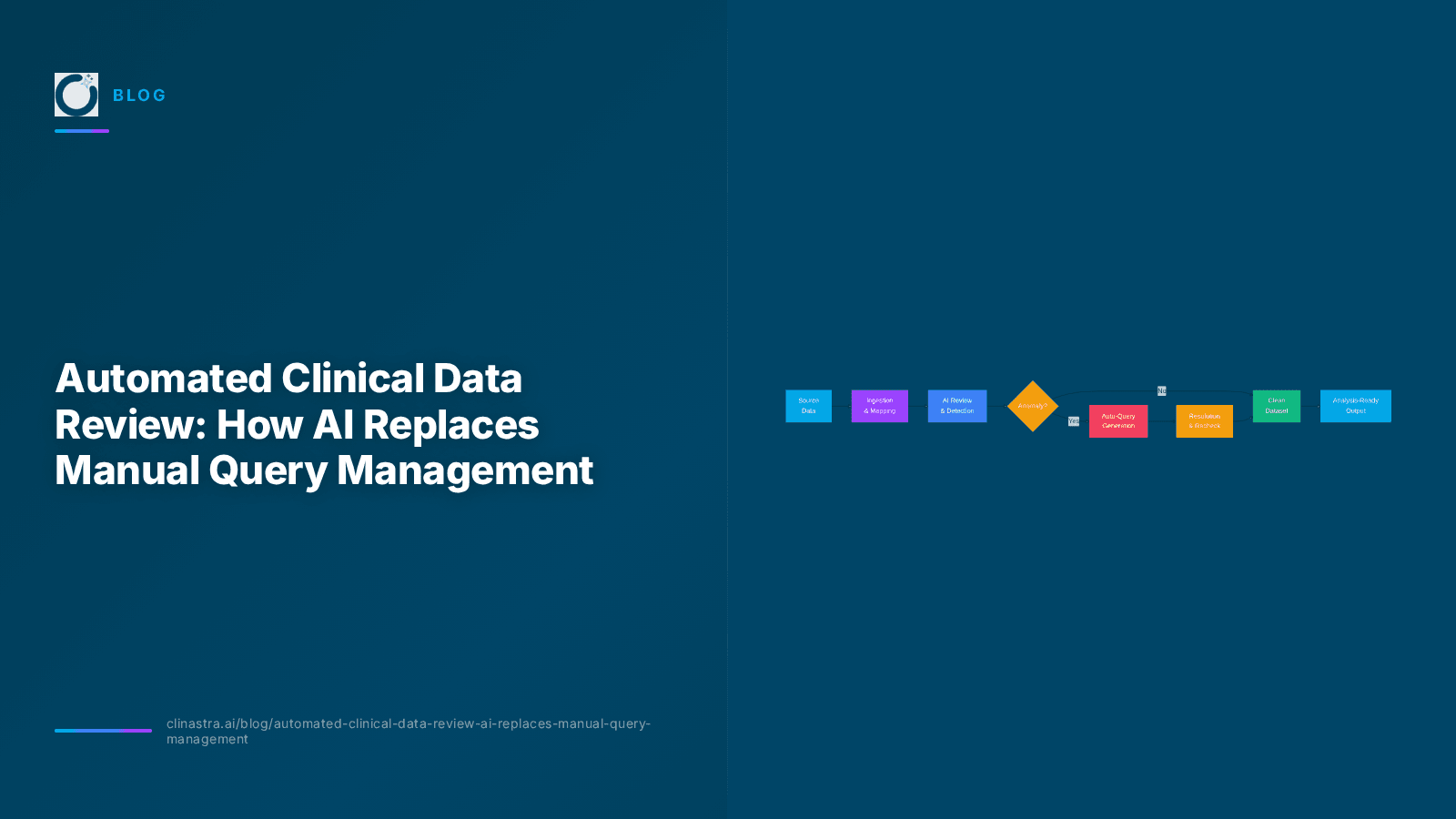
Automated clinical data review replaces manual query generation, lab reconciliation, and SDTM validation with AI-native processes delivering 99.9% accuracy and audit-ready traceability. From months to days.
Key Takeaways:
- The average clinical trial generates 21,104 queries — 36% of which are manual, costing roughly €150 per query. Automated clinical data review eliminates that cost floor.
- Manual data review consumes 70–80% of a clinical data manager's time. AI-native review compresses that to minutes while delivering 99.9% anomaly detection accuracy.
- Automated review integrates with your existing EDC and CDMS (Veeva, Medidata) — it does not rip out your stack. It sits on top and makes it 100x faster.
- Audit-ready traceability is built into every flag, every query, and every reconciliation check. No black boxes. No "trust us."
- Every day shaved off a trial timeline is a day a patient waits less for therapy. Speed isn't a metric — it's a moral imperative.
Clinical trials don't fail because the science is wrong. They stall because data review is a manual relic — a 20-year-old process built on spreadsheets, static listings, and human pattern-matching that an AI can do in seconds. The industry accepted this bottleneck as "just how it works." ClinAstra exists to retire it.
Here is the number nobody wants to talk about: a single clinical trial requires an average of 21,104 queries, of which approximately 7,560 (36%) are manual, at an operational cost of roughly €150 per manual query. That is over €1.1 million in manual query resolution alone — per trial — spent on work that machines now do better. Worse, one in four regulatory applications must be resubmitted, and a preliminary refusal adds a median of 435 days to the approval timeline. The bottleneck is not discovery. It is not protocol design. It is data review.
Automated clinical data review replaces manual query generation, discrepancy detection, lab reconciliation, and anomaly flagging with AI-native processes that deliver 99.9% accuracy, traceable audit trails, and timelines compressed from months to days. This is not an assistant that helps humans review faster. This is a replacement for the manual review workflow itself — built by people who spent years inside the clinical data management grind, not by a GPT wrapper that doesn't know what an SDTM dataset is.
Manual data review is the single largest operational bottleneck in clinical development. It is not a process problem. It is a category problem. You cannot optimize your way out of a workflow that was never designed to handle modern trial data volumes.
Today's trials pull data from EDC systems, ePRO and eCOA tools, central labs, biomarker assays, imaging, wearables, and electronic medical records. The volume and velocity of this data exceed what any human reviewer can process in real time. By the time a manual reviewer identifies a discrepancy in a static listing, the study has already moved on. The query is stale before it is raised.
The economics of manual review are indefensible. Consider the math:
That figure does not include the opportunity cost of PhD-level data managers spending 70–80% of their time on pattern-matching tasks instead of scientific decisions. It does not include the cost of trial delays caused by review backlogs. It does not include the human cost — reviewer burnout, turnover, and the institutional knowledge that walks out the door when a data manager quits.
"Manual data review is not slow because humans are bad at it. It is slow because the task — cross-referencing SDTM domains, identifying anomalies across labs and adverse events, reconciling third-party data — is a computation problem disguised as a human workflow. We built ClinAstra because we lived this problem. The solution was never a better spreadsheet. It was a different approach entirely." — Karthik Nadakuditi, Co-Founder, ClinAstra
The failure modes of manual review are predictable and well-documented:
Automated clinical data review is not "edit checks with a chatbot." It is a fundamentally different architecture: AI-native review that ingests trial data in real time, applies domain-specific anomaly detection algorithms across SDTM and ADaM datasets, generates traceable queries, and flags discrepancies with 99.9% accuracy — all within your existing EDC and CDMS stack.
Manual review looks at one domain at a time. ClinAstra looks at all of them simultaneously. A lab value that is clinically implausible given the subject's adverse event history, concomitant medications, and protocol deviations is flagged instantly — not after three separate reviewers happen to compare notes.
The system applies statistical surveillance across continuous variables (lab trends, vital signs), categorical consistency checks (medication coding vs. adverse event coding), and temporal logic (dose changes that precede safety signals). Every flag comes with a traceable explanation: which domains were compared, what threshold was breached, and why the query was raised.
When ClinAstra detects a discrepancy, it does not just flag it. It generates a structured query — with the right severity, the right routing, and the right context — and sends it to the site or data manager through your existing query management workflow. Queries are traceable from detection to resolution. No manual query drafting. No inconsistent severity assignments. No queries lost in email threads.
Lab reconciliation is one of the most time-consuming manual tasks in clinical data management. Matching central lab results to EDC entries, reconciling local lab data, and identifying missing or mismatched records across vendors is a deterministic problem that AI solves in minutes. ClinAstra cross-references lab datasets against EDC records, flags mismatches, and generates reconciliation reports — audit-ready by design.
Before a dataset reaches a regulatory submission, it must conform to CDISC standards. Manual SDTM validation is tedious, error-prone, and bottlenecked by reviewer availability. ClinAstra validates SDTM and ADaM datasets against CDISC conformance rules, identifies structural and content issues, and generates a traceable validation report. This is not a replacement for your CDISC validator — it is a layer that catches issues before they reach that stage.
| Dimension | Manual Review | Automated Review (ClinAstra) |
|---|---|---|
| Query volume handled | ~7,560 manual queries per trial | All queries auto-generated and routed |
| Cost per manual query | ~€150 per query | €0 — AI-generated, traceable |
| Anomaly detection accuracy | Variable (85–92%, reviewer-dependent) | 99.9% — consistent, algorithmic |
| Cross-domain analysis | Sequential, domain-by-domain | Simultaneous, all domains at once |
| Review latency | Days to weeks (batch listings) | Seconds (real-time ingestion) |
| Audit trail | Email threads, spreadsheets, memory | Every flag traceable, regulatory-ready |
| Reviewer time allocation | 70–80% on data entry / pattern-matching | Reviewers focus on scientific decisions |
| Scalability | Linear with headcount | Scales with compute — no headcount cap |
| Consistency | Two reviewers = two different queries | Same input = same output, every time |
| Integration | Manual exports from EDC, labs, vendors | Sits on top of EDC/CDMS — no rip-and-replace |
The most common objection to automated clinical data review is not "does it work?" — it is "can I trust it with my trial data?" The answer is yes, and the reason is traceability.
Generic AI cannot be trusted with clinical data because it cannot explain its reasoning. A GPT wrapper that flags an anomaly without showing which domains it compared, what threshold it applied, or why the query was raised is a black box. Regulatory inspectors reject black boxes. Clinical operations leaders should too.
ClinAstra's 99.9% accuracy is not a marketing number. It is a commitment backed by methodology:
"Trust in clinical AI is not earned with claims. It is earned with receipts. If we flag an anomaly, we show why. If we generate a query, it is traceable. No black boxes. No 'trust us.' Audit-ready by design." — ClinAstra
Implementing automated review is not a rip-and-replace project. ClinAstra integrates with your existing EDC and CDMS stack. Here is the implementation path:
ClinAstra is not a competitor to your EDC or clinical data platform. It is the layer that makes them faster. Veeva, Medidata, and other EDC systems are excellent at capturing data. They were not designed to review it at the speed and depth modern trials require.
ClinAstra sits on top of your existing stack:
The promise is simple: your stack stays. Your review process transforms. From months to days.
Speed is not just a business metric. It is an ethical one.
According to Tufts CSDD, the average clinical trial takes 7.5 years from first-in-human to submission. Data review accounts for a disproportionate share of that timeline — not because the science requires it, but because the process is manual. Every week spent on manual query resolution is a week patients wait for therapy.
The financial cost is staggering. A 2024 McKinsey analysis estimated that each day of delay in a Phase III trial costs sponsors between $600,000 and $8 million in lost revenue, depending on the therapeutic area. But the human cost is worse. For a patient with a progressive disease, a 435-day regulatory resubmission delay — the median for applications that require rework — is not a line item. It is a decline in quality of life. It is a prognosis that worsens. In some cases, it is a life that ends before the therapy arrives.
Every day saved is a day a patient waits less. That is not a tagline. It is the reason automated clinical data review exists. When you compress data review from months to days, you are not optimizing a process. You are accelerating access to therapy for people who do not have time to wait.
If you are a Director, VP, or Head of Clinical Operations, here is what you can do this week:
Automated clinical data review uses AI-native algorithms to detect anomalies, generate queries, reconcile lab data, and validate SDTM/ADaM datasets in real time — replacing manual review tasks with traceable, audit-ready processes. It integrates with your existing EDC and CDMS; it does not replace them.
Yes — for the tasks that constitute 70–80% of manual review time: query generation, discrepancy detection, lab reconciliation, and SDTM validation. ClinAstra delivers 99.9% anomaly detection accuracy with full traceability. Human reviewers transition from data pattern-matching to scientific decision-making. Review less. Decide more.
ClinAstra ingests data from your EDC via API in real time — no manual exports or batch processing. It sits on top of your existing stack and routes queries through your current query management workflow. Sites see no new interface. Your EDC stays. Your review process transforms.
ClinAstra is audit-ready by design. Every flag, query, and reconciliation check includes a traceable audit trail: which domains were compared, what threshold was triggered, who confirmed the query, and when. Regulatory inspectors can follow the trail from detection to resolution. No black boxes.
Manual review costs approximately €150 per manual query, with 7,560 manual queries per average trial — over €1.1 million per trial. Automated review eliminates the per-query cost and reduces operational costs by up to 70%. The ROI is immediate and quantifiable.
ClinAstra is human-in-the-loop by design. Every flag is reviewed by a data manager before action. False positives are tracked, fed back into the model, and reduced over successive review cycles. The 99.9% accuracy rate reflects continuous improvement — not a static benchmark.
Data review is not a human job anymore. The industry has known this for years. What was missing was a solution built by people who lived the problem — not a GPT wrapper, not a generic AI bolted onto a legacy system, but an AI-native review layer purpose-built for clinical data management.
ClinAstra was founded by Karthik Nadakuditi, a clinical data manager who spent his career inside the manual review grind, and Mohan Praneeth, an AI engineer who looked at clinical data review and saw a computation problem hiding inside a human workflow. The person who knew the pain and the person who knew the solution were in the same room. That is when ClinAstra was born.
The question is not whether automated clinical data review will become the standard. It will. The question is whether your trial will be the one that benefits from it — or the one that competes against a competitor who adopted it first.
From months to days. Audit-ready by design. Built in the trenches, not the ivory tower.
Request a parallel validation run on your active trial →
Learn more about how ClinAstra replaces manual clinical data review with AI-native automation:
Co-founder & Clinical Data Expert, ClinAstra
Spent years inside clinical data management living the manual review grind. Built ClinAstra to replace it — not assist it. 99.9% accuracy, audit-ready by design.
Request a DemoManual SDTM dataset review takes weeks. AI-assisted review takes hours. Here is how ClinAstra replaces pattern-matching with computation, with full audit trail.
The clinical data review tools market splits into AI-bolted-on assistants and AI-native replacements. Only AI-native tools deliver months-to-days timelines. Here is how to evaluate them.
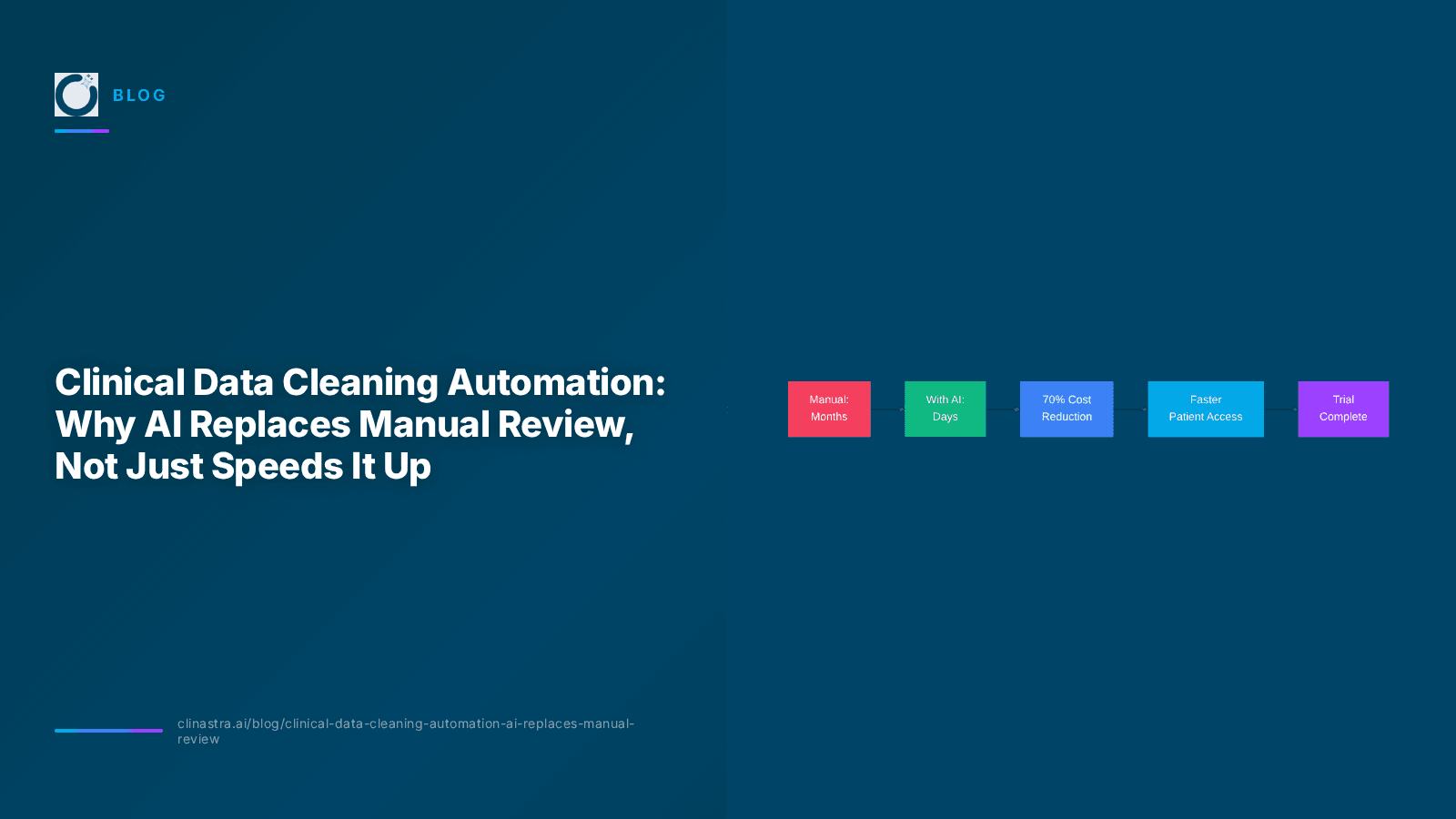
Manual clinical data cleaning is the bottleneck nobody questions. AI doesn't speed it up — it replaces it. From months to days with 99.9% accuracy and audit-ready traceability.