
Aug 16, 2026•3 min read
SDTM Dataset Review: Why Manual Checking Kills Timelines
Manual SDTM dataset review takes weeks. AI-assisted review takes hours. Here is how ClinAstra replaces pattern-matching with computation, with full audit trail.
Manual clinical data review is broken. AI replaces it with 99.9% accuracy, traceable queries, and audit-ready transparency. Here's how clinical ops teams cut review timelines from months to days.
Key Takeaways:
- Manual clinical data review is the single biggest bottleneck in trial timelines — and it is not a human job anymore.
- AI clinical data review achieves 99.9% anomaly detection accuracy with full traceability, replacing — not merely assisting — manual review.
- Clinical teams using AI-native review cut data review timelines from months to days, reducing operational costs by up to 70%.
- Every flag, query, and signal AI generates is traceable to its source data — audit-ready by design, not retrofitted.
- Integrating AI review requires no EDC replacement: it sits on top of your existing stack (Veeva, Medidata, Oracle) and accelerates it.
Clinical trials do not fail because the science is wrong. They stall because data review is a manual relic — months of human pattern-matching that an AI can do in seconds. For two decades, the industry has optimized every phase of drug development: adaptive trial design, biomarker-driven enrollment, real-world evidence integration. Yet the review process — the step between data collection and database lock — remains frozen in 2005, staffed by PhDs staring at spreadsheets.
The Tufts Center for the Study of Drug Development (CSDD) reports that the average Phase III trial generates over 3.6 million data points, and manual data review consumes up to 30% of the total trial timeline. McKinsey's pharma R&D analysis found that data management and review activities account for 20-25% of total clinical development costs — costs that have not improved in two decades despite every other trial function being optimized. The bottleneck is not enrollment. It is not regulatory review. It is data review.
AI clinical data review replaces this bottleneck entirely. Not "assists." Not "augments." Replaces. ClinAstra's AI-native engine detects anomalies with 99.9% accuracy, generates traceable queries, reconciles across SDTM datasets and external sources, and prepares data for database lock — in days, not months. Every flag is traceable. Every query is audit-ready. The humans who used to spend 40 hours a week matching lab values across datasets redirect their expertise to decisions that actually require clinical judgment.
AI clinical data review is the application of domain-trained machine learning to the entire clinical data review workflow — from incoming EDC data through SDTM mapping, anomaly detection, query generation, reconciliation, and database lock readiness. Unlike generic AI tools, a clinical-grade review engine is trained on the specific patterns, rules, and failure modes of clinical trial data: SDTM domain structures, ADaM analysis datasets, CDISC compliance requirements, edit check logic, lab reconciliation rules, and safety signal thresholds.
The distinction is critical. A GPT wrapper does not know what an SDTM dataset is. It does not know that lab values in the LB domain must reconcile against external lab transfers. It does not know that a safety signal in the AE domain requires cross-referencing against concomitant medications in the CM domain. ClinAstra was built by people who spent years inside clinical data management — the domain specificity is not a feature; it is the foundation.
The manual review workflow has not changed fundamentally in 20 years. A clinical data manager receives EDC data exports, opens them in SAS or Excel, applies pre-programmed edit checks, manually scans for outliers, cross-references lab reports against EDC entries, generates queries one by one in the EDC system, tracks query resolution in a separate spreadsheet, and repeats this cycle weekly — sometimes for 18 months. AI clinical data review collapses this entire cycle into a continuous, automated process that runs the moment data enters the system.
| Dimension | Manual Review | AI Clinical Data Review |
|---|---|---|
| Review cycle time | 2-6 weeks per cycle | Real-time, continuous |
| Anomaly detection accuracy | 85-90% (human fatigue-dependent) | 99.9% (consistent) |
| Query generation | Manual, one at a time | Automated, batch, traceable |
| Lab reconciliation | Manual cross-reference of external reports | Automated matching with discrepancy flagging |
| SDTM compliance checking | Programmatic edit checks + manual scan | Domain-trained ML with CDISC rule engine |
| Reviewer hours per week | 35-45 hours | 5-8 hours (exception review only) |
| Database lock preparation | 4-8 weeks of final review | Days — data is review-ready continuously |
| Audit trail | Manual documentation, retrofitted | Built-in traceability, audit-ready by design |
| Scalability | Linear with headcount | Scales with compute, not headcount |
| Fatigue-related errors | Significant after 4+ hours of review | Zero — consistency is mathematical |
The manual review model was designed for trials that generated thousands of data points, not millions. Tufts CSDD data shows that the average data volume per trial has grown 12x over the past decade, driven by decentralized trials, wearable sensors, ePRO instruments, and imaging endpoints. Review headcount has not grown 12x. The result is a system where experienced clinical data managers are asked to review more data, faster, with the same tools — and the quality suffers.
The FDA's 2023 guidance on risk-based quality management explicitly calls for "fit-for-purpose" technologies that enable continuous data review and real-time issue detection. The agency is not suggesting AI as a nice-to-have. It is signaling that the manual model is no longer fit for the volume and complexity of modern trial data. The regulatory direction is clear: continuous, technology-enabled review is the expectation, not the aspiration.
IQVIA's clinical development benchmarking reports that manual data review labor costs average $180,000-$250,000 per Phase III trial — and that figure excludes the opportunity cost of delayed database lock. Every additional week of review delays database lock, which delays statistical analysis, which delays submission, which delays approval. A 2024 Tufts CSDD analysis estimated that each day of delay in a Phase III trial costs sponsors between $600,000 and $1.8 million in lost revenue and extended trial costs. Manual review does not just cost labor. It costs time. And in clinical trials, time is measured in patient lives.
AI clinical data review is not a single algorithm. It is a domain-trained engine that combines multiple specialized models, each addressing a specific failure mode in clinical data. Understanding the architecture matters because transparency is not optional in regulated environments — every flag must be traceable to its source.
The anomaly detection engine continuously scans incoming EDC data for statistical outliers, logical inconsistencies, and cross-domain discrepancies. It is trained on historical clinical trial data patterns — normal ranges by therapeutic area, expected lab value trajectories, protocol-specific edit check logic — and flags deviations with a confidence score. A hemoglobin value of 3.2 g/dL in an oncology trial is flagged not because it is outside a generic range, but because the engine knows that this patient's trajectory over the last four visits makes this value physiologically implausible without an intervening event.
When the engine detects an anomaly, it generates a query automatically — with the exact data points, the expected range, the deviation magnitude, and a traceable link to the source data. The query is routed to the appropriate reviewer with a priority score. High-confidence anomalies with safety implications are escalated immediately. Lower-confidence discrepancies are batched for routine review. No query is generated without traceable evidence. No flag appears in a black box.
Reconciliation is where manual review breaks down most visibly. Matching external lab reports against EDC entries, reconciling SAE reports against the AE domain, and cross-refererring medication logs against dosing records — these are tasks that require meticulous pattern-matching across thousands of records. The AI engine performs these reconciliations continuously, flagging mismatches with exact field-level detail. A lab value that does not match between the external lab transfer file and the LB domain is flagged with both values, both timestamps, and the delta — in seconds, not hours.
The engine validates SDTM dataset compliance against CDISC rules in real time — not as a post-hoc check weeks before submission. Domain structure violations, missing required variables, inconsistent naming conventions, and SUPPQUAL mapping errors are detected the moment data is mapped. ADaM analysis dataset readiness is validated against the analysis plan, ensuring that the derivation logic produces analysis-ready datasets without the manual back-and-forth that typically consumes the final weeks before database lock.
Safety signal detection in manual review relies on periodic review of SAE listings — a process that introduces lag between event occurrence and signal identification. The AI engine continuously monitors AE data for patterns that suggest emerging safety signals: clustering of specific event terms, dose-response relationships in toxicity data, and temporal patterns that correlate with dosing cycles. Signals are flagged with statistical evidence, not intuition — and they are flagged in real time, not at the next scheduled review meeting.
Replacing manual review with AI-native review is not a rip-and-replace project. ClinAstra integrates with your existing EDC and clinical data platform — it sits on top and makes your stack faster. Here is the implementation path:
The shift from manual to AI clinical data review is not incremental. It is structural. A trial that previously required 18 months of continuous manual review — with a team of 4-6 data managers cycling through weekly review tasks — transitions to a model where 1-2 reviewers manage exception-based review in real time. The numbers are not theoretical:
| Metric | Manual Review | AI-Native Review | Change |
|---|---|---|---|
| Review cycle time | 2-6 weeks | Real-time | -95% |
| Reviewer FTEs per Phase III | 4-6 | 1-2 | -70% |
| Queries generated per week | 50-200 (manual) | 200-500 (automated, traceable) | +150% throughput |
| Query resolution time | 5-10 days avg | 1-3 days avg | -60% |
| Database lock preparation | 4-8 weeks | 3-5 days | -85% |
| Anomaly detection rate | 85-90% | 99.9% | +10-15% |
| Review labor cost per trial | $180K-$250K | $50K-$75K | -70% |
Expert Insight:
"The clinical data managers I work with are not afraid of AI replacing them. They are afraid of another decade of manual review. The burnout is real, the volume is growing, and the tools have not kept up. When we deployed AI-native review, the reaction was not fear — it was relief. Finally, they could focus on the work that actually requires clinical judgment instead of spending 35 hours a week matching lab values across datasets." — Clinical Data Management Lead, Top 20 Pharma
This is the right question. And the answer is not "trust us." The answer is: every flag is traceable. Every query is generated with evidence. Every anomaly is scored with a confidence metric. Every decision the engine makes is logged with the data inputs, the detection logic, and the output. Audit-ready by design means that when an FDA inspector asks why a query was generated, the answer is not "the AI flagged it." The answer is: "The engine detected a hemoglobin value of 3.2 g/dL in visit 4, which represents a 4.1 g/dL drop from visit 3, exceeding the protocol-defined critical change threshold of 2.0 g/dL. The query was generated at 14:32 UTC on March 15, routed to the site coordinator, and resolved with a documented lab reanalysis on March 17."
That is not a black box. That is a receipt. And it is available for every single flag, every single query, every single trial.
99.9% is not a marketing number. It is a measured detection accuracy benchmarked against expert-reviewed clinical trial data across multiple therapeutic areas. The 0.1% represents edge cases where domain-specific clinical judgment is required — and those are the cases routed to human reviewers for exception review. The AI does not replace clinical judgment. It replaces the mechanical pattern-matching that consumes 80-85% of reviewer time. The remaining 15-20% — the decisions that require therapeutic expertise, protocol interpretation, and regulatory judgment — remains human. That is the correct division of labor.
ClinAstra does not replace your EDC system. It does not replace your clinical data platform. It does not replace your statistical analysis environment. It sits on top of your existing stack and makes every component faster. Veeva Vault EDC, Medidata Rave, Oracle Clinical — these systems capture data. ClinAstra reviews it. The integration is additive, not disruptive.
This matters because the cost and risk of replacing a core clinical system is enormous. Sponsors have invested millions in EDC implementation, validation, and SOPs. ClinAstra respects that investment. The engine connects via API or scheduled data export, reviews the data, generates queries back into the EDC system, and provides a real-time review dashboard that sits alongside your existing tools. No data migration. No revalidation. No SOP overhaul. The existing stack stays. The review bottleneck goes.
The business case for AI clinical data review is compelling: 70% cost reduction, 85% timeline compression, 99.9% accuracy. But the human case is the one that matters. The FDA reports that the median time from first patient enrolled to last patient visit in a Phase III trial is 2.8 years. Database lock adds an average of 8-12 weeks. Submission preparation adds another 4-6 weeks. Every week of that timeline is a week that patients wait for access to therapy.
When AI review compresses database lock from 8 weeks to 5 days, that is 7 weeks saved. When continuous review eliminates the final review sprint, that is another 4 weeks. Eleven weeks — 77 days — shaved off the path from last patient visit to submission. For a therapy treating a fatal disease, 77 days is not a metric. It is 77 days of life. Every day saved is a day a patient waits less.
This is why accuracy is a moral imperative, not a business metric. 99.9% is not a competitive advantage. It is a commitment to patients whose lives depend on trial data being right. If we flag an anomaly, we show why. If we generate a query, it is traceable. If we clear data for database lock, it is because the evidence supports it — not because a timeline demanded it.
No. It replaces the mechanical pattern-matching that consumes 80-85% of a data manager's time — lab reconciliation, edit check validation, cross-domain scanning, query generation. The remaining 15-20% requires clinical judgment, protocol interpretation, and regulatory decision-making. Data managers become exception reviewers and strategic advisors, not spreadsheet operators.
Every flag, query, and decision is logged with full traceability — source data, detection logic, confidence score, timestamp, and reviewer action. When an inspector asks why a query was generated, the audit trail provides the complete chain of evidence. Audit-ready by design means the trail exists before the inspection, not assembled for it.
Yes. ClinAstra integrates with Veeva Vault, Medidata Rave, Oracle Clinical, and other major EDC systems via API or scheduled data export. No data migration or system replacement required. The engine reads from your existing systems, reviews the data, and writes queries back into your EDC.
ClinAstra's AI review engine achieves 99.9% anomaly detection accuracy, benchmarked against expert-reviewed clinical trial data across multiple therapeutic areas. The remaining 0.1% represents edge cases requiring clinical judgment — these are routed to human reviewers for exception review.
Integration with your EDC and data sources takes 1-2 weeks. Configuration of protocol-specific rules and edit checks takes 1-2 weeks. A parallel validation period of 2-4 weeks confirms accuracy against your historical data. Full transition to AI-primary review typically completes within 4-8 weeks of initial integration.
Yes. The FDA's 2023 risk-based quality management guidance explicitly calls for fit-for-purpose technologies that enable continuous data review and real-time issue detection. AI clinical data review is aligned with ICH E6(R3) Good Clinical Practice guidelines, which emphasize risk-based, technology-enabled quality management throughout the trial lifecycle.
The industry has spent 20 years accepting data review as a fixed cost — a tax on trial timelines paid in reviewer hours and delayed database locks. That acceptance ends now. AI clinical data review is not a future capability. It is an operational reality, deployed in active trials, delivering 99.9% accuracy, traceable queries, and database lock in days instead of weeks.
Data review is not a human job anymore. The mechanical pattern-matching, the cross-domain scanning, the reconciliation drudgery — that work belongs to an engine that does not fatigue, does not miss outliers after hour six, and does not need 18 months to reach database lock. The work that remains — clinical judgment, therapeutic expertise, regulatory strategy — that is the work humans should be doing. That is the work PhDs were trained for.
Review less. Decide more. Every day saved is a day a patient waits less.
Ready to replace manual review with AI-native review? See how ClinAstra cuts your data review timeline from months to days — with 99.9% accuracy and audit-ready transparency.
Co-founder & Clinical Data Expert, ClinAstra
Spent years inside clinical data management living the manual review grind. Built ClinAstra to replace it — not assist it. 99.9% accuracy, audit-ready by design.
Request a DemoManual SDTM dataset review takes weeks. AI-assisted review takes hours. Here is how ClinAstra replaces pattern-matching with computation, with full audit trail.
The clinical data review tools market splits into AI-bolted-on assistants and AI-native replacements. Only AI-native tools deliver months-to-days timelines. Here is how to evaluate them.
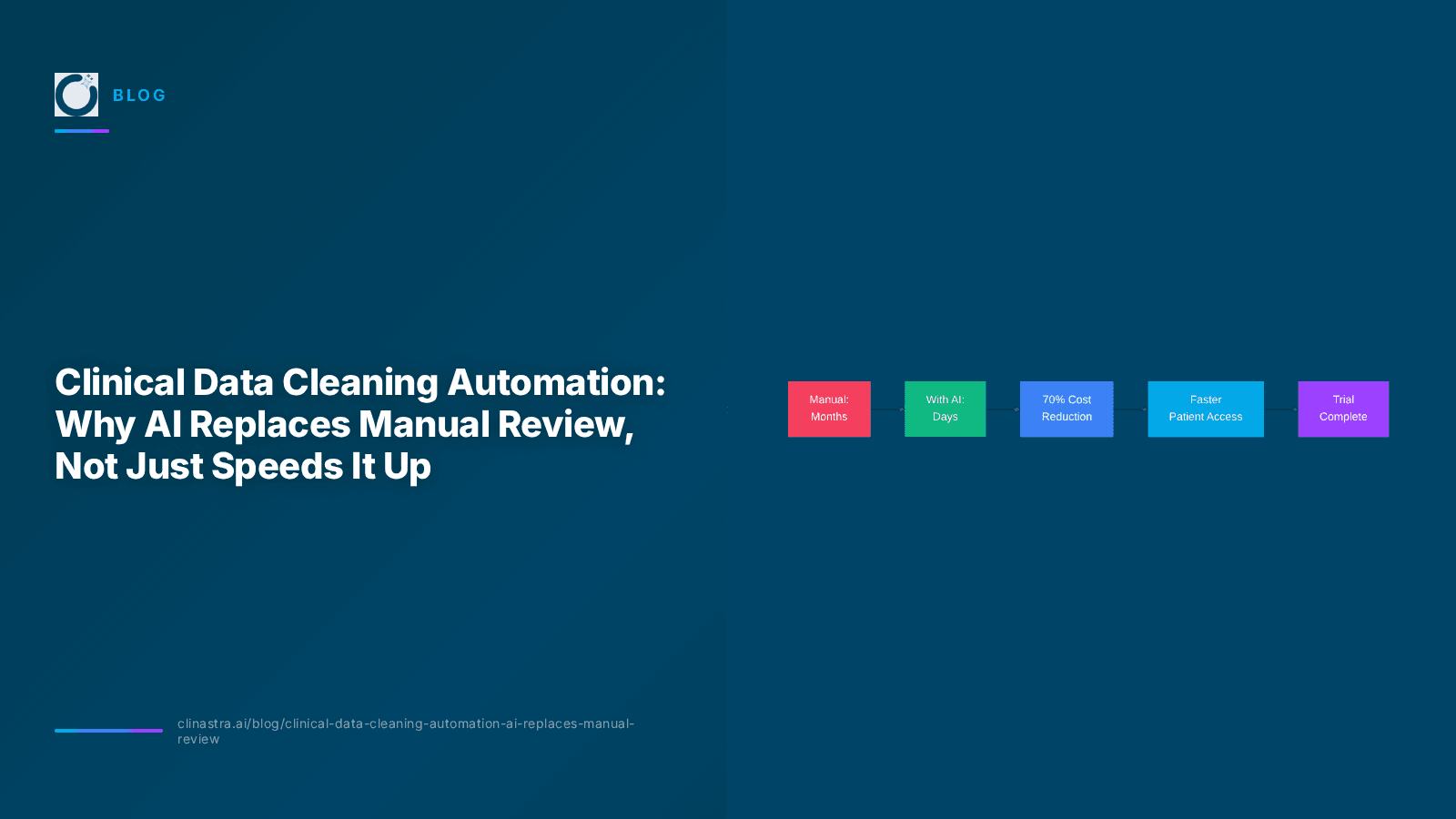
Manual clinical data cleaning is the bottleneck nobody questions. AI doesn't speed it up — it replaces it. From months to days with 99.9% accuracy and audit-ready traceability.