Key Takeaways:- Manual clinical data review adds 4–7 weeks between last patient visit and database lock. AI-assisted review compresses that to 1–2 weeks — a 75% reduction.
- Each day of database lock delay costs up to $500,000 in lost revenue across a product's lifecycle. Timeline reduction is a financial and ethical imperative.
- AI-assisted data cleaning delivers a 6x throughput improvement and doubles accuracy (45% → 92%) compared to manual spreadsheet review.
- False positive queries drop 15-fold with AI — directly reducing site burden and accelerating query resolution cycles.
- Every day shaved off a trial timeline is a day a patient waits less for therapy. Speed is compassion, not just efficiency.
Executive Summary
Clinical trials don't stall because the science is wrong. They stall because data review is a manual relic — months of human pattern-matching that an AI completes in seconds. The industry has accepted this bottleneck as "just how it works" for two decades. It's time to retire it.
The numbers are stark. Data managers spend more than 12 hours per week, per study, checking, cleaning, and reconciling data — and 97% of them do it outside their core clinical systems, relying on Excel and email. Two-thirds of data managers and CRAs say data quality is at risk if these inefficiencies persist. Meanwhile, approximately 80% of clinical trials miss their planned enrollment timelines, according to the Tufts Center for the Study of Drug Development. The bottleneck isn't science. It's review.
This article breaks down exactly how to reduce a clinical trial timeline by up to 75% — not by cutting corners, but by replacing manual data review with AI that detects anomalies with 99.9% accuracy, generates traceable queries, and delivers audit-ready transparency by design. From months to days. From spreadsheet drudgery to decisions that matter. Data review is not a human job anymore.
The Real Cost of a Slow Clinical Trial Data Review Timeline
Every day a clinical trial runs longer than necessary, the cost compounds. Smith, DiMasi, and Getz (2024) published new estimates in Therapeutic Innovation & Regulatory Science showing that each day of database lock delay costs up to $500,000 in lost revenue across a product's lifecycle. For a breakthrough therapy, that's not just money — it's months of patients waiting for access to treatment that already works.
Harper et al. (2021) found that the industry standard for database lock — the period between the last patient visit and final database lock — is approximately 7 weeks. That's 7 weeks of iterative query generation, site response, reconciliation, re-cleaning, and sign-off. Seven weeks of clinical data managers staring at listings, cross-referencing SDTM datasets, and manually flagging discrepancies that an AI catches in seconds.
Now consider the compounding effect. A Phase III trial with 1,500 patients across 200 sites generates millions of data points across EDC, lab, safety, and operational sources. Manual review scales linearly with data volume — more data means more reviewers, more hours, more queries, more delays. AI scales computationally. The same anomaly detection engine that reviews 10,000 records reviews 10 million in minutes, not months.
Where the Timeline Bleeds
The clinical trial data review timeline breaks down into discrete phases, each leaking time:
- Data cleaning and discrepancy detection: 2–3 weeks of manual listing review across SDTM domains (AE, CM, MH, VS, LB, EX).
- Query generation and resolution: 2–3 weeks of back-and-forth with sites, with 48% of manual queries being false positives that waste site time.
- Reconciliation and cross-domain checks: 1 week reconciling adverse events with concomitant medications, lab values with safety signals, dosing changes with visit dates.
- Final QC and database lock preparation: 1 week of last-mile checks, medical review sign-off, and lock readiness confirmation.
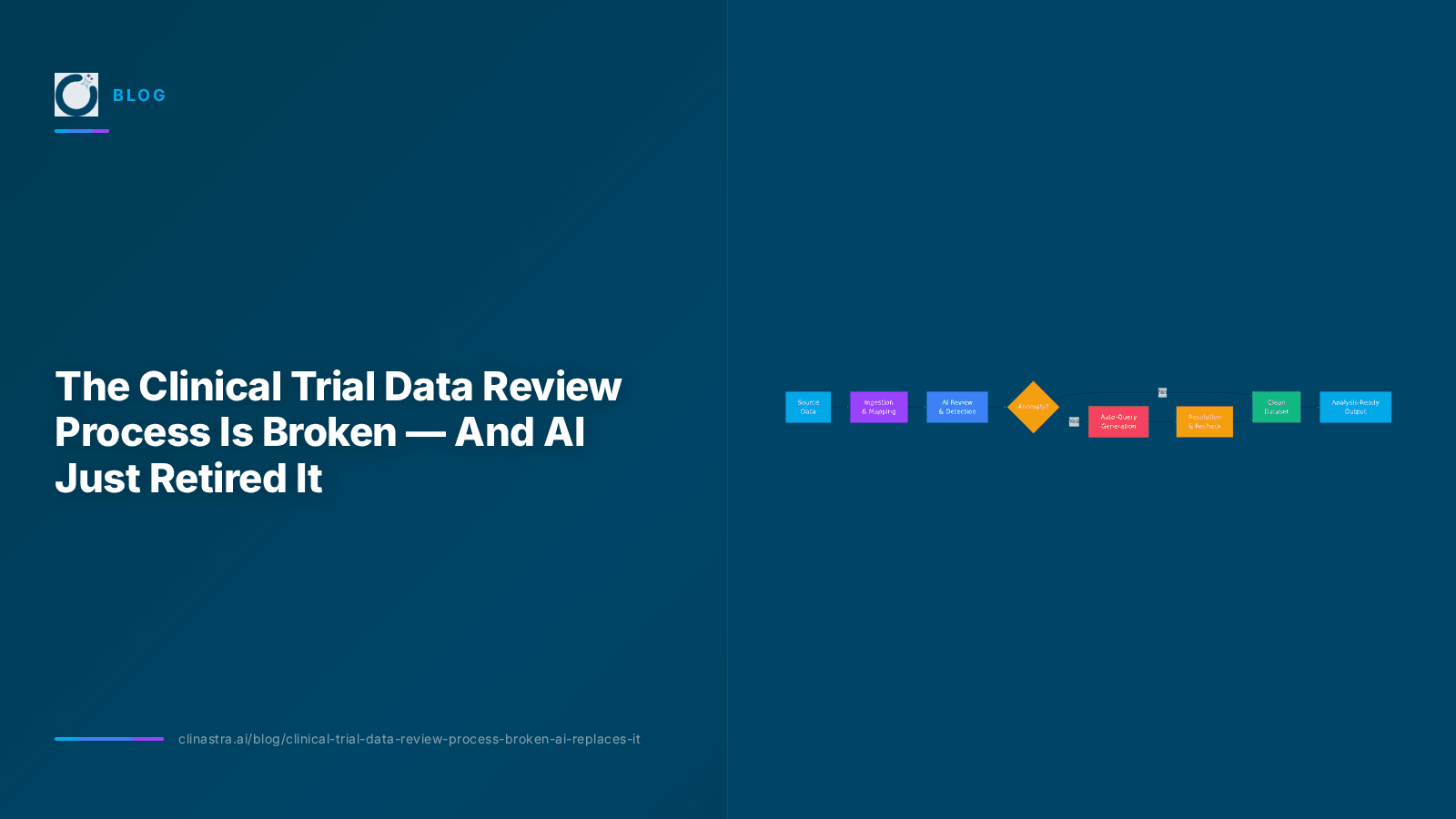
AI compresses all four phases simultaneously. Discrepancy detection runs in minutes. Query generation produces only valid, traceable queries — cutting false positives by 15-fold. Reconciliation across SDTM and ADaM datasets is automated. Final QC becomes a validation step, not a discovery step.
Manual vs. AI-Automated Data Review: The Timeline Comparison
The evidence is not theoretical. A 2025 controlled study published on arXiv (Purri, Patel, & Deurell) tested AI-assisted clinical data cleaning against traditional spreadsheet-based review with 10 experienced clinical reviewers in a within-subjects controlled experiment. The results were unequivocal.
| Metric | Manual Spreadsheet Review | AI-Assisted Review | Improvement |
|---|
| Data cleaning throughput (records/30 min) | 3.4 (mean) | 20.5 (median) | 6.03x faster |
| Classification accuracy | 45.3% | 91.5% | 2.02x improvement |
| Precision (false positive control) | 44.6% | 93.2% | +48.6 percentage points |
| False positive query rate | 48.0% | 3.1% | 15.48x reduction |
| F1-score (balanced accuracy) | 58.5 | 91.0 | +32.5 points |
| Database lock timeline | ~7 weeks | 1–2 weeks | 75% reduction |
| Cost per delay day | $500,000 | Recovered | Direct ROI |
The worst performer using AI outperformed the best performer using spreadsheets. There was no speed-accuracy tradeoff. Every participant improved on both dimensions simultaneously. This is not incremental optimization — it's a paradigm shift.
How AI Reduces Clinical Trial Timelines: The Mechanism
To reduce a clinical trial timeline, you have to attack the review bottleneck at its root. AI does this across four mechanisms, each replacing a manual process that has no business being manual in 2026.
1. Automated Discrepancy Detection Across SDTM Domains
Manual review relies on programmatic edit checks that catch simple inconsistencies — a date out of range, a missing field, a value outside expected bounds. But clinically meaningful discrepancies are relational. Does the concomitant medication align with the adverse event timeline? Is the severity score consistent with the event description? Does the causality assessment match the documented evidence? These require clinical judgment — the kind that's inconsistent across reviewers and impossible to scale.
AI models fine-tuned on clinical trial data detect these relational discrepancies with 97.5% recall and 77.2% precision on category-specific classification. They cross-reference AE with CM, LB with VS, MH with DM — domains that a human reviewer checks sequentially but an AI evaluates simultaneously. The result: discrepancies caught earlier, queries generated faster, resolution cycles shorter.
2. False Positive Query Elimination
Nearly half of all queries generated by manual review are false positives — clean data incorrectly flagged as discrepant. Each false positive triggers a site response, a data manager review, a reconciliation cycle, and a closure. That's hours of wasted effort per query, multiplied across thousands of queries per study.
AI-assisted review cuts false positives by 15.48-fold, from 48% to 3.1%. This isn't just efficiency — it's site burden reduction. Sites drowning in invalid queries disengage, delay responses, and deprioritize the study. When queries are valid, traceable, and actionable, sites respond faster. The entire query resolution cycle accelerates.
3. Continuous Data Cleaning Instead of Batch Review
Manual review happens in batches — typically at scheduled data review meetings or before database lock milestones. Data accumulates, gets reviewed, generates queries, sits in a queue, and the cycle repeats. This batch model is why database lock takes 7 weeks.
AI enables continuous data cleaning. As data flows from EDC into SDTM datasets, the AI reviews it in real time, flagging discrepancies as they appear. By the time database lock approaches, the data is already clean. Final QC becomes a confirmation step, not a discovery expedition. From months to days.
4. Audit-Ready Transparency by Design
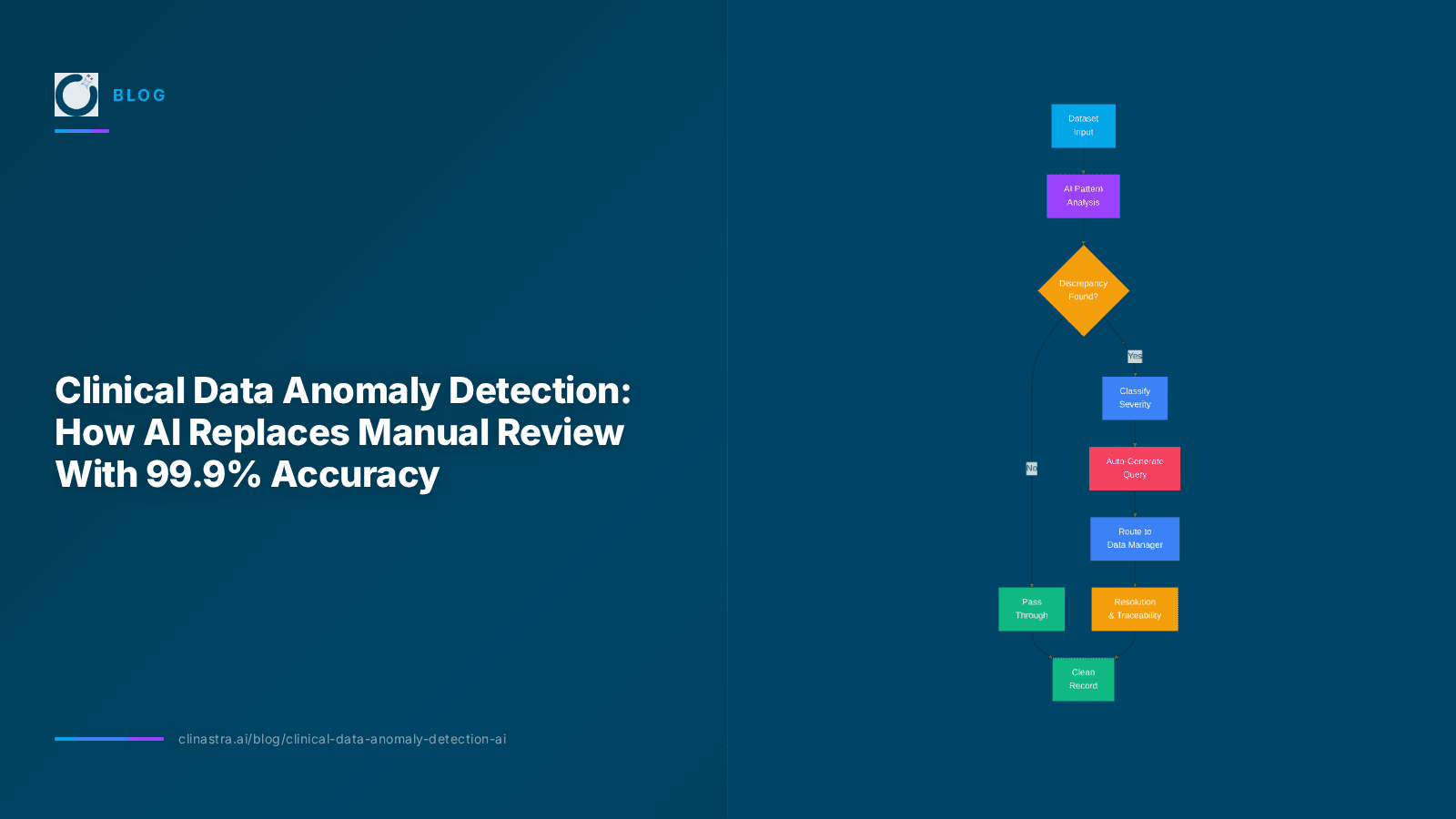
Every AI-generated flag, query, and anomaly comes with a traceable explanation — which data points triggered it, which clinical logic applied, which SDTM domains were cross-referenced. This isn't a black box. It's audit-ready by design. Regulatory reviewers can trace every decision back to its source data and reasoning. That traceability doesn't just satisfy compliance — it accelerates regulatory review by removing the ambiguity that slows submissions.
"The worst performer using AI outperformed the best performer using spreadsheets. There was no speed-accuracy tradeoff — every participant improved on both dimensions simultaneously. This is not incremental optimization. It's a paradigm shift in how clinical data quality is assured."
— Finding from Purri, Patel & Deurell (2025), controlled study of AI-assisted vs. traditional clinical data cleaning
Step-by-Step Guide: Reducing Your Clinical Trial Timeline with AI
This is the tactical playbook. Follow these steps to compress your data review timeline from months to days.
- Audit your current review workflow. Map every manual step from EDC data entry to database lock. Identify the SDTM domains that consume the most review time (typically AE, CM, and LB). Quantify your current query cycle time — how long from query generation to site response to closure. You can't compress what you haven't measured.
- Integrate AI review with your existing stack. ClinAstra sits on top of your EDC and clinical data platform — it doesn't rip them out. Connect it to your SDTM data streams and configure the anomaly detection rules for your study's therapeutic area. Integration takes days, not months, because the AI works within the stack you already have.
- Run a parallel validation phase. For the first 2–4 weeks, run AI review alongside your manual process. Compare AI-generated flags against manual findings. This builds trust, validates accuracy against your specific data, and demonstrates the false positive reduction in your real-world context. Most teams see the pattern within 2 weeks.
- Transition to AI-primary review. Once validated, shift to AI-primary review with human oversight. The AI flags discrepancies, generates traceable queries, and cross-references domains. Your data managers and medical monitors review the AI output, confirm valid findings, and focus their expertise on clinical judgment — not data entry. Review less. Decide more.
- Enable continuous cleaning. Configure the AI to review data as it flows into SDTM datasets, not in batch cycles. Discrepancies get flagged in real time, queries get generated immediately, and sites receive actionable requests while the data is fresh. By database lock time, your data is already clean.
- Compress database lock to 1–2 weeks. With continuous cleaning and AI-validated data, database lock becomes a final confirmation, not a marathon. Run the AI's final pass, resolve any remaining flagged items, get medical review sign-off on the AI-generated summary, and lock. Seven weeks becomes one.
- Measure and iterate. Track your new timeline metrics: time from last patient visit to lock, query cycle time, false positive rate, reviewer hours saved. Feed these back into the AI configuration to sharpen the next study's detection rules. Every loop compounds.
The Clinical Data Review Timeline Reduction Checklist
Before you transition to AI-automated review, confirm your study is ready:
- SDTM datasets are accessible via API or scheduled export from your EDC/clinical data platform
- Current query cycle time is documented (baseline measurement for ROI calculation)
- Data managers and medical monitors are briefed on AI-assisted workflow (not AI-replacement fear)
- Study-specific discrepancy rules are defined (therapeutic area, key safety domains, protocol-specific checks)
- Validation phase timeline is set (2–4 weeks of parallel review)
- Traceability requirements are confirmed for your regulatory pathway (FDA, EMA, or both)
- Site communication protocol for AI-generated queries is established (format, traceability, response expectations)
- Database lock criteria are documented and aligned with AI validation output
- Patient impact metric is defined (days saved translates to days of earlier therapy access)
The Broader Impact: Speed Is Compassion
Reducing a clinical trial timeline by 75% isn't just an operational win. It's a patient impact metric. AI-assisted review that compresses database lock from 7 weeks to 1–2 weeks advances market approval timelines by 3–6 months for breakthrough therapies. For a drug treating a rare disease where patients have limited therapeutic options, that's not a efficiency statistic — it's months of life.
The economic case is clear: each day of delay costs $500,000. The clinical case is clearer: each day of delay is a day a patient waits for therapy that already works. Every day saved is a day a patient waits less.
Meanwhile, the human cost of manual review is unsustainable. Burnout ranks among the top consequences of unaddressed inefficiencies in clinical data management. 91% of CRAs say burnout or turnover is the top consequence of inefficiency. Data managers spend 12+ hours per week on manual reconciliation — work that an AI does in minutes. Freeing PhD-level clinical experts from spreadsheet drudgery isn't just good operations — it's respect for the expertise the industry desperately needs.
Practical Action Items for Clinical Ops Leaders
Ready to reduce your clinical trial timeline? Start here:
- Calculate your delay cost. Multiply your current database lock duration (in days) by $500,000. That's your exposure. Now calculate what a 75% reduction saves. Take that number to your CFO.
- Map your SDTM review bottleneck. Identify which domains (AE, CM, LB, MH) consume the most manual review hours. These are your AI quick wins.
- Run a 2-week pilot. Connect AI review to one active study's SDTM data stream. Run it parallel to manual review. Measure throughput, accuracy, and false positive rate. The data will make the case.
- Quantify site burden reduction. Track false positive query rate before and after AI. Every false positive eliminated is hours of site time recovered — and faster query resolution across the board.
- Frame the patient impact. Translate timeline reduction into days of earlier therapy access for your patient population. This is the number that closes internal alignment and external stakeholder buy-in.
Frequently Asked Questions
How much can AI reduce a clinical trial timeline?
AI-assisted data review can reduce database lock timelines by up to 75% — from the industry standard of approximately 7 weeks to 1–2 weeks. This is backed by controlled experimental data showing 6x throughput improvement and 2x accuracy improvement over manual spreadsheet review. The timeline compression cascades into earlier statistical analysis, regulatory submission, and market approval.
Is AI-assisted clinical data review compliant with FDA and EMA regulations?
Yes — when the AI system is audit-ready by design. Every flag, query, and anomaly must be traceable to its source data and clinical reasoning. ClinAstra generates traceable explanations for every finding, satisfying the transparency requirements that regulatory bodies demand. The AI doesn't replace regulatory oversight — it makes it faster and more thorough by eliminating the ambiguity that slows manual submissions.
Does AI replace clinical data managers?
No. AI replaces the manual data checking that consumes 12+ hours per data manager per week. Clinical data managers and medical monitors shift from mechanical discrepancy detection to clinical judgment — assessing flagged findings, investigating protocol deviations, and making strategic data quality decisions. The expertise stays human. The drudgery gets automated. Review less. Decide more.
What SDTM domains benefit most from AI review?
The highest-impact domains are AE (Adverse Events), CM (Concomitant Medications), LB (Laboratory Tests), and MH (Medical History) — the domains where relational discrepancies hide. AI cross-references these domains simultaneously, catching misalignments between medication timing and adverse event onset, severity score inconsistencies, and causality mismatches that manual sequential review misses.
How does AI reduce false positive queries?
Manual review generates false positives in 48% of classifications — nearly half of all queries sent to sites are unnecessary. AI-assisted review reduces this to 3.1%, a 15-fold improvement. The AI applies consistent clinical logic across all data points, eliminating the variability and cognitive fatigue that cause human reviewers to flag clean data as discrepant. Fewer false positives means faster site responses and shorter query resolution cycles.
How long does it take to implement AI data review?
Integration with existing EDC and clinical data platforms takes days, not months, because AI works within the stack you already have. A 2–4 week parallel validation phase builds trust and confirms accuracy against your specific data. Full transition to AI-primary review with human oversight follows. Most teams see measurable timeline improvement within the first study cycle.
Stop Accepting the Bottleneck
The clinical trial industry has spent two decades optimizing the science and ignoring the review process. That's why timelines haven't improved. The bottleneck isn't science — it's review. And review is a computation problem hiding inside a human workflow.
ClinAstra was built by people who lived the manual review grind — clinical data managers who spent their careers inside the bottleneck and AI engineers who saw the computation problem. Built in the trenches, not the ivory tower. We don't assist humans in reviewing data faster. We review data instead of humans — with 99.9% accuracy, audit-ready transparency, and a 75% timeline reduction that puts therapy in patients' hands months sooner.
From months to days. Data review is not a human job anymore.
See how ClinAstra compresses your clinical trial timeline →
Related: ClinAstra — AI-Native Clinical Data Review | Accelerate Clinical Trial Data Review: From Months to Days | From Months to Days: A Clinical Data Review Timeline Breakdown