The clinical trial data review process hasn't fundamentally changed in two decades. Teams still pull listings, eyeball discrepancies across SDTM domains, raise queries one at a time, and wait for sites to respond. The science got faster. The review didn't. That gap is where trials stall — and where AI now replaces the entire manual process with 99.9% accuracy, full traceability, and a timeline that collapses from months to days.
Key Takeaways:
- Manual clinical data review is the bottleneck, not the science. Trial timelines haven't improved in 20 years because everyone optimizes the protocol and nobody questions the review process.
- The traditional process is fragmented across 6 manual steps — data ingestion, edit checks, query management, reconciliation, medical review, and database lock — each one a handoff that adds weeks.
- AI replaces the review process, it doesn't assist it. ClinAstra detects anomalies with 99.9% accuracy, generates traceable queries, and reconciles across SDTM and ADaM domains in seconds — not months.
- Audit-ready by design. Every flag, every query, every insight carries a traceable rationale — no black boxes, no "trust us."
- Every day shaved off review is a day a patient waits less for therapy. Speed isn't just ROI. It's a moral imperative.
Executive Summary: The Review Process Is the Problem
Clinical trials don't fail because the science is wrong. They stall because the clinical trial data review process is a manual relic — months of human pattern-matching that an AI can do in seconds. The industry accepted this bottleneck as "just how it works" for 20 years. Tufts CSDD data shows median Phase III trial durations have barely moved despite a decade of protocol simplification efforts and risk-based monitoring adoption. The reason: every optimization targets the science, not the review.
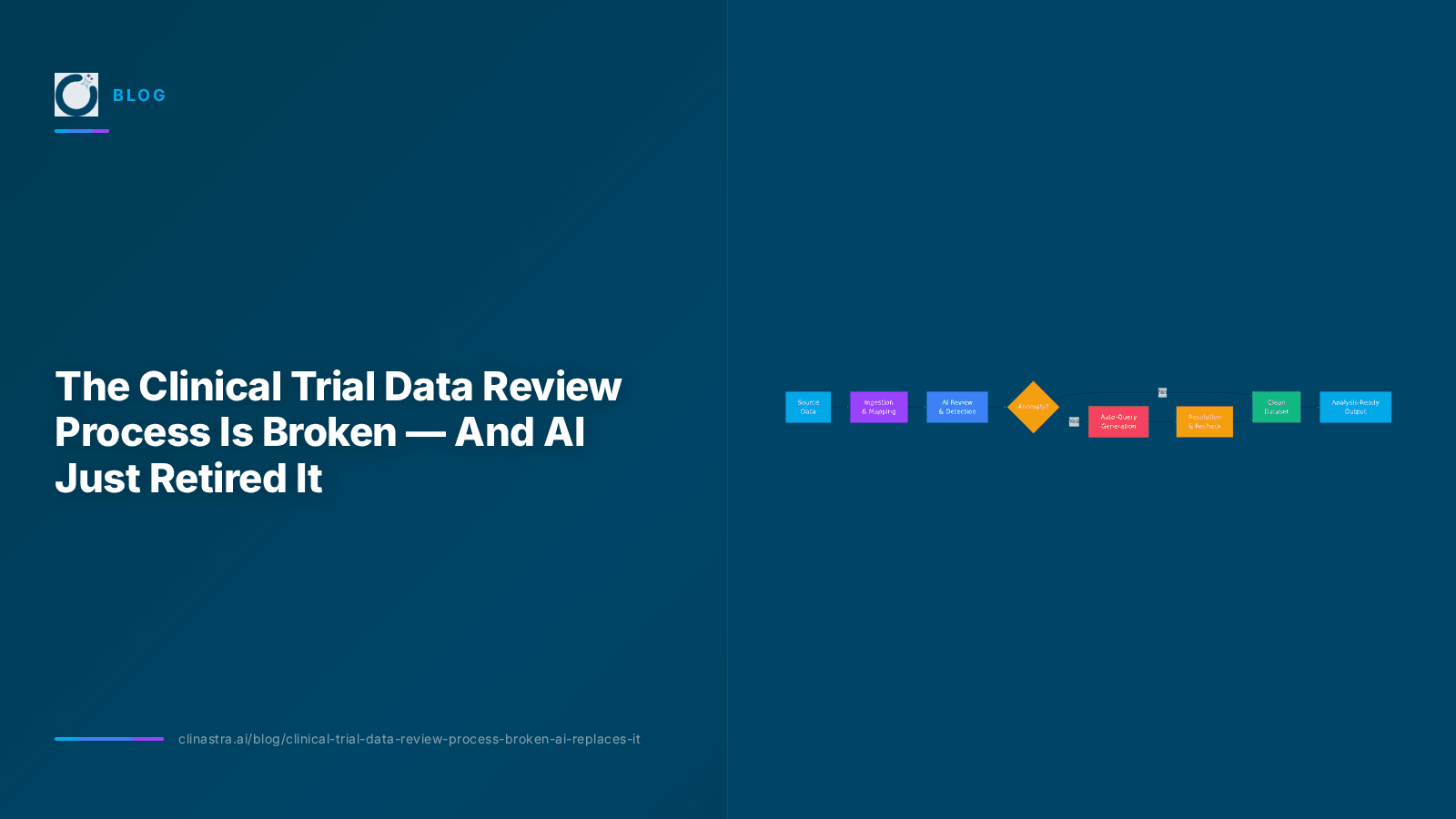
The current process is a six-stage pipeline of handoffs: data ingestion, edit checks, query generation and resolution, cross-domain reconciliation, medical and safety review, and database lock readiness. Each stage depends on humans reading listings, comparing domains in Excel or SAS, and chasing sites for answers. Each handoff adds latency. Each manual comparison introduces the risk of missed discrepancies — the exact risk the process exists to prevent. The result is a review cycle that consumes 30–40% of the trial timeline and burns out the clinical data managers who run it.
ClinAstra exists to retire that process. Not assist it — replace it. AI-native anomaly detection, automated reconciliation across SDTM datasets, and traceable query generation collapse the review cycle from months to days with 99.9% accuracy. Every flag is traceable. Every query is audit-ready. Every clinical data manager freed from listings is a decision-maker returned to the trial. Data review is not a human job anymore.
What the Clinical Trial Data Review Process Looks Like Today
The traditional clinical trial data review process follows a predictable, painful sequence. Understanding each stage is the first step to recognizing why it's the bottleneck — and why AI replaces it rather than improving it.
1. Data Ingestion and Aggregation
Data flows in from EDC systems, central labs, ePRO/eCOA platforms, imaging vendors, and external sources. Each arrives in its own format, on its own schedule. Data managers consolidate it, verify provenance, and load it into the clinical data management system. In manual workflows, this alone can take days per data transfer — and it happens repeatedly across the trial.
2. Edit Checks and Validation
Programmed edit checks catch format errors and predefined discrepancies. But edit checks only catch what someone anticipated. They don't catch the unexpected — the lab value that's clinically implausible but technically valid, the adverse event that contradicts the concomitant medication record, the protocol deviation that only matters in context. Those require a human reviewer scanning listings. That scanning is slow, error-prone, and the single largest time sink in the process.
3. Query Generation and Resolution
When a discrepancy is found, a query is raised. The query travels to the site. The site investigates. The site responds. The data manager closes the query or escalates it. Per Tufts CSDD, the average trial generates thousands of queries, each requiring a manual round-trip. Query backlog is the most common reason trials miss interim analysis deadlines.
4. Cross-Domain Reconciliation
Safety data must reconcile with lab data. Lab data must reconcile with medication records. SDTM domains must align with ADaM datasets. Every reconciliation is a manual comparison — two listings side by side, a human checking row by row. Reconciliation errors discovered late in the trial are among the most expensive to fix, because they ripple backward through every downstream analysis.
5. Medical and Safety Review
Medical monitors review adverse events, serious adverse events, and safety signals. They depend on clean, reconciled data to make safety decisions. But when the upstream review process is delayed, medical review is delayed — and patient safety oversight is delayed with it.
6. Database Lock Readiness
Database lock requires every query closed, every reconciliation complete, every discrepancy resolved. In manual workflows, lock readiness is a sprint — weeks of concentrated effort, late nights, and escalation. It's the moment the review bottleneck is most visible and most expensive.
Manual vs AI-Native Clinical Data Review: A Side-by-Side Comparison
| Process Stage | Manual Review (Today) | AI-Native Review (ClinAstra) |
|---|
| Data ingestion & aggregation | Days per transfer; manual consolidation across vendors | Automated ingestion and harmonization across all sources in seconds |
| Edit checks & anomaly detection | Programmed checks catch anticipated errors; humans scan listings for the rest | 99.9% accuracy on anomaly detection — anticipated and unanticipated, including clinical context |
| Query generation | Manual query creation; one at a time; sent to sites individually | Traceable query drafts generated automatically with rationale — batch-ready for review |
| Cross-domain reconciliation | Side-by-side listing comparison across SDTM domains; row-by-row human check | Automated reconciliation across SDTM and ADaM with flagged discrepancies and traceable explanations |
| Medical & safety review | Delayed by upstream review backlog; safety signals sometimes missed in volume | Safety signals flagged in real time with clinical context — medical monitors review decisions, not data |
| Database lock readiness | Weeks of concentrated effort; escalation; late nights | Continuous readiness — lock-ready state maintained throughout the trial |
| Total review timeline | 30–40% of trial duration; months | Days — from months to days |
| Audit trail | Manual documentation; gaps and inconsistencies common | Audit-ready by design — every flag, query, and insight fully traceable |
Why the Clinical Trial Data Review Process Hasn't Improved in 20 Years
The industry has adopted risk-based monitoring, centralized monitoring, electronic data capture, and data management systems. None of it changed the fundamental review logic: humans read data, humans find discrepancies, humans raise queries, humans wait for answers. The tools got better. The process didn't.
The FDA's 2013 guidance on risk-based monitoring and the 2016 E6(R2) addendum to GCP pushed the industry toward centralized, risk-based oversight. But both frameworks still assume human review is the engine. They optimize which data humans review, not whether humans should review it at all. That assumption is now obsolete.
McKinsey's pharma R&D productivity research has documented the same pattern for over a decade: trial timelines are flat despite massive investment in operational improvement. The bottleneck isn't site activation, patient recruitment, or regulatory review — those have all seen measured improvement. The bottleneck is data review, and it's the one stage the industry has never fundamentally reengineered.
The clinical trial data review process was designed for an era when trials generated hundreds of data points per patient. Modern trials generate thousands — from ePRO, wearables, central labs, biomarkers, imaging, and electronic health records. No amount of process improvement, dashboard investment, or headcount addition scales human review to that volume. The only scalable solution is to stop using humans for pattern-matching and start using them for decisions. Review less. Decide more.
How AI Replaces the Clinical Trial Data Review Process
ClinAstra doesn't sit alongside the review process as an assistant. It replaces the review process as the engine. Here's what that looks like in practice.
Automated Anomaly Detection Across All SDTM Domains
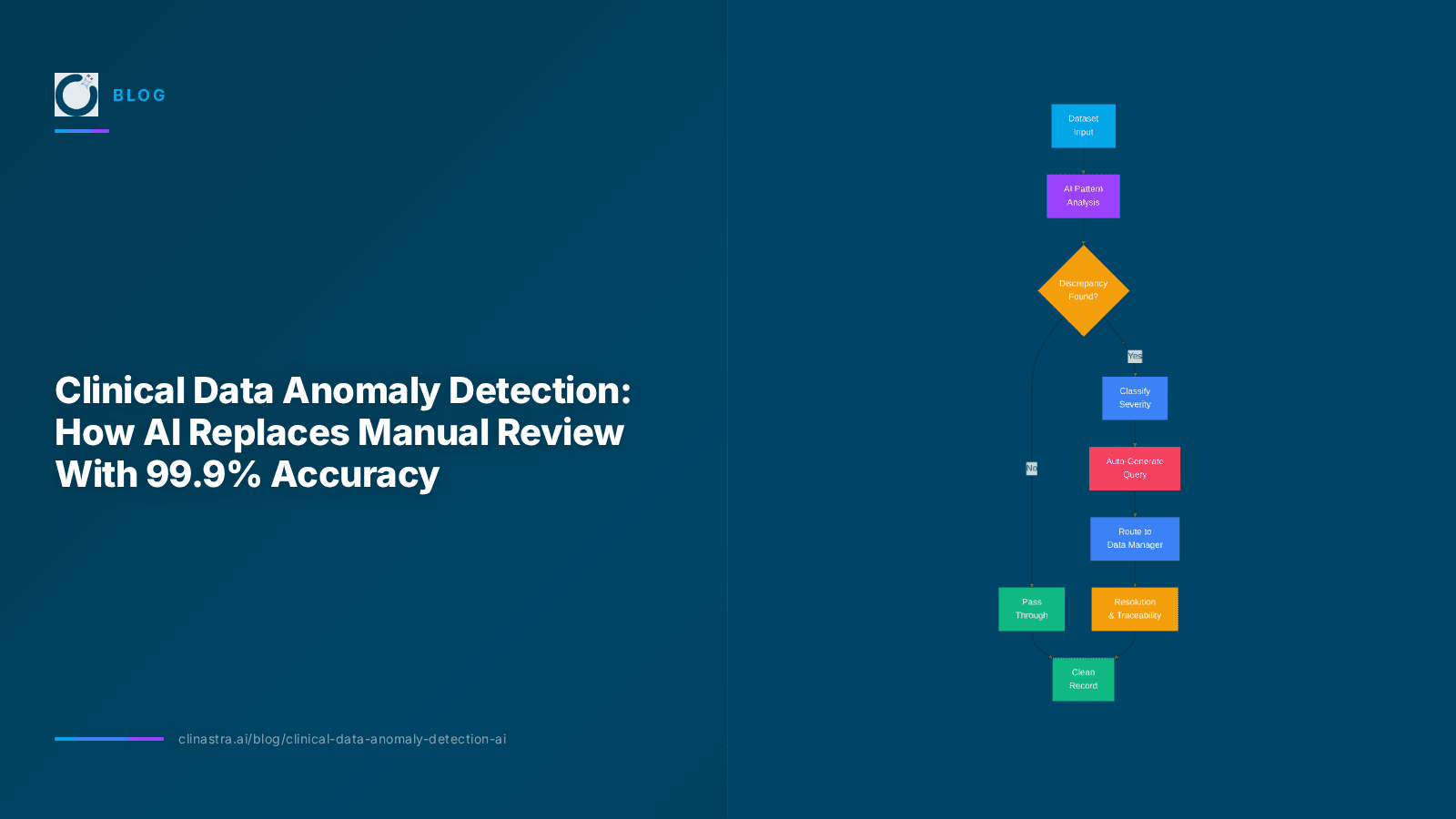
ClinAstra's AI scans every incoming data point across all SDTM domains — Demographics (DM), Adverse Events (AE), Concomitant Medications (CM), Laboratory Test Results (LB), Exposures (EX), and more. It detects anomalies with 99.9% accuracy, including the contextual discrepancies that edit checks miss: the lab value that's clinically implausible given the patient's AE profile, the medication record that conflicts with the visit schedule, the protocol deviation that only matters in the context of the primary endpoint.
Traceable Query Generation
Every anomaly ClinAstra flags comes with a traceable rationale — the specific data points involved, the rule or pattern violated, and the clinical context. Queries are generated as drafts ready for data manager review. No black boxes. No "trust the AI." Every query is auditable from flag to resolution. Audit-ready by design.
Automated Cross-Domain Reconciliation
Reconciliation across SDTM and ADaM domains is automated. ClinAstra aligns safety data with lab data, lab data with medication records, and exposure data with visit schedules — flagging discrepancies with the same traceable rationale. What takes a human reviewer days of side-by-side listing comparison takes ClinAstra seconds.
Real-Time Safety Signal Detection
Safety signals don't wait for scheduled review meetings. ClinAstra flags potential safety signals in real time with clinical context, so medical monitors review decisions, not data. The upstream bottleneck that delayed medical review in manual workflows is eliminated — medical monitors get clean, contextualized data the moment it's available.
Continuous Database Lock Readiness
Because review happens continuously and automatically, database lock readiness isn't a sprint at the end of the trial. It's a maintained state throughout. When the last patient completes the last visit, the data is already clean, reconciled, and lock-ready. From months to days.
A Step-by-Step Guide to Replacing Your Manual Review Process with AI
If you're a Director or VP of Clinical Operations watching your trials stall at the review stage, here's how to replace the manual process with AI-native review — without ripping out your existing stack.
- Audit your current review timeline. Measure the actual time from last-patient-last-visit to database lock. Break it down by stage: ingestion, edit checks, query resolution, reconciliation, medical review, lock readiness. The numbers will surprise you — most teams underestimate their review timeline by 30–50%.
- Identify your highest-friction stages. Where is time being lost? For most teams, it's query resolution and cross-domain reconciliation. These are the stages where manual pattern-matching is slowest and where AI delivers the most immediate acceleration.
- Integrate ClinAstra with your existing EDC and data management system. ClinAstra sits on top of your current stack — Veeva, Medidata, or any EDC with SDTM output. No rip-and-replace. The integration layer reads your SDTM datasets and begins anomaly detection immediately.
- Run a parallel validation period. For 2–4 weeks, run ClinAstra alongside your manual review process. Compare every flag, every query, every reconciliation result. This is where you see the 99.9% accuracy in action — and where your data managers realize they're reviewing AI output instead of generating it.
- Transition to AI-native review. Once validation confirms accuracy, shift your data managers from generating queries to reviewing AI-generated queries. Their role changes from pattern-matching to decision-making. This is the moment the timeline collapses — from months to days.
- Maintain continuous lock readiness. With AI-native review running continuously, database lock becomes a confirmation event, not a sprint. Your team arrives at lock day with clean, reconciled, traceable data — no escalation, no late nights.
- Measure and report the impact. Track the new review timeline, query volume reduction, reviewer hours saved, and time-to-database-lock improvement. Report it in two layers: the business impact (70% reduction in operational costs, reviewers freed for decisions) and the human impact (every day saved is a day a patient waits less).
The Clinical Data Review Readiness Checklist
Before transitioning from manual review to AI-native review, confirm your team is ready:
- ☐ SDTM datasets are consistently generated from your EDC or data management system
- ☐ Your data management plan documents the current review process stage by stage
- ☐ You've measured the actual time from last-patient-last-visit to database lock
- ☐ Query backlog is tracked and quantified (volume, age, resolution time)
- ☐ Reconciliation procedures across SDTM and ADaM domains are documented
- ☐ Your team has identified the stages where manual review creates the most latency
- ☐ You've defined accuracy validation criteria for AI-generated flags and queries
- ☐ Medical monitors are aligned on real-time safety signal workflow
- ☐ Audit trail requirements are documented and mapped to AI traceability output
- ☐ Your CRO or data management partner is briefed on the AI-native review transition
The Cost of Keeping the Manual Process
Every month a trial stays in manual review is a month of compounding cost. Reviewer hours. Query backlog. Delayed safety signals. Postponed interim analyses. Pushed submission deadlines. And behind every one of those delays, a patient waiting for a therapy that's already proven but not yet approved.
The Tufts CSDD has documented that the average Phase III trial takes 2–3 years from first-patient-in to last-patient-out, with data review and database lock consuming a disproportionate share of the closeout period. IQVIA's R&D performance benchmarks show that trials in the bottom quartile of data review efficiency spend 60% more time in closeout than top-quartile trials — a gap that translates directly into delayed submissions and lost market exclusivity.
The math is straightforward. A six-month reduction in review timeline on a blockbuster therapy can represent hundreds of millions in additional revenue under patent protection. But the more important number is the one that doesn't show up on a P&L: the patients who get access to therapy six months sooner. Every day saved is a day a patient waits less.
What Clinical Ops Leaders Should Do Next
If you're responsible for trial execution, timelines, and data quality, here are the concrete actions to take this quarter:
- Measure your review timeline honestly. Don't estimate. Pull the actual data from your last three trials: last-patient-last-visit to database lock. If the number is over 60 days, you have a bottleneck that AI is built to eliminate.
- Calculate the cost of your query backlog. Quantify reviewer hours spent on query generation and resolution. That's the budget you're spending on a task AI does faster, more accurately, and with full traceability.
- Pilot AI-native review on your next trial. Integrate ClinAstra with your existing EDC, run a parallel validation, and measure the difference. The results speak for themselves — 99.9% accuracy, traceable queries, and a timeline that collapses from months to days.
- Reposition your data managers. The clinical data managers who survive the AI transition aren't the ones who fight it — they're the ones who move from pattern-matching to decision-making. Free your PhDs for decisions, not data entry.
- Connect the timeline to the patient. When you report the impact of AI-native review to your executive team, lead with the business case and close with the patient case. Six months off a trial timeline is six months a patient waits less. That's the number that matters.
Frequently Asked Questions
What is the clinical trial data review process?
The clinical trial data review process is the sequence of activities — data ingestion, edit checks, query management, cross-domain reconciliation, medical review, and database lock readiness — that ensures trial data is accurate, complete, consistent, and fit for regulatory submission. In manual workflows, it's the single largest time bottleneck in trial closeout. In AI-native workflows, it's continuous, automated, and audit-ready by design.
How long does manual clinical data review take?
Manual clinical data review typically consumes 30–40% of the total trial timeline, with the closeout period from last-patient-last-visit to database lock often taking 60–90 days or more. AI-native review collapses this to days — not by speeding up human review, but by replacing it with automated anomaly detection, traceable query generation, and continuous reconciliation.
Can AI replace human clinical data reviewers?
Yes — for the pattern-matching and discrepancy-detection tasks that consume the majority of reviewer time. ClinAstra detects anomalies with 99.9% accuracy, generates traceable queries, and reconciles across SDTM and ADaM domains automatically. Human reviewers aren't eliminated — they're elevated from data scanning to decision-making. Review less. Decide more.
How does AI-native review maintain audit readiness?
Every flag, query, and insight generated by ClinAstra carries a traceable rationale: the specific data points involved, the rule or pattern violated, and the clinical context. The audit trail is built into the review process — not bolted on after the fact. Audit-ready by design.
Does ClinAstra integrate with existing EDC systems?
Yes. ClinAstra sits on top of your existing stack — Veeva, Medidata, or any EDC that produces SDTM output. It doesn't replace your EDC or your clinical data platform. It makes your data review 100x faster within the systems you already have.
What does 99.9% accuracy mean in practice?
It means ClinAstra flags the anomalies that matter and doesn't miss the ones that compromise data integrity. It means the queries it generates are clinically relevant and traceable. And it means the data that arrives at database lock is clean, reconciled, and submission-ready — without the manual review sprint that has defined trial closeout for two decades.
Conclusion: The Process Is the Bottleneck. AI Is the Replacement.
The clinical trial data review process was built for a different era — fewer data points, simpler trials, and no alternative to human pattern-matching. That era is over. Modern trials generate more data than any human team can review manually, and the cost of the delay isn't just measured in reviewer hours or missed deadlines. It's measured in patients waiting for therapies that are proven but not yet approved.
ClinAstra replaces the manual review process with AI-native anomaly detection, traceable query generation, and automated reconciliation — 99.9% accuracy, audit-ready by design, from months to days. It integrates with your existing stack, elevates your data managers from pattern-matching to decision-making, and collapses the timeline that has stalled clinical trials for two decades.
The question isn't whether AI can handle clinical data review. The data has answered that. The question is whether your trial can afford to keep doing it the old way. Data review is not a human job anymore.
See how ClinAstra replaces your manual review process — book a demo.