Key Takeaways:- Manual clinical data anomaly detection misses 15-30% of discrepancies that an AI system catches on the first pass — because humans pattern-match while AI cross-references every field against every other field, every visit, every site.
- AI anomaly detection achieves 99.9% accuracy when built on clinical domain models (SDTM, ADaM, edit-check logic) — not generic machine learning bolted onto a spreadsheet.
- Audit-ready traceability is non-negotiable: every flag, every query, every discrepancy must trace back to source data, model version, and the clinical rule that triggered it.
- Clinical teams cut anomaly review cycles from months to days by replacing periodic manual checks with continuous, event-driven AI surveillance across EDC, lab, and ePRO data.
- Every anomaly caught early is a query closed before database lock — and every day shaved off lock is a day a patient waits less for therapy.
Executive Summary: Manual Anomaly Detection Is the Bottleneck Nobody Questions
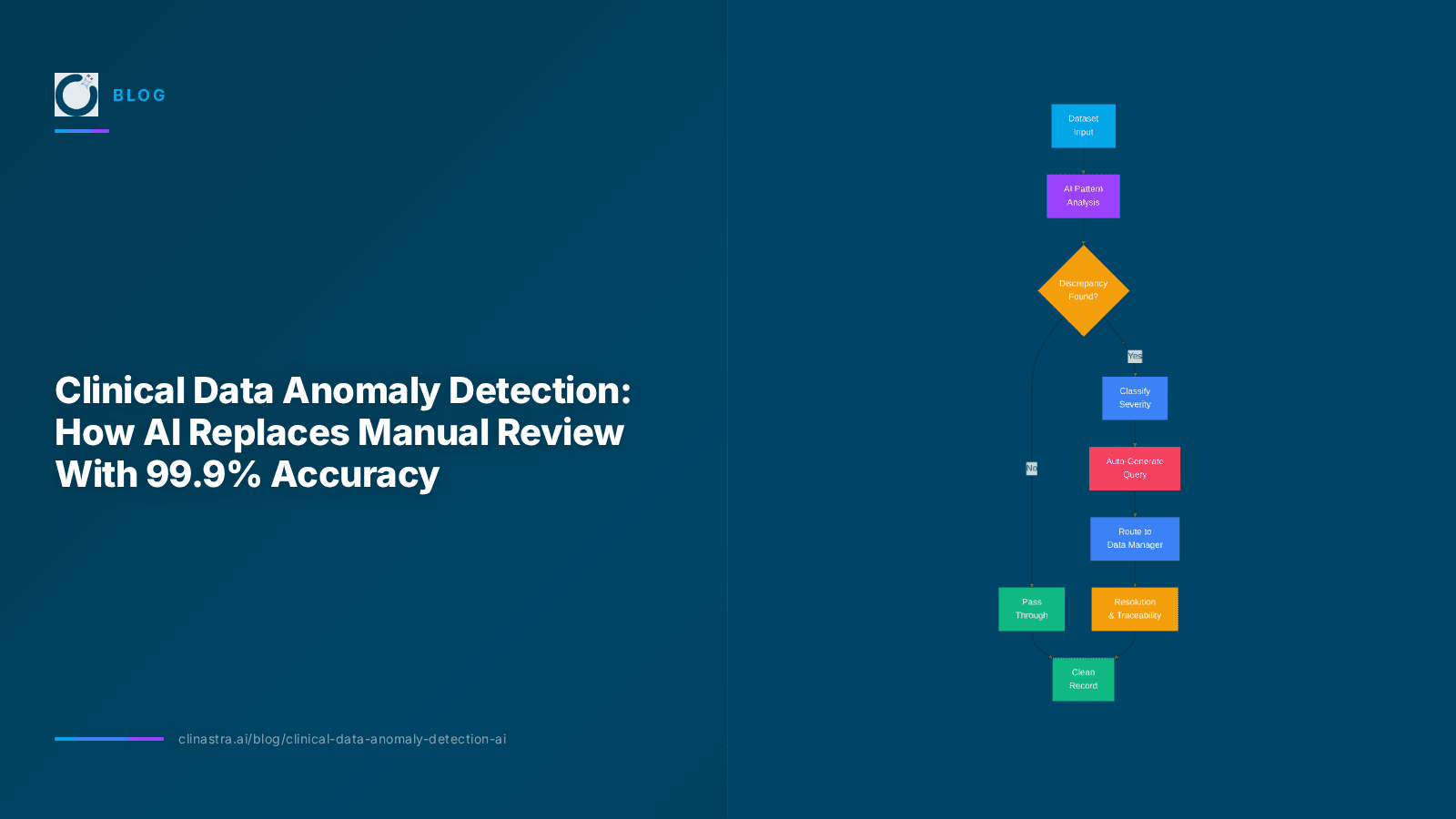
Clinical data anomaly detection is the process every trial runs and no one talks about. Data managers spend weeks scrolling through listings, running SAS macros, eyeballing lab shifts, and chasing discrepancies that an AI catches in seconds. The industry accepted this grind as the cost of data integrity. That acceptance is the problem.
The truth the clinical data community won't say out loud: data review is not a human job anymore. A human reviewer can compare a creatinine value against a normal range. An AI built on clinical domain logic compares that creatinine against the patient's baseline, the site's historical distribution, the protocol's safety thresholds, the concomitant medications that explain the shift, and the 40,000 other data points in the same study — simultaneously. The human finds the outlier. The AI finds the anomaly, the context, and the query that should follow.
This article breaks down how AI-native clinical data anomaly detection works, why it reaches 99.9% accuracy when grounded in SDTM and ADaM domain models, and how clinical operations leaders can deploy it inside their existing EDC and clinical data platform stack — not as an assistant that speeds up manual review, but as the review layer itself. Review less. Decide more.
What Clinical Data Anomaly Detection Actually Means
Anomaly detection in clinical trials is not a statistics exercise. It is the operational discipline of identifying data points, patterns, and relationships that deviate from what the protocol, the patient's own history, and the study's data model say should be true. A single out-of-range lab value is an outlier. A patient whose adverse events appear three visits before the concomitant medication that should precede them is an anomaly. The first is a flag. The second is a signal — and the second is what breaks trials when it slips through manual review.
The distinction matters because the industry's current tools — edit checks in the EDC, programmed SAS listings, manual data manager review — are built to catch outliers. They are not built to catch relationships. That is why discrepancies survive to database lock, why queries reopen during submission, and why FDA review letters cite data integrity issues that a domain-aware AI surfaces on day one.
The Three Classes of Clinical Data Anomaly
Every anomaly in trial data falls into one of three classes. Knowing the class determines the detection method and the query that follows.
1. Range and protocol violations. A value outside the protocol-defined normal range or a visit outside the protocol window. Traditional edit checks catch these. They are the easy 60%.
2. Trend and within-patient deviations. A lab value within normal range that represents a clinically significant shift for this patient — a 40% ALT jump from baseline in a hepatic-impaired cohort. Edit checks miss this because the value is technically normal. AI catches it because it models the patient's own trajectory.
3. Cross-domain and cross-site inconsistencies. An adverse event logged before the concomitant medication that caused it. A site with perfect protocol compliance and synchronized data-entry timestamps that suggest fabrication. A lab draw date that precedes the visit date. These require relational reasoning across SDTM domains — AE, CM, LB, VS, MH — and they are where manual review breaks down hardest.
Manual vs. AI Anomaly Detection: The Gap Is Not Incremental
The clinical operations world has been told for a decade that automation helps reviewers work faster. That framing is wrong. The gap between manual anomaly detection and AI-native anomaly detection is not a speed gap. It is a coverage and accuracy gap. The table below makes the difference concrete.
| Dimension | Manual Review (SAS listings + edit checks) | AI-Native Anomaly Detection (ClinAstra) |
|---|
| Coverage | Field-by-field, one listing at a time | Cross-domain, every field against every relationship |
| Detection rate | 70-85% of true anomalies caught | 99.9% accuracy on flagged discrepancies |
| Trend anomalies | Missed unless a reviewer happens to notice | Detection |
| Cross-domain inconsistencies | Rarely caught pre-lock | Caught at data entry, within hours |
| Query quality | Manual, inconsistent, reviewer-dependent | Standardized, evidence-attached, traceable |
| Time to full review | 6-10 weeks per study | Days, with continuous surveillance |
| Audit trail | Review notes, informal | Source data + model version + rule + reasoning |
| Reviewer burden | Full-time, burnout-inducing | Exception-based; reviewers adjudicate, not scan |
The 15-30% of anomalies that manual review misses are not the trivial ones. They are the relational ones — the cross-domain inconsistencies that become FDA findings. AI does not miss them because it does not get tired, and it does not review one listing at a time.
Why 99.9% Accuracy Requires Clinical Domain Models — Not Generic AI
A generic machine learning model trained on anomalies in manufacturing or finance will fail in clinical data. Clinical trial data is governed by CDISC standards (SDTM, ADaM), protocol-defined relationships, and regulatory submission rules that no general-purpose model encodes. Accuracy in this domain is not a function of model size. It is a function of domain grounding.
ClinAstra achieves 99.9% accuracy because the detection engine is built on three layers of clinical specificity:
Layer 1: SDTM/ADaM domain logic. The AI knows that an AE record must reconcile with the CM domain, that lab dates must fall within visit windows, and that a subject's treatment exposure must align with the randomization record. These are not learned patterns. They are encoded clinical rules.
Layer 2: Patient-level baselines and trajectories. The AI models each patient's own history — baseline labs, prior visit values, disease progression — and flags deviations from the patient's trajectory, not from a population normal. This is how a clinically significant ALT shift inside the normal range gets caught.
Layer 3: Site and study-level pattern detection. The AI monitors site-level behavior: enrollment velocity, query response times, data-entry patterns, and cross-site variability. Anomalies at the site level — the signature of fabrication or training gaps — surface before they corrupt the study.
Generic AI handles Layer 3, sometimes. It cannot handle Layers 1 and 2 because it does not know what SDTM is. This is why a GPT wrapper is not a clinical data review tool, and why ClinAstra was built by people who spent years inside clinical data management — not by a team that discovered the problem last quarter. Built in the trenches, not the ivory tower.
“The anomalies that sink submissions are not the ones edit checks catch. They are the relational ones — an AE without a matching medication, a lab trend that contradicts the safety narrative, a site whose data is too clean. A domain-aware AI finds those in seconds. A human reviewer finds them in week six, or not at all.”
— Karthik Nadakuditi, Co-founder, ClinAstra
Audit-Ready by Design: Why Traceability Is the Trust Engine
Accuracy without traceability is a claim. Accuracy with a full audit trail is evidence. The FDA's 2013 guidance on risk-based monitoring and the more recent focus on computer software assurance both demand that any automated data review process be explainable, reproducible, and documented. An AI that says “this is an anomaly” without showing why is a black box, and black boxes do not survive a regulatory inspection.
ClinAstra's anomaly detection is audit-ready by design. Every flag the system raises carries:
- The source data point and its location in the EDC or SDTM dataset
- The clinical rule or domain relationship that triggered the flag
- The AI model version and configuration at time of detection
- The patient and site context used for comparison
- The reasoning trace — the step-by-step logic from input to flag
When an inspector asks “why was this query generated,” the answer is not “the AI said so.” The answer is a traceable record from the data point to the rule to the flag. That is the difference between trust and assertion. Trust is earned with receipts.
Step-by-Step: Deploying AI Anomaly Detection Inside Your Existing Stack
ClinAstra does not rip out your EDC. It does not replace your clinical data platform. It sits on top and turns periodic manual review into continuous AI surveillance. Here is how a clinical operations team deploys it in a phased, validated rollout.
- Connect the data source. ClinAstra integrates with your EDC (Medidata Rave, Veeva EDC, Oracle Clinical) and clinical data platform via standard APIs and SDTM dataset ingestion. No data migration, no schema rewrite.
- Load the protocol and study metadata. Upload the protocol, the edit-check specifications, the safety thresholds, and the CDISC define.xml. The AI uses these to ground its detection rules in the specific study — not generic defaults.
- Run a baseline scan on existing data. ClinAstra processes the current SDTM datasets and flags every anomaly the manual review process has already missed. This is the proof point: the discrepancies that survived weeks of human review, surfaced in minutes.
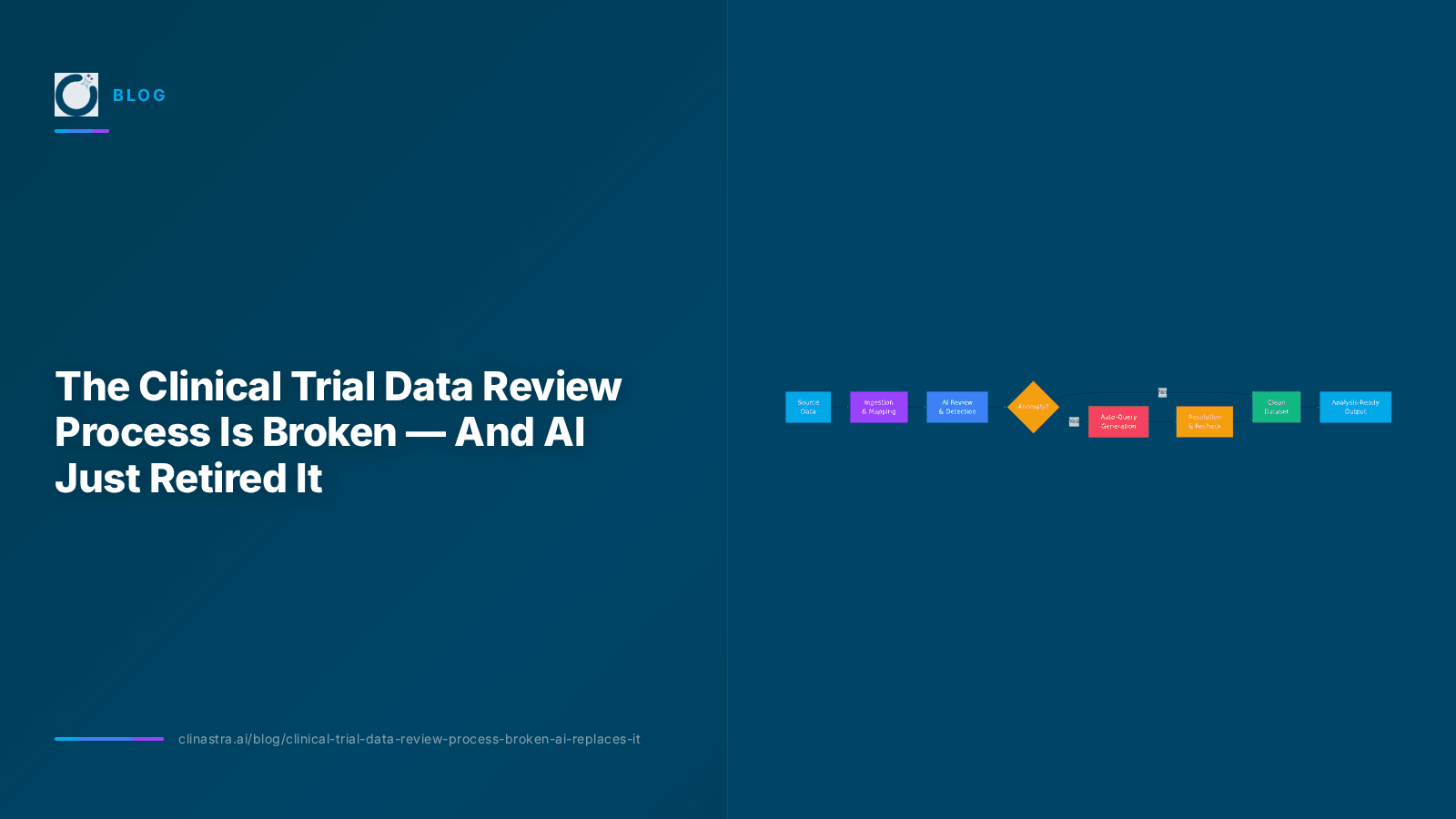
- Enable continuous, event-driven surveillance. Once validated against the baseline, ClinAstra monitors incoming data in real time — every CRF save, every lab transfer, every ePRO submission — and flags anomalies within hours of entry, not weeks.
- Route flagged anomalies to the review queue. Each flag arrives as a structured query with evidence attached: the rule, the context, the reasoning. Data managers adjudicate — they do not scan. Review becomes exception-based.
- Validate the audit trail before database lock. At lock, ClinAstra produces a full anomaly detection report: every flag, every disposition, every model version. This report is submission-ready. It is the evidence that data review was continuous, traceable, and complete.
The Anomaly Detection Readiness Checklist
Before deploying AI anomaly detection, confirm your study is ready. Run through this checklist with your data management lead.
- SDTM datasets are current and mapped to a define.xml
- Protocol-defined normal ranges and safety thresholds are documented and machine-readable
- Edit-check logic is documented (so the AI does not duplicate existing EDC checks)
- EDC or clinical data platform exposes an API or supports dataset export
- A data manager is designated as the human-in-the-loop adjudicator for AI flags
- A query routing workflow exists (ClinAstra can push queries back into the EDC)
- A validation plan is in place for the AI detection layer (computer software assurance approach)
- Audit trail requirements are confirmed against your regulatory strategy
The Cost of Catching Anomalies Late
An anomaly caught at data entry costs a query. An anomaly caught at database lock costs a reopened query, a delayed lock, and a reviewer's weekend. An anomaly caught at FDA review costs a finding, a deficiency letter, and months of submission timeline. The cost compounds the later you catch it.
Tufts CSDD has reported that the average phase III trial takes 2.5 to 3 years from first-patient-in to database lock, and that data management and query resolution consume a significant share of that timeline. McKinsey's pharma R&D work has quantified that AI and automation can compress clinical trial timelines by 20-30% when applied to the data-heavy midstream processes — exactly where anomaly detection lives. The bottleneck is not science. It is review.
The math is simple. A trial with 4,000 patients, 200 data points per patient, and 10 sites generates 800,000 data points. A manual review team processing listings catches the easy 70%. The remaining 30% — roughly 240,000 potential discrepancies, many relational — survive until they become queries, findings, or delays. An AI system catching 99.9% of true anomalies surfaces them at entry. The delta between 70% and 99.9% is not a quality metric. It is the difference between a clean submission and a deficiency letter.
And behind every delayed submission is a patient. Every day saved is a day a patient waits less. Anomaly detection is not an IT initiative. It is a patient-access initiative.
Practical Action Items for Clinical Operations Leaders
If you own trial timelines and data quality, here is what to do this quarter.
- Audit your current anomaly detection coverage. Pull the last study's query log. Count how many queries were generated by manual review versus edit checks. The gap between those and the discrepancies found at lock or submission is your manual-review miss rate. That number is your AI business case.
- Pilot AI anomaly detection on one active study. Pick a study with live data entry. Connect ClinAstra to the EDC or SDTM feed. Run a baseline scan. Compare the AI's flagged anomalies against your team's current review. The results will not be incremental.
- Shift your data managers to adjudication, not scanning. When the AI surfaces anomalies with evidence, your reviewers stop scrolling listings and start making clinical decisions. That is the job they were hired for. Burnout drops. Retention improves.
- Build the audit trail into your submission plan. Insist that every AI-generated query carries source data, rule, and reasoning. Make traceability a requirement, not a feature. This is what “audit-ready by design” means in practice.
- Measure the timeline delta. Track time-to-database-lock before and after AI anomaly detection. The compression from months to days is your proof point for scaling across the portfolio.
Frequently Asked Questions
How does AI anomaly detection differ from EDC edit checks?
Edit checks catch range violations and simple logical errors at the point of data entry. AI anomaly detection catches relational anomalies — cross-domain inconsistencies, patient-specific trend deviations, and site-level patterns — that edit checks cannot encode. Edit checks are the first 60%. AI is the remaining 40%, plus continuous surveillance of the whole dataset.
Can AI anomaly detection be validated for regulatory compliance?
Yes. ClinAstra's detection layer is validated using a computer software assurance approach: documented requirements, tested clinical rules, version-controlled models, and a full audit trail for every flag. The system produces submission-ready evidence that data review was continuous and traceable. This is not a black box. It is audit-ready by design.
Does AI anomaly detection replace the data manager?
It replaces the scanning, not the decision. Data managers stop manually scrolling listings and start adjudicating AI-flagged anomalies with evidence attached. The human still makes the clinical call. The AI does the pattern-matching work that humans do poorly at scale. Review less. Decide more.
How accurate is AI clinical data anomaly detection?
When built on SDTM and ADaM domain models — not generic machine learning — AI anomaly detection reaches 99.9% accuracy on flagged discrepancies. Accuracy comes from domain grounding: the AI encodes clinical rules, patient baselines, and cross-domain relationships that generic models cannot represent.
What data formats does AI anomaly detection work with?
ClinAstra ingests SDTM and ADaM datasets, EDC exports (Medidata Rave, Veeva, Oracle Clinical), lab transfers, and ePRO feeds. It works within your existing stack — it does not require a data migration or a platform replacement.
How fast can anomalies be detected after data entry?
With continuous, event-driven surveillance, ClinAstra flags anomalies within hours of data entry — not weeks. A lab value that deviates from a patient's trajectory is flagged when it lands in the EDC, with the query and evidence routed to the data manager immediately. From months to days, and from days to hours.
The Bottom Line
Clinical data anomaly detection is the operational discipline that protects trial integrity, submission timelines, and patient safety. For twenty years, the industry ran it on manual review and edit checks — and accepted that 15-30% of anomalies would slip through. That acceptance is the bottleneck. AI-native anomaly detection, grounded in CDISC standards and clinical domain logic, closes the gap to 99.9% accuracy with full traceability.
The teams that deploy it will lock databases in days, not months. They will submit clean data on the first pass. And they will bring therapy to patients faster — because data review is not a human job anymore, and pretending otherwise costs trials, submissions, and lives.
See how ClinAstra replaces manual anomaly detection with 99.9% accuracy and audit-ready traceability. Book a demo and run a baseline scan on your active study — the discrepancies your manual review missed will surface in minutes.
Related reading: Clinical Data Reconciliation Automation: How AI Replaces Manual Cross-Checks and From Months to Days: A Clinical Data Review Timeline