The 90-Day Review Myth
Ask any clinical operations leader how long data review takes after database lock, and you'll get a version of the same answer: "It depends, but usually two to three months."
Two to three months. That's 60-90 days of skilled professionals reviewing data, raising queries, waiting for site responses, reconciling discrepancies, and re-checking. It's so baked into trial planning that it shows up in every timeline, every budget, every Gantt chart — as a fixed block. An immovable cost.
It's not immovable. It's just never been challenged with the right tool.
Let's tear down what actually happens during those 90 days — and then show what happens when ClinAstra compresses it to days.
The Manual Review Timeline: Where 90 Days Go
Phase 1: Initial Data Review (Days 1-30)
The data management team receives analysis-ready datasets and begins systematic review. This means:
- SDTM dataset review: Checking each domain for completeness, consistency, and conformance to the SDTM IG. Manually scanning lab datasets for missing visits, vital signs for out-of-range values, AE datasets for consistency with the safety database.
- Cross-domain checks: Does the AE dataset reconcile with the concomitant medications dataset? Do lab abnormalities correlate with AEs of interest? Does the exposure dataset match the visit schedule?
- Source reconciliation: Matching EDC data against lab data, PK data, central imaging, and external vendor datasets. Each source has its own format, its own quirks, its own potential for mismatch.
Time: 30 days. Most of this is sequential — one reviewer checks, another validates, discrepancies get logged, queries get raised.
Phase 2: Query Management (Days 31-60)
Now the queries flow. Each discrepancy generates a query that goes to the site or data partner. Then you wait.
- Query generation: Manual drafting of queries — describing the discrepancy, providing context, requesting clarification or correction.
- Site response cycle: Sites respond at their own pace. Urgent queries might get a 5-day turnaround. Routine queries? 10-15 days. Some fall through the cracks and need follow-up.
- Resolution and re-check: Once a site responds, the reviewer evaluates the response, updates the data, and re-checks for any new discrepancies the resolution may have introduced.
Time: 30 days. Most of this is waiting — but waiting isn't free. Every day in this phase is a day the trial isn't moving forward.
Phase 3: Final QC and Lock Prep (Days 61-90)
After queries are resolved, the team enters final QC:
- Final reconciliation: One more pass across all datasets to confirm everything is clean. Are there any remaining discrepancies? Any unresolved queries? Any data that doesn't reconcile across sources?
- Metadata review: Checking define.xml, reviewing CRF annotations, confirming derivations are correct.
- Pre-lock checklist: Working through the database lock checklist, getting sign-offs from biostatistics, clinical, safety, and data management.
Time: 30 days. This phase is shorter in theory but stretches because it's sequential — each sign-off waits on the previous one, and any late-discovered discrepancy restarts the cycle.
The Total: ~90 Days
And that's if everything goes smoothly. Add a reviewer on vacation, a site that's slow to respond, a discrepancy that requires a protocol deviation assessment — and you're looking at 100+ days easily.
The ClinAstra Timeline: Where 90 Days Becomes 3
Day 1: Automated Full-Dataset Review
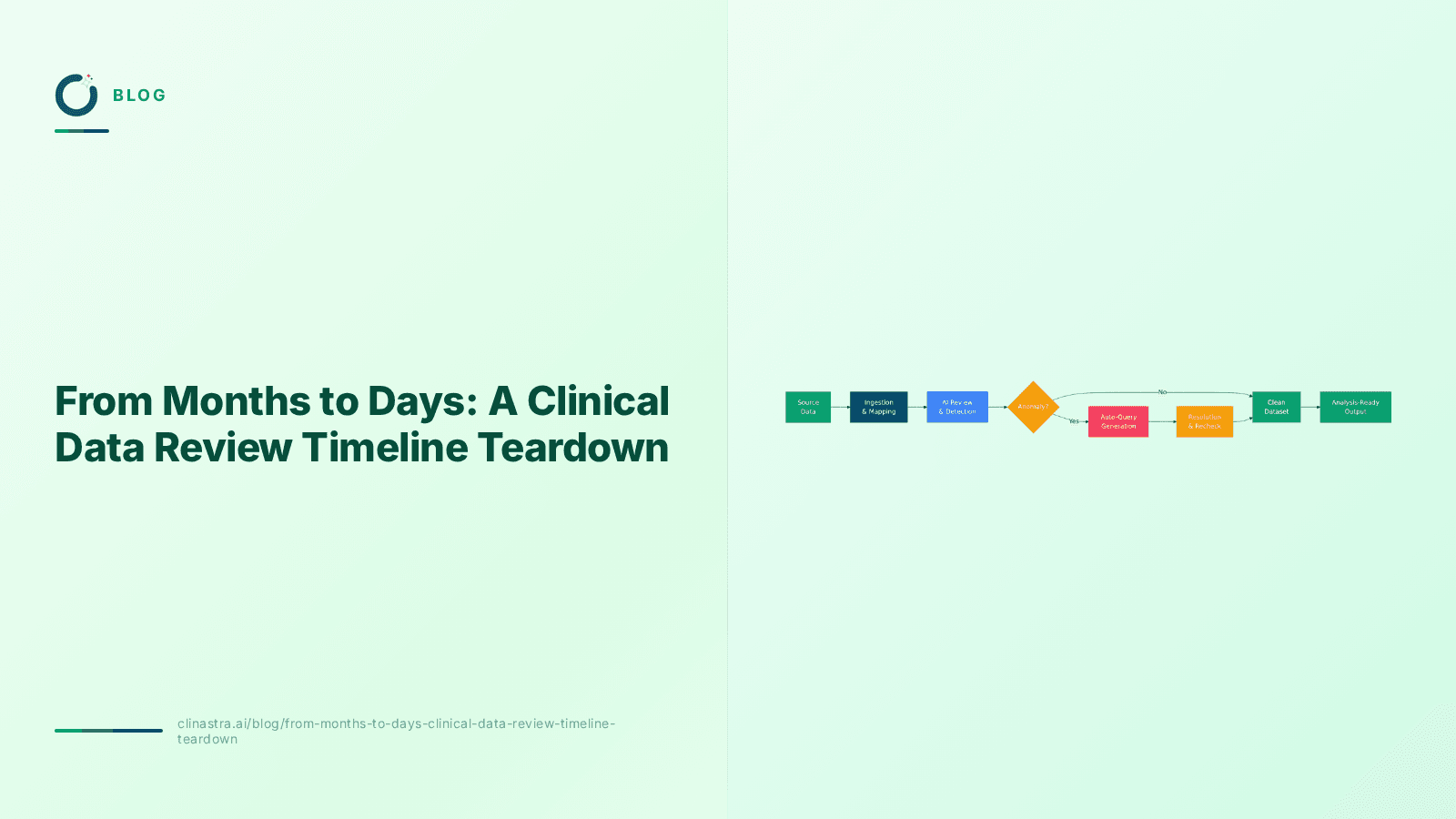
ClinAstra ingests the datasets and runs a complete review — all domains, all cross-checks, all source reconciliation — in hours, not weeks.
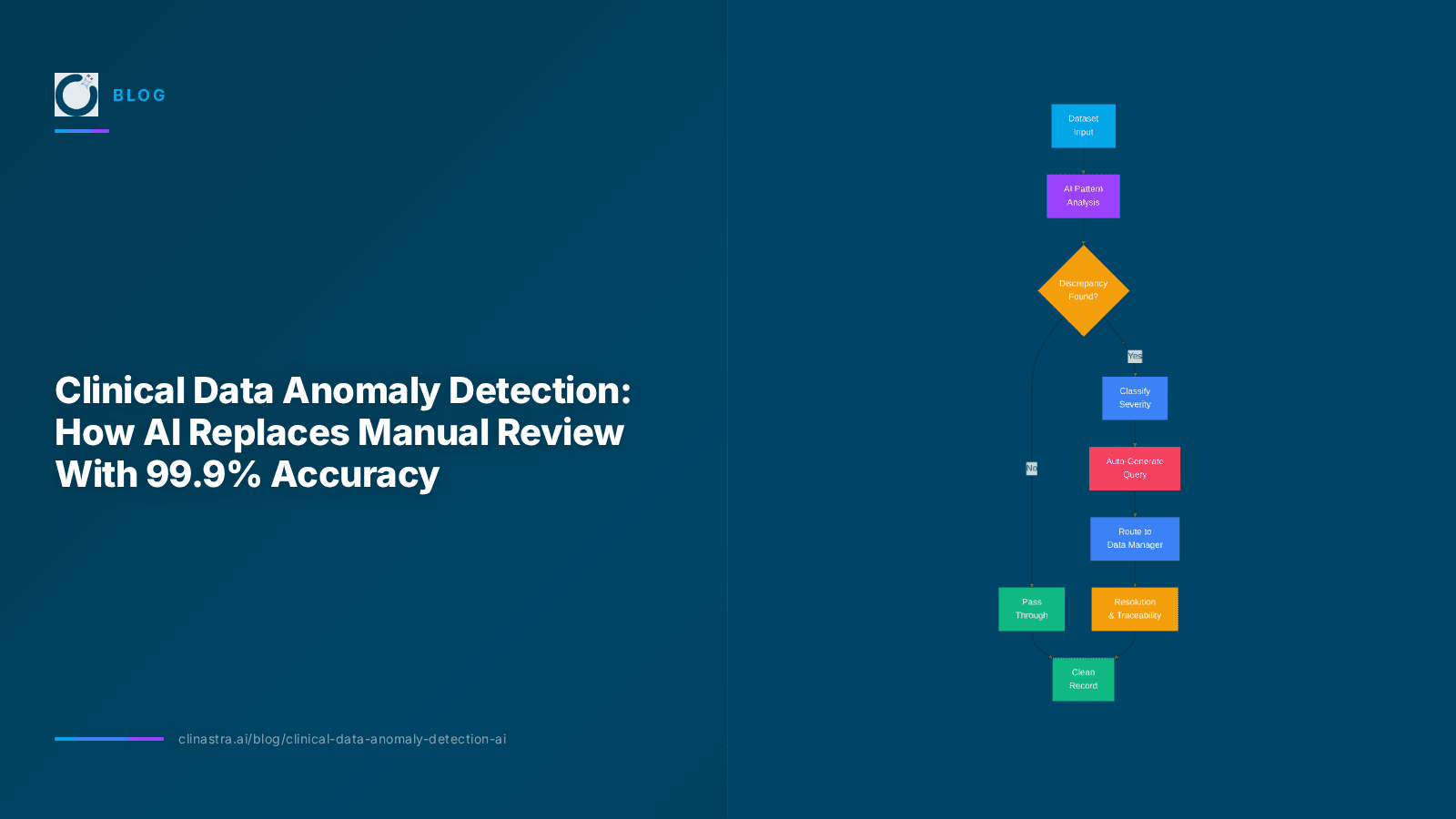
- Anomaly detection: AI scans every data point across all SDTM domains, flagging discrepancies, outliers, and inconsistencies with 99.9% accuracy. What takes a human reviewer 30 days takes ClinAstra less than a day.
- Cross-domain reconciliation: The system automatically checks every cross-domain relationship — AE vs. concomitant meds, labs vs. safety, exposure vs. visit schedule — and flags any mismatch.
- Source reconciliation: ClinAstra reconciles EDC data against lab data, vendor data, and any connected source system — automatically, in real-time, as data flows in.
Time: Hours. Not 30 days. Hours.
Day 1-2: Automated Query Generation
ClinAstra doesn't just find discrepancies — it generates queries automatically. Each flag includes:
- The specific discrepancy identified
- The data points involved (with full traceability)
- The suggested query text for the site or partner
- Priority ranking based on impact
No manual drafting. No human deciding which discrepancies are worth querying. The AI has already done the pattern-matching work — and it shows its reasoning for every flag.
Time: Same day. Queries are generated and ready to send before a human reviewer would have finished their first cup of coffee on Day 1.
Day 2-3: Human Review of AI Findings (Not Data Review)
Here's where humans come back — not to review data, but to review the AI's findings.
- A clinical data manager reviews the prioritized list of flagged anomalies.
- For each flag, they can see exactly what ClinAstra identified, why it was flagged, and the supporting data.
- They confirm, dismiss, or adjust the query — then it goes out.
This isn't months of data review. This is a few hours of decision-making by someone who now spends their time on judgment, not pattern-matching.
Time: 1-2 days. And this is the human-in-the-loop step that ensures the AI's work meets clinical standards.
Day 3: Database Lock Ready
With queries resolved and data validated, the datasets are analysis-ready and audit-ready.
- All flags are traceable — every anomaly identified, every query generated, every resolution documented.
- The define.xml and metadata are consistent with the reviewed datasets.
- The database lock checklist is pre-populated based on the AI's comprehensive review.
Time: 3 days. Not 90.
The Side-by-Side
| Step | Manual Review | ClinAstra |
|---|---|---|
| Full dataset review | 30 days | Hours |
| Cross-domain reconciliation | 10-15 days | Hours (automated) |
| Source reconciliation | 10-15 days | Hours (automated) |
| Query generation | 5-10 days | Same day (automated) |
| Query response cycle | 15-30 days | 1-2 days (faster, pre-prioritized) |
| Final QC and lock prep | 15-30 days | 1 day (pre-validated) |
| Total | ~90 days | ~3 days |
What 87 Saved Days Actually Means
It's tempting to look at this and think: "Great, we save 87 days." But the impact is compounding, not linear.
For the trial:
- Database lock moves up by 87 days. Analysis starts sooner. Submission starts sooner. Approval comes sooner.
- The next trial phase starts earlier. If this is a Phase II trial, Phase III planning begins 87 days earlier — which means the entire development program shifts forward.
For the team:
- Reviewers spend 3 days on decisions instead of 90 days on data checking. That's 87 days of senior talent redirected to high-value work — protocol design, safety analysis, statistical planning.
- No reviewer burnout cycle. The team isn't grinding through 3 months of repetitive pattern-matching. They're reviewing prioritized flags and making calls.
For the budget:
- 70% reduction in review operational costs. Fewer reviewer hours, faster query cycles, less re-work.
- Faster time-to-market. For a blockbuster therapy, each day earlier to market can mean millions in revenue. 87 days? The math speaks for itself.
For the patient:
- 87 days. That's nearly 3 months a patient gets access to a therapy sooner. In oncology, in rare disease, in any condition where patients are waiting — that's not a number. That's someone's life.
The Reframe
The clinical industry has treated 90-day data review as a law of physics. It's not. It's a limitation of manual processing — and that limitation no longer exists.
From months to days. Not faster humans. Not better spreadsheets. Not a tool that "assists" reviewers. A system that does the review — with 99.9% accuracy, full traceability, and audit-ready output.
The 90-day block on your Gantt chart is not fixed. It's a choice. And it's one you no longer have to make.
ClinAstra automates clinical data review from source to analysis-ready datasets, detecting anomalies and discrepancies with 99.9% accuracy in real-time. From months to days. Audit-ready by design. Request a demo to see your timeline teardown.