The 20-Year Bottleneck Nobody Questions
Here's a number that should make every clinical operations leader uncomfortable: the average Phase III trial takes 7-9 years. And that number hasn't meaningfully improved in two decades.
We've innovated everywhere — adaptive trial designs, biomarker-driven enrollment, decentralized trials, real-world evidence. The science has never been more sophisticated. The protocols have never been more refined. The technology supporting trials has never been more advanced.
Yet timelines haven't moved.
Why? Because everyone is optimizing the science and nobody is questioning the review process.
Where Trials Actually Stall
Let's trace where time goes in a typical trial. Protocol design? Weeks. Site activation? Months, yes — but well-studied and actively optimized. Patient enrollment? The entire industry has built solutions around it.
Then data comes in. And everything stops.
Data review — the process of checking, reconciling, validating, and cleaning trial data — consumes months of manual effort. Clinical data managers, reviewers, and biostatisticians spend weeks poring over SDTM and ADaM datasets, manually identifying discrepancies, flagging anomalies, raising queries, and waiting for responses from sites and partners.
This isn't a minor step in the process. It's the single largest block of non-science time between database lock and submission. And it's treated as fixed — an unchangeable cost of doing clinical trials.
It's not fixed. It's just never been challenged.
The Hidden Cost of Manual Review
The damage isn't just time. It's talent.
When you run a clinical trial, you hire some of the most skilled professionals in the industry — PhDs, statisticians, clinical scientists — and then you spend a significant portion of their time asking them to do pattern-matching work. Checking if Lab Value A matches Lab Value B. Reconciling the EDC against the lab database. Cross-referencing adverse events across multiple source systems.
These are people trained to analyze efficacy signals, design statistical approaches, and interpret clinical outcomes. Instead, they're spending days doing what is, at its core, data reconciliation.
The cost is threefold:
- Time cost. Months of review delays compound. A 2-month review bottleneck doesn't just add 2 months — it pushes back database lock, which pushes back analysis, which pushes back submission, which pushes back approval.
- Talent cost. Senior reviewers burn out doing repetitive work. Turnover in clinical data management is a quiet crisis nobody talks about. When a data manager quits, their institutional knowledge walks out with them — and re-onboarding adds more delay.
- Patient cost. Every month of delay is a month patients wait for a therapy that may already be proven effective but hasn't been submitted yet. In oncology trials, this isn't an inconvenience. It's lives.
Why the Industry Accepted This for 20 Years
If the problem is this obvious, why hasn't anyone fixed it?
Because for 20 years, there was no alternative. Manual review was the only way to ensure data integrity. You couldn't automate pattern recognition across unstructured clinical data. You couldn't algorithmically reconcile discrepancies across heterogeneous source systems. You needed humans because only humans could identify anomalies that didn't fit expected patterns.
So the industry built its entire workflow around the assumption that review is manual. Protocols include review time. Budgets include review headcount. Timelines include review months. The bottleneck isn't an accident — it's structurally baked into how trials are planned and executed.
Questioning it means questioning the foundation. And nobody wanted to question the foundation because the stakes are too high — you can't afford to get clinical data wrong.
That was a valid argument. Until it wasn't.
What Changed: AI Can Now Do This Better
The breakthrough isn't that AI got faster. It's that AI got precise enough to be trusted with clinical data.
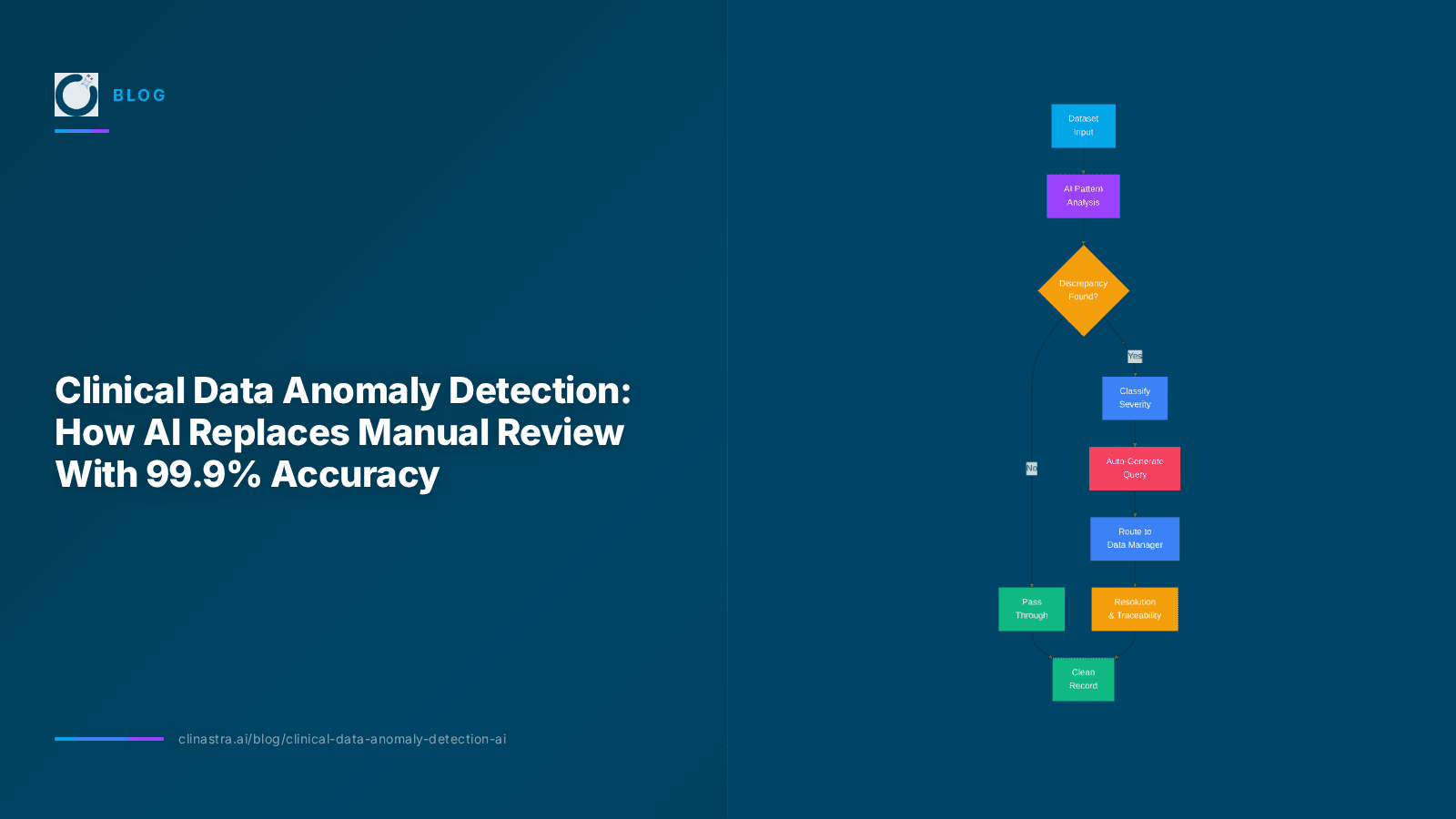
ClinAstra's platform achieves 99.9% accuracy in anomaly detection across clinical trial datasets. Not 95%. Not "pretty good." 99.9% — a number that exceeds what manual review typically achieves in practice, where reviewer fatigue, inconsistent standards, and human error introduce their own failure rate.
Here's what that means: the argument that manual review is necessary for accuracy is no longer true. AI doesn't just do it faster. It does it better — more consistently, more comprehensively, and without the fatigue that causes human reviewers to miss the 4th discrepancy in a 400-row dataset on a Friday afternoon.
And it does it in days, not months.
The Reframe: Review Is Not a Human Job Anymore
This is the uncomfortable truth the industry needs to sit with:
Data review is not a human job anymore. It is a computation problem hiding inside a human workflow. The discrepancies are patterns. The anomalies are signals. The reconciliation is logic. These are things AI was built to do — and now, with 99.9% accuracy and audit-ready traceability, it can do them at a standard that meets clinical trial requirements.
This doesn't mean humans are removed from the process. It means humans are elevated. Instead of spending months checking data, your team spends their time on what they were trained for: interpreting results, making decisions, and advancing the science.
Review less. Decide more.
What Happens When the Bottleneck Disappears
When data review goes from months to days, the entire trial timeline shifts:
- Database lock comes faster — because data is clean in real-time, not after a months-long review cycle.
- Submission timelines compress — because analysis-ready datasets are available sooner.
- Teams focus on decisions, not data entry — because the pattern-matching work is done.
- Reviewers stop burning out — because their jobs become about judgment, not checking.
- Patients get access sooner — because every day saved in review is a day a patient waits less.
The 7-9 year trial timeline isn't a law of nature. It's a product of a workflow that includes a step that no longer needs to be manual. Remove that step, and the timeline moves.
The Question for Clinical Operations Leaders
If you're a Director or VP of Clinical Operations, here's the question worth asking yourself:
How much of your team's time is spent reviewing data — and how much is spent making decisions based on that data?
If the answer makes you uncomfortable, you're not alone. Every clinical ops leader is carrying the same bottleneck. Most have just stopped seeing it as a bottleneck — they see it as "the way trials work."
It's not the way trials work. It's the way trials worked. The way trials work now is faster.
ClinAstra automates clinical data review from source to analysis-ready datasets, detecting anomalies and discrepancies with 99.9% accuracy in real-time. From months to days. Audit-ready by design. Request a demo to see how ClinAstra can compress your trial timelines.