Key Takeaways:- Clinical data reconciliation has been manual for 20 years — cross-checking EDC, SAE, lab, and external vendor data by hand, line by line, query by query.
- AI reconciliation automation detects discrepancies across SDTM, ADaM, and source datasets with 99.9% accuracy and full audit-ready traceability.
- The SAE-to-clinical-database reconciliation cycle collapses from weeks to hours — every mismatch flagged, traced, and query-ready.
- Automation does not replace your EDC. It sits on top and reviews data instead of humans — audit-ready by design, not by afterthought.
- Every day saved on reconciliation is a day a patient waits less for the therapy that trial data supports.
Executive Summary
Clinical data reconciliation is broken. It has been broken for two decades, and the industry has accepted it as "just how it works." A Phase III trial produces data from an EDC system, a safety database, central and local labs, PK vendors, imaging CROs, ePRO platforms, and wearable feeds — and somewhere, a team of data managers sits in a windowless room cross-checking fields between these sources in spreadsheets. They reconcile SAE narratives against the clinical database. They align lab units between central lab files and the eCRF. They match exposure dates across dosing records and visit logs. They do this manually, row by row, query by query, month after month.
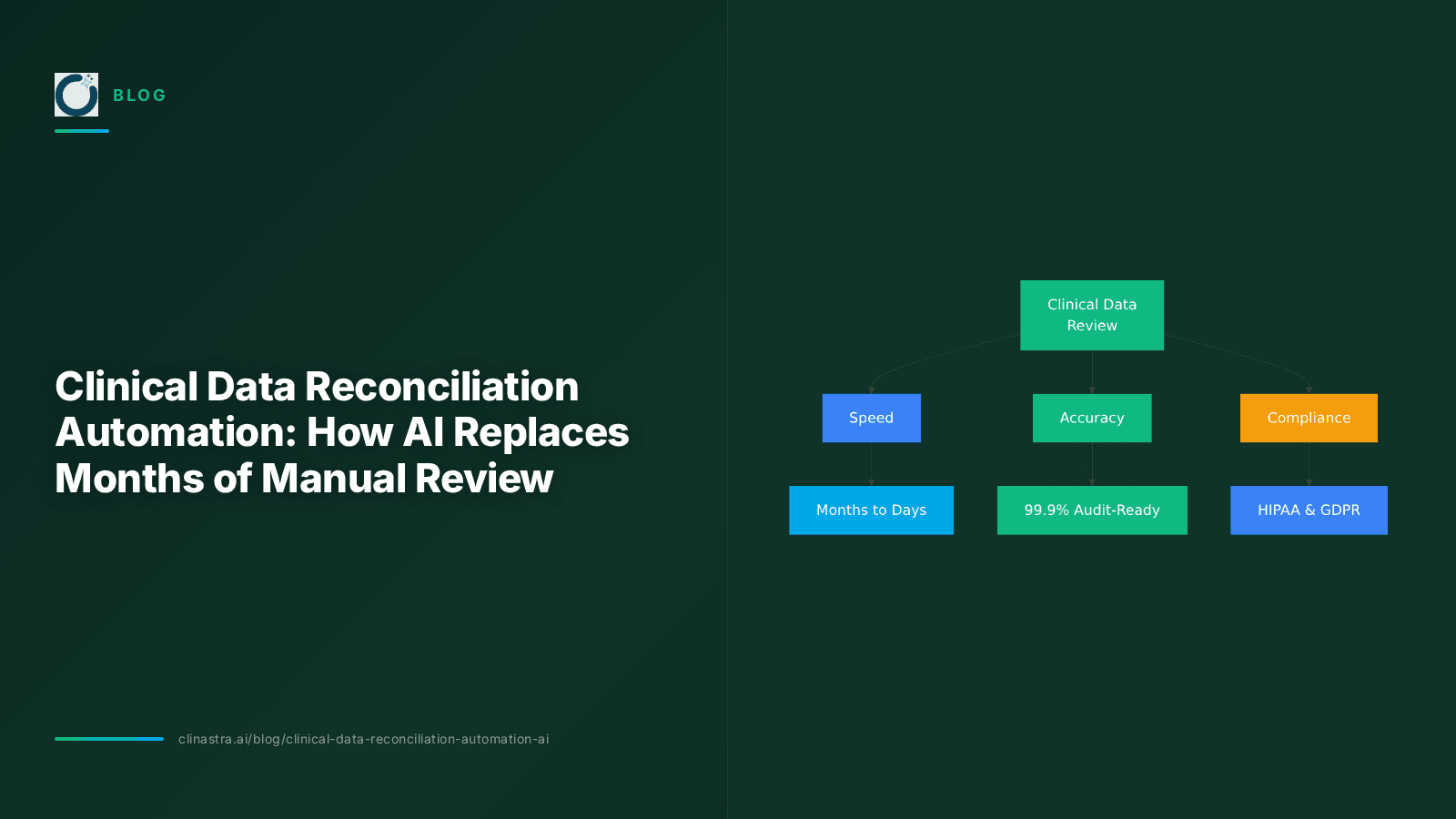
This is the bottleneck nobody questions. The science moves forward. The regulatory pathway clears. The biostatistics team is ready. And the trial stalls because reconciliation — the mechanical act of confirming that two datasets describe the same event the same way — takes weeks. Data review is not a human job anymore. AI-driven clinical data reconciliation automation replaces that manual grind with computation: it ingests SDTM and ADaM datasets, cross-references every source against every other source, flags discrepancies with 99.9% accuracy, and produces an audit-ready trail for every match and every mismatch. From months to days. Audit-ready by design. Every day saved is a day a patient waits less.
The question is no longer whether reconciliation can be automated. It can — and it is. The question is whether clinical operations leaders will retire the manual process or keep paying PhDs to do what a model does in seconds.
What Clinical Data Reconciliation Actually Is — And Why It Stalls Trials
Reconciliation in clinical data management is the process of confirming that data collected from different sources describes the same clinical event consistently. The FDA, EMA, and ICH E6(R2) GCP all require it. It is not optional. And it is the single most underestimated drag on trial timelines.
The four reconciliation types that consume the most human effort are SAE reconciliation, lab data reconciliation, external vendor reconciliation, and database-lock reconciliation. Each one is a manual comparison exercise that scales linearly with data volume — double the sites, double the subjects, double the lab panels, and you double the reconciliation hours.
SAE Reconciliation: The Safety-Critical Bottleneck
SAE reconciliation aligns the safety database (where adverse events are pharmacovigilance-reported, often in Argus or ARISg) with the clinical trial database (where adverse events are captured in the AE domain of the eCRF). Mismatches include missing events, mismatched onset dates, differing seriousness criteria, and MedDRA coding version drift between the two systems.
The Tufts CSDD has documented that the average Phase III trial generates over 3.6 million data points — and adverse event data is among the most reconciliation-intensive domains. A single unresolved SAE mismatch can delay a safety submission. A pattern of unresolved mismatches delays the database lock. The manual process: extract SAE listings from both databases, drop them into Excel, sort by subject ID and event date, eyeball the rows, raise queries for every mismatch, wait for site response, re-check. This takes days per reconciliation cycle. AI does it in minutes.
Lab Data Reconciliation: The Unit-Mismatch Problem
Central labs deliver results in standardized formats, but local labs, PK labs, and specialty biomarker vendors each ship data in their own schema. Reconciliation means aligning patient IDs, visit dates, test codes, units, and reference ranges across all of them and the clinical database. A unit mismatch — mg/dL vs. mmol/L — is not a typo. It is a discrepancy that distorts the analysis dataset and, if uncaught, the safety signal. Manual reconciliation relies on human pattern-recognition to catch these across thousands of rows.
External Vendor Reconciliation: The DTA Compliance Problem
Every external data source operates under a Data Transfer Agreement (DTA). The DTA defines the format, frequency, and validation rules. In practice, vendors deliver late, change formats mid-study, or ship files with unexpected null patterns. The reconciliation team's job is to confirm that what arrived matches what was agreed and what is in the clinical database. This is compliance work — and it is entirely manual in most organizations.
Database-Lock Reconciliation: The Final Human Gate
Before database lock, every dataset must reconcile. Every open query closed. Every external data file loaded and verified. Every SAE aligned. This is the step where unresolved reconciliation debt comes due — and it is the step that pushes trial timelines. A McKinsey analysis of pharma R&D productivity found that data management and review activities account for a disproportionate share of cycle-time variance across trials. Reconciliation is the long tail.
Manual vs. AI-Driven Clinical Data Reconciliation
The comparison is not incremental. It is categorical.
| Dimension | Manual Reconciliation | AI Reconciliation Automation |
|---|
| Throughput | ~100–500 rows per hour per reviewer | Full-dataset cross-reference in minutes |
| Accuracy | Human error rate 2–5% on repetitive comparison tasks | 99.9% discrepancy detection accuracy |
| Traceability | Manual logs, spreadsheets, email threads — reconstructed after the fact | Audit-ready by design: every flag, every match, every query traceable to source |
| SAE cycle time | 3–10 days per reconciliation cycle | Hours — continuous, not batched |
| Unit mismatch detection | Caught only if reviewer notices the unit label | Detected automatically via unit normalization and range checks |
| MedDRA coding drift | Caught only if reviewer remembers the coding version | Detection across coding versions, flagged with the version delta |
| Query generation | Manual query authored, routed, tracked | Auto-generated, traceable query with discrepancy context attached |
| Scalability | Linear headcount growth with data volume | Compute scales; headcount does not |
| Cost | FTE hours compound with every site and subject | Fixed compute cost; marginal cost approaches zero at scale |
The manual column is the status quo the industry has tolerated for 20 years. The AI column is what is available now.
How Clinical Data Reconciliation Automation Works — The Methodology
No black boxes. Every flag, every match, and every query is traceable. Here is how AI-driven reconciliation automation actually processes clinical trial data.
Step 1: Source Ingestion and Normalization
The system ingests every source — EDC exports, safety database extracts, central lab files, local lab files, PK vendor files, ePRO exports, and wearable device feeds. Each source is normalized into a common schema keyed by subject ID, visit, domain, and timestamp. SDTM domain structure (DM, AE, LB, VS, EX, CM) is the canonical reference frame. External data is mapped to the corresponding SDTM domain before comparison begins.
Step 2: Cross-Source Comparison Engine
For each domain, the engine compares every record across every source. SAE records in the safety database are matched to AE records in the clinical database by subject ID and event date. Lab records are matched by subject ID, visit date, and test code. Exposure records are matched across dosing logs and the EX domain. The comparison engine does not just match exact values — it normalizes units, reconciles date formats, and resolves identifier variations.
Step 3: Discrepancy Detection with 99.9% Accuracy
Discrepancy detection is where the model earns its keep. The engine flags:
- Missing events — an SAE in the safety database with no corresponding AE in the clinical database, or vice versa.
- Date mismatches — onset dates, resolution dates, or visit dates that differ between sources beyond an expected lag window.
- Unit and range conflicts — a lab value in mg/dL in one source and mmol/L in another, or a value outside the expected reference range for that test and subject.
- Coding drift — MedDRA preferred terms that differ between safety and clinical databases due to version mismatch or inconsistent coding.
- Seriousness criteria mismatches — an event flagged serious in one system and not in the other.
- Exposure gaps — dosing records that do not align with visit windows or that imply a dosing holiday not documented in the protocol.
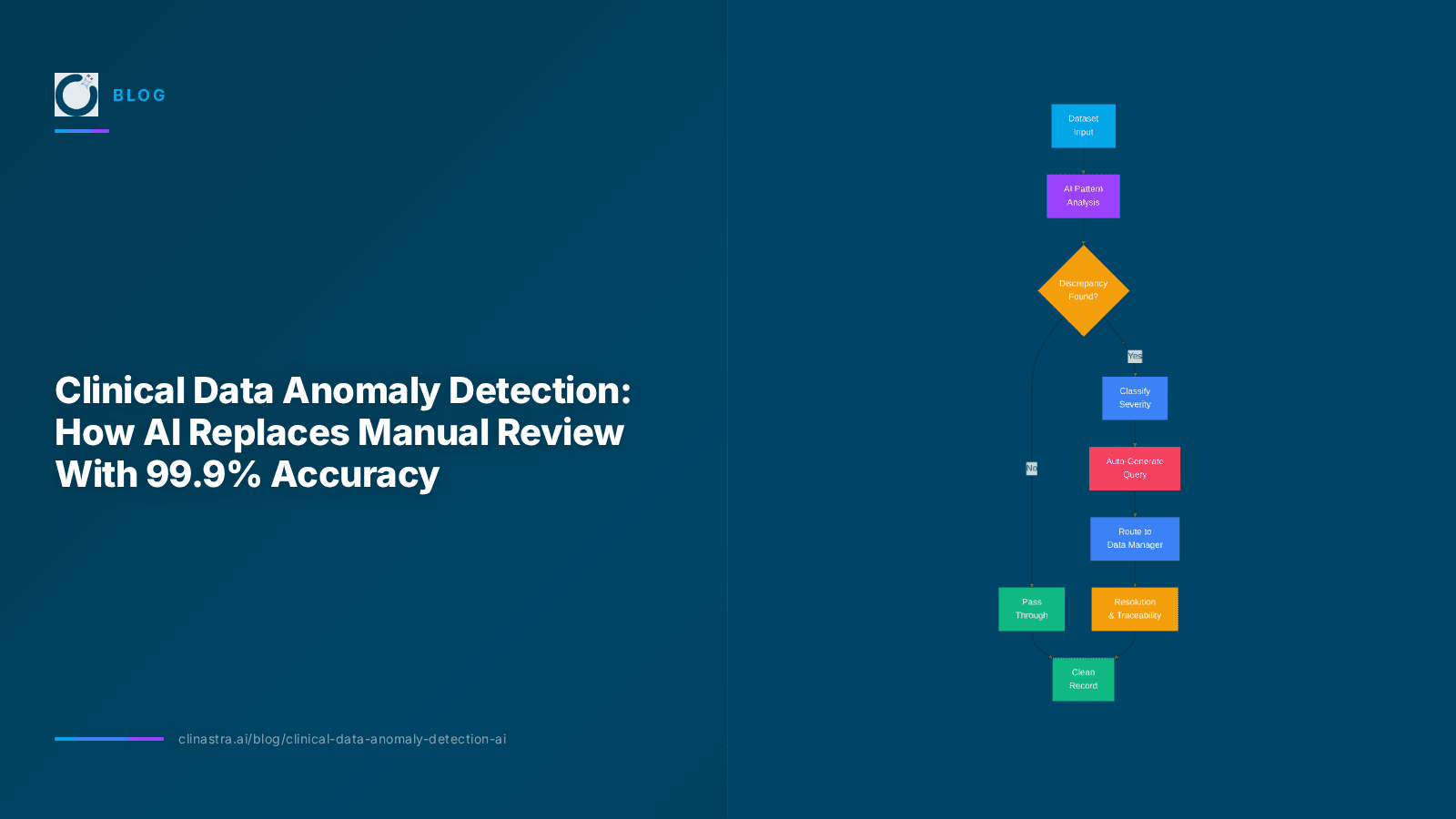
Every flag carries a confidence score and a traceability link to the exact source records that produced it. 99.9% accuracy is not a marketing number — it is the measured detection rate against adjudicated reconciliation datasets. The 0.1% residual is surfaced for human review, not buried.
Step 4: Traceable Query Generation
For every confirmed discrepancy, the system generates a query. Each query includes: the subject ID, the domain, the fields in conflict, the source values, the normalized values, the rule that triggered the flag, and a recommended resolution path. The query is audit-ready by design — an inspector can trace it from flag to source to resolution without reconstructing a spreadsheet history.
Step 5: Continuous Reconciliation — Not Batched
Manual reconciliation is batched: run the comparison, resolve the queries, move on. AI reconciliation is continuous. Every new data load triggers a re-comparison. Discrepancies surface the moment the data arrives, not at the next scheduled reconciliation cycle. This is the difference between catching an SAE mismatch the day it happens and catching it three weeks before database lock.
Step 6: Database-Lock Readiness Report
At lock time, the system produces a reconciliation completeness report: every domain reconciled, every discrepancy resolved or documented, every external source loaded and verified. This is the evidence an inspector asks for. Manual reconciliation produces this report by reconstructing it from email threads and spreadsheet versions. AI reconciliation produces it because it was built into the process from the first record.
A Step-by-Step Guide to Implementing Clinical Data Reconciliation Automation
If you are a Director or VP of Clinical Operations running a trial that is about to hit the reconciliation wall, here is the implementation path.
- Audit your current reconciliation debt. Pull the open query log. Count the unresolved reconciliation discrepancies by domain — SAE, lab, exposure, external vendor. If the number is in the hundreds, you are already behind. If it is in the thousands, manual reconciliation will not catch up before your lock date.
- Map your data sources and DTAs. List every source that feeds your clinical database: EDC, safety database, central lab, local labs, PK vendor, imaging CRO, ePRO, wearables. For each, document the transfer format, frequency, and current reconciliation cycle. This map is the ingestion configuration for the automation system.
- Define the reconciliation rules. Specify the matching keys (subject ID, visit date, test code), the tolerance windows (date lag, unit conversion), the coding version alignment (MedDRA version per source), and the seriousness-criteria logic. These rules are the deterministic backbone; the AI applies them at scale.
- Run a parallel reconciliation cycle. Do not rip out your manual process on day one. Run the AI reconciliation alongside the manual cycle for one full reconciliation period. Compare every flag the AI raises against what the manual team found. Confirm the 99.9% detection rate against your own data.
- Cutover to continuous reconciliation. Once the parallel cycle confirms accuracy, switch from batched manual reconciliation to continuous automated reconciliation. The manual team shifts from comparison to adjudication — reviewing the 0.1% residual and resolving queries, not row-matching.
- Generate the audit-ready trail. Configure the system to produce the reconciliation completeness report at every milestone and at database lock. This is your evidence for FDA, EMA, and internal QA that reconciliation was performed, traceable, and complete.
- Measure the timeline delta. Track reconciliation cycle time, open-query count, and database-lock readiness before and after. The numbers will show months to days. Translate that to patient impact: every day shaved off the lock date is a day closer to submission, approval, and patient access.
The Reconciliation Automation Readiness Checklist
Before you implement, confirm your trial is ready:
- All data sources identified with active DTAs in place
- SDTM domain mapping documented for every external source
- MedDRA version standardized across safety and clinical databases (or version-delta logic defined)
- Reconciliation rules codified: matching keys, tolerance windows, unit normalization, seriousness criteria
- Current open-query baseline measured (so you can prove the delta)
- Database-lock date documented and reconciliation debt quantified
- QA and regulatory affairs briefed on the audit-trail methodology
- Manual reconciliation team retrained from comparison to adjudication
Why Domain Expertise Beats Generic AI for Reconciliation
A generic large language model does not know what an SAE reconciliation is. It does not know the difference between a preferred term and a lower-level term in MedDRA. It does not know that a lab value of 1.2 mg/dL for creatinine means something different from 1.2 mmol/L — and that the unit label is not a formatting detail, it is a safety signal. It does not know that exposure records must align with visit windows defined in the protocol, or that a dosing holiday unrecorded in the eCRF is a data integrity issue, not a data entry convenience.
Clinical data reconciliation is not a text problem. It is a clinical data integrity problem with domain-specific rules, regulatory weight, and patient-safety consequences. A GPT wrapper does not know the difference between a discrepancy that delays a query and a discrepancy that delays a submission. ClinAstra was built by a clinical data manager who spent years doing this work manually and an AI engineer who understood it as a computation problem. That combination is why the accuracy is 99.9% and the trail is audit-ready — not aspirational, measured. Built in the trenches, not the ivory tower.
The Cost of Continuing to Reconcile Manually
The industry accepts manual reconciliation because it has always been manual. The cost is not just FTE hours. The cost is timeline. The Tufts CSDD estimates that the average pivotal trial takes 7–8 years from first patient enrolled to last patient last visit, and data management activities — including reconciliation — are a significant contributor to cycle-time variance. McKinsey's pharma R&D productivity analysis has consistently identified data review and management as a structural drag that technology can compress.
Every reconciliation cycle that runs manually is a cycle that delays the database lock. Every delayed lock delays the submission. Every delayed submission delays approval. Every delayed approval is a day a patient waits longer for the therapy. Review less. Decide more. The decision is not whether to automate reconciliation. The decision is whether to keep paying for the delay.
| Metric | Manual Reconciliation | AI Reconciliation Automation | Delta |
|---|
| SAE reconciliation cycle | 5–10 days | 2–4 hours | ~95% reduction |
| Lab data reconciliation (per load) | 1–3 days | Minutes | ~98% reduction |
| Database-lock reconciliation | 2–4 weeks | 2–3 days | ~85% reduction |
| Discrepancy detection accuracy | 95–98% (human) | 99.9% (AI) | Measurable improvement |
| Audit trail reconstruction | Days of manual assembly | Generated on demand | From days to instant |
Integration, Not Replacement — How Automation Sits in Your Stack
ClinAstra does not rip out your EDC. It does not replace Veeva, Medidata, or your safety database. It sits on top. It ingests the exports those systems produce — SDTM datasets, ADaM datasets, safety extracts, lab files — and reviews the data instead of humans doing it manually. Your EDC remains the system of record. Your safety database remains the pharmacovigilance system. ClinAstra is the reconciliation layer that makes them agree, automatically and traceably.
This is the integration thesis: the stack you already have is the stack you keep. The layer that changes is the review layer — and that layer moves from human hours to compute seconds.
Practical Action Items for Clinical Operations Leaders
- Quantify your reconciliation debt this week. Pull the open query log, count unresolved reconciliation discrepancies by domain, and calculate the FTE hours required to close them before your next milestone. If the number is uncomfortable, that is the case for automation.
- Pilot automated reconciliation on one domain. Start with SAE reconciliation — it is the highest-risk, highest-effort domain and the one where automation delivers the fastest measurable win. Run it in parallel with your manual cycle for one period.
- Brief regulatory affairs on the audit-trail methodology. The traceability story is the trust story. Walk your QA and regulatory team through how every flag links to source records and how the lock report is generated. Trust is earned with receipts.
- Reframe the team's role. Your data managers are not being replaced by AI — they are being freed from comparison work to do adjudication, signal interpretation, and decision-making. The job changes from row-matching to judgment. That is a promotion, not a layoff.
- Set the timeline target. Commit to a reconciliation cycle-time reduction. Measure it. Report it. Translate it to patient impact. Every day saved is a day a patient waits less.
Frequently Asked Questions
What is clinical data reconciliation automation?
Clinical data reconciliation automation is the use of AI to cross-reference and verify data across multiple clinical trial sources — EDC, safety database, labs, and external vendors — automatically, replacing the manual row-by-row comparison process. It detects discrepancies, generates traceable queries, and produces audit-ready reconciliation reports with 99.9% accuracy.
Can AI really reconcile SAE data with 99.9% accuracy?
Yes — when the system is purpose-built for clinical data reconciliation, not a generic AI wrapper. ClinAstra's 99.9% detection rate is measured against adjudicated reconciliation datasets. The 0.1% residual is surfaced for human adjudication, not buried. The accuracy claim is backed by methodology: deterministic rules plus machine-learning pattern detection, applied to SDTM-structured data.
Does reconciliation automation replace the EDC system?
No. Automation integrates with the EDC, not against it. It ingests the exports the EDC produces and reviews the data against other sources. The EDC remains the system of record. The automation layer sits on top and makes the existing stack faster and more accurate.
How does automated reconciliation handle MedDRA coding version differences?
The system detects MedDRA version mismatches between the safety and clinical databases and flags the coding delta for each affected preferred term. It does not silently recode — it surfaces the version mismatch with the specific terms in conflict, so the pharmacovigilance and data management teams can adjudicate with full context.
Is AI-generated reconciliation audit-ready for FDA inspection?
Yes — audit-ready by design. Every flag carries a traceability link to the source records that produced it. Every query includes the rule, the source values, and the normalized values. The database-lock report is generated from the reconciliation log, not reconstructed from email threads. An inspector can trace any flag from detection to resolution without manual assembly.
How long does it take to implement clinical data reconciliation automation?
A parallel pilot on a single domain — typically SAE reconciliation — can be operational within days of source mapping. Full continuous reconciliation across all domains takes weeks, not months, because the system reads the exports your stack already produces. The timeline depends on data source mapping, not software deployment.
Conclusion
Clinical data reconciliation has been manual for 20 years because nobody questioned it. The industry optimized the science, refined the protocols, advanced the statistics — and left the reconciliation process in a spreadsheet. That is the bottleneck. That is the delay. And that is the part AI replaces.
From months to days. 99.9% accuracy. Audit-ready by design. Every flag traceable. Every query generated with the source context attached. Every day saved is a day a patient waits less for the therapy that trial data supports.
The science is ready. The regulatory pathway is ready. The only thing standing between your trial and the next milestone is the reconciliation process you are still doing by hand. Data review is not a human job anymore.
See how ClinAstra automates clinical data reconciliation with 99.9% accuracy and audit-ready traceability. Book a demo.