Key Takeaways:- The LPLV-to-database-lock window averages 4–8 weeks. With AI-native review, it collapses to days — not by working faster, by replacing the manual process entirely.
- Tufts CSDD estimates every day of trial delay costs $40,000 in direct costs and up to $500,000 in lost revenue. Data review acceleration is the highest-leverage move left.
- ClinAstra delivers 99.9% anomaly-detection accuracy with full traceability — every flag, every query, every signal is audit-ready by design.
- Continuous data review (not batch post-LPLV cleaning) is the structural shift. AI makes it possible at scale without burning out your data managers.
- Every day saved is a day a patient waits less for therapy. Speed is compassion, not just efficiency.
Executive Summary: The Bottleneck Is Review, Not Science
Clinical trials don't fail because the science is wrong. They stall because data review is a manual relic — months of human pattern-matching that an AI can do in seconds. The industry accepted this bottleneck as “just how it works” for twenty years. It's time to retire it.
When you accelerate clinical trial data review, you don't just shorten a timeline — you unlock the entire downstream pipeline. Database lock happens sooner. SDTM and ADaM datasets are cleaner faster. Safety signals surface before they become headlines. Regulatory submissions land on time. And the people who used to spend their weeks eyeballing listings and reconciliation spreadsheets get to do the work they were actually trained for: making decisions.
Here's the bold claim, backed by evidence: with AI-native review, the LPLV-to-database-lock window compresses from an industry average of 4–8 weeks to days. Not by making humans work faster. By replacing the manual process entirely. Data review is not a human job anymore.
Why Data Review Is the Hidden Bottleneck
Ask a clinical operations leader what slows their trial, and they'll name enrollment, site activation, or regulatory approval. Those are real bottlenecks — but they're the ones the industry has spent twenty years optimizing. Data review is the one nobody questions.
It hides between two milestones everyone tracks: Last Patient Last Visit (LPLV) and database lock. That gap — the weeks where data managers manually reconcile, query, validate, and clean — is where trial timelines go to die. Tufts Center for the Study of Drug Development reports that average LPLV-to-database-lock timelines hover at 4–8 weeks, with complex Phase III trials stretching to 7–8 weeks or longer. Some sponsors still take three months.
The PPD clinical research business of Thermo Fisher Scientific quantifies the stakes bluntly: each day of delay in a clinical trial results in approximately $40,000 in direct costs and an estimated $500,000 per day in lost potential revenue as drugs are held back from market. A four-week review window isn't a process — it's a $14 million problem dressed up as a milestone.
“The bottleneck isn't that humans are slow. It's that manual review is the wrong tool for a job that involves millions of data points across hundreds of domains. You don't accelerate a spreadsheet. You replace it.” — Karthik Nadakuditi, Founder, ClinAstra
The Manual Review Timeline (Before)
To accelerate clinical trial data review, you first have to see what's actually happening. Here's what a traditional review timeline looks like for a mid-size Phase III trial:
| Phase | Manual Process | Typical Duration | What's Actually Happening |
|---|
| 1. Data Listing Review | Data managers manually scan SDTM listings for outliers, missing values, and inconsistencies | 1–2 weeks | Human eyes on thousands of rows across dozens of domains |
| 2. Edit Check Execution | Pre-programmed edit checks run, results reviewed manually | 3–5 days | Static rules miss contextual anomalies; manual triage of every flag |
| 3. Reconciliation | Safety, efficacy, and operational data reconciled across sources (EDC, safety DB, lab, ePRO) | 1–2 weeks | Spreadsheet cross-referencing, manual query generation |
| 4. Query Management | Queries raised, sent to sites, answered, re-reviewed | 1–2 weeks | Back-and-forth cycles, manual tracking in spreadsheets |
| 5. Medical Review & Sign-off | Medical monitors review flagged data, safety signals, SAE reconciliation | 3–5 days | Manual prioritization, subjective triage |
| 6. Database Lock Prep | Final QC, SDTM validation, metadata review, lock checklist | 3–5 days | Manual checklist execution, last-minute surprises |
Total: 4–8 weeks. And that's if nothing goes wrong. The moment a reviewer quits, a site goes unresponsive, or a reconciliation discrepancy reveals a systemic issue, the timeline balloons.
The AI-Native Review Timeline (After)
Here's the same trial with AI-native data review:
| Phase | AI-Native Process | Typical Duration | What Changed |
|---|
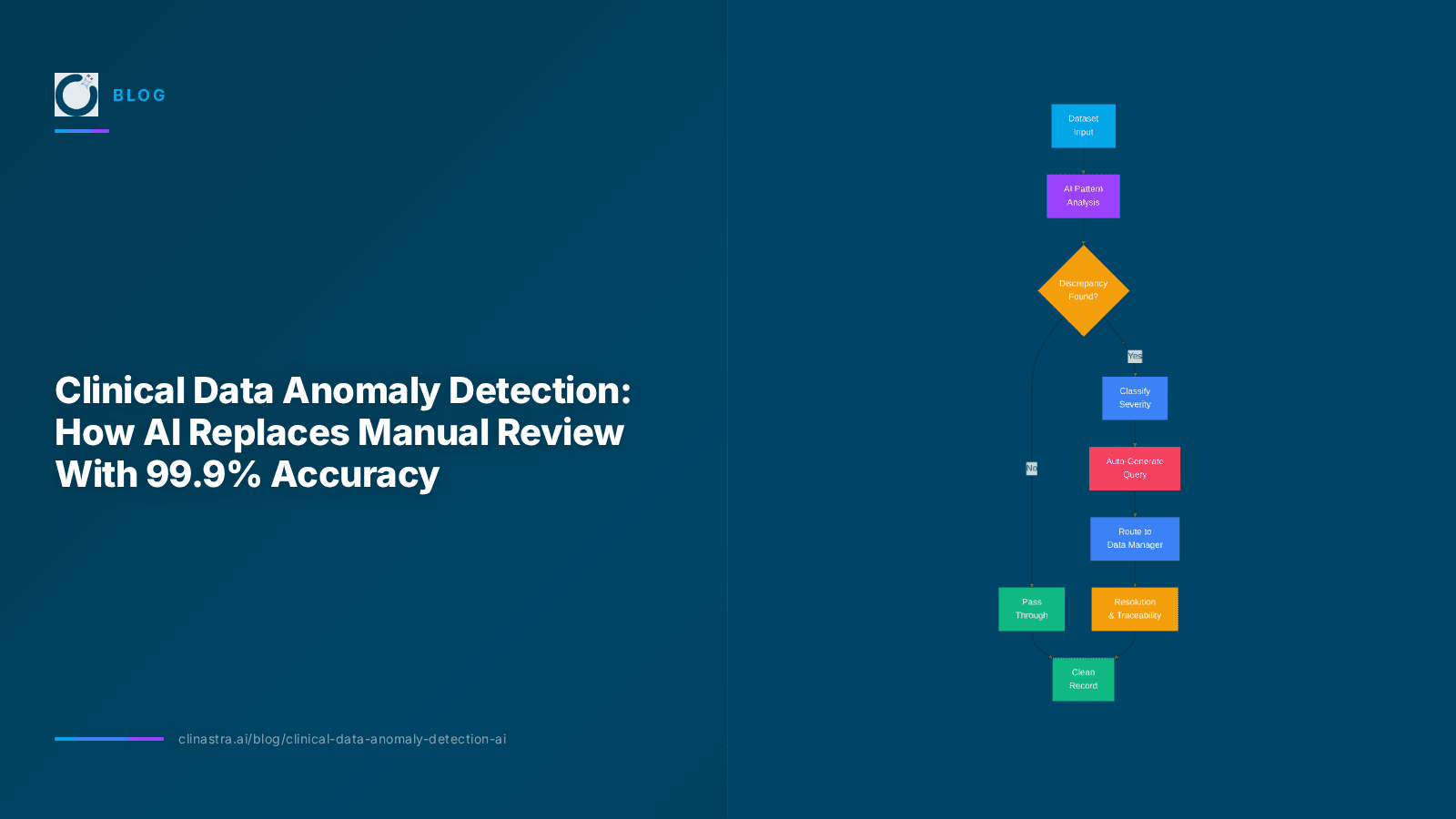
| 1. Data Listing Review | AI scans all SDTM domains simultaneously, flags anomalies with 99.9% accuracy, prioritizes by risk | Hours, not days | Continuous review starts at first data point, not at LPLV |
| 2. Edit Check Execution | Dynamic, contextual anomaly detection runs alongside static edit checks — catches what rules miss | Real-time | No manual triage; AI prioritizes and explains every flag |
| 3. Reconciliation | Automated cross-source reconciliation across EDC, safety DB, lab, ePRO — discrepancies surfaced with traceability | Hours | No spreadsheets. Every discrepancy is traceable to source. |
| 4. Query Management | AI-generated queries, auto-routed, auto-tracked, auto-reverified | Days, not weeks | Query backlog cleared in a fraction of the time |
| 5. Medical Review & Sign-off | Medical monitors see prioritized, AI-explained flags — review the exceptions, not the ocean | 1–2 days | Medical review focuses on decisions, not data sorting |
| 6. Database Lock Prep | Continuous validation means lock prep is a confirmation, not a scramble | 1 day | No last-minute surprises — issues surfaced continuously |
Total: Days, not weeks. From months to days. Not because humans work faster — because the manual pattern-matching work is done by a system built for it.
How to Accelerate Clinical Trial Data Review: A Step-by-Step Guide
The shift from months to days isn't a feature toggle. It's a structural change in how review work happens. Here's the methodology:
- Start continuous review at first data point, not at LPLV. The single biggest lever is timing. Traditional review waits until LPLV, then batch-cleans. AI-native review starts the moment data enters the EDC. Anomalies surface in real time. Queries generate while the trial is still enrolling. By the time LPLV hits, the data is already clean. This is what “continuous data cleaning” means — and sponsors who adopt it compress LPLV-to-lock from 6 weeks to 2 weeks at minimum. AI pushes that further.
- Replace manual listing review with AI anomaly detection across all SDTM domains. A data manager can review a few hundred rows per hour. AI scans every domain — DM, AE, LB, VS, EX, CM, MH, and dozens more — simultaneously, in seconds. It doesn't just check rules. It learns the data's expected patterns and flags deviations that static edit checks structurally cannot catch.
- Automate reconciliation across every data source. Safety database, EDC, central lab, ePRO, PK — manual reconciliation across these sources is where weeks disappear. Automated reconciliation surfaces discrepancies with full traceability: every flag links back to the source record, the rule that triggered it, and the recommended action. No spreadsheets. No manual cross-referencing.
- Let AI generate and route queries — with human oversight at the decision point. AI-generated queries are specific, contextual, and traceable. They auto-route to the right site or function. The human reviews the query, not the data ocean. This is the difference between “assisting” and “replacing” — the system does the review work; the human makes the call on edge cases.
- Validate continuously, not at the end. SDTM validation, metadata checks, and conformance testing run continuously, not as a final-week scramble. By database lock prep, you're confirming — not discovering. No last-minute surprises. No unlock-requery-refreeze cycles.
- Lock with audit-ready evidence. Every flag, every query, every reconciliation discrepancy, every medical review decision — traceable. When a regulator asks “why was this query generated?” or “how was this anomaly detected?” you have the answer. Audit-ready by design, not audit-ready by panic.
The Numbers Behind the Claim
The “months to days” claim isn't aspirational. It's structural. Here's the math:
- Manual review throughput: A data manager reviews roughly 200–500 data points per hour. A Phase III trial generates hundreds of thousands to millions of data points across all domains.
- AI review throughput: ClinAstra scans all domains in a single pass. Millions of data points in seconds. 99.9% anomaly-detection accuracy.
- Continuous vs. batch: Traditional review is batch — 4–8 weeks of compressed effort after LPLV. Continuous review distributes that effort across the entire trial duration. The LPLV-to-lock window shrinks because most of the work is already done.
- Query resolution: AI-routed queries resolve in days, not weeks. No manual tracking spreadsheets. No lost queries. No reviewer burnout cycles.
The PPD blog on accelerating clinical trials notes that AI platforms can cut the time needed for database lock by up to 50%. That's the floor, not the ceiling — and it describes AI-assisted review, not AI-native review. When you replace the manual process entirely instead of bolting AI onto it, the compression is greater.
Manual vs. AI-Native Data Review: The Comparison
| Dimension | Manual Review | AI-Native Review (ClinAstra) |
|---|
| Review start | Post-LPLV (batch) | First data point (continuous) |
| Throughput | 200–500 points/hour per reviewer | Millions of points in seconds |
| Anomaly detection | Static edit checks + human eyes | Dynamic AI detection + static checks, 99.9% accuracy |
| Reconciliation | Manual spreadsheet cross-reference | Automated, multi-source, traceable |
| Query management | Manual generation, tracking, routing | AI-generated, auto-routed, auto-tracked |
| Traceability | Depends on process discipline | Audit-ready by design — every flag traceable |
| LPLV-to-lock timeline | 4–8 weeks (industry average) | Days |
| Reviewer burnout | High — repetitive, high-volume, low-decision work | Eliminated — humans decide, AI reviews |
| Cost per trial | Full data management team for weeks | 70% reduction in operational cost |
The Patient Impact: Why Speed Is Compassion
Here's the part that matters more than the ROI math. The FDA reports that it takes 10–12 years on average for a new drug to reach approval and reach patients. Data review is a measurable slice of that timeline — and it's one of the few slices that can be compressed by an order of magnitude without compromising quality.
Every week shaved off the review window is a week closer a patient gets to therapy. For a patient in a Phase III oncology trial, the difference between an 8-week review window and a 2-day review window isn't a metric — it's time. It's a treatment cycle. In some cases, it's survival.
This is why ClinAstra frames speed as compassion, not just efficiency. The $40,000-per-day cost of delay is real. The $500,000-per-day in lost revenue is real. But the patient waiting for a therapy that's already proven but stuck behind a spreadsheet — that's the reason this work matters.
Every day saved is a day a patient waits less.
Your Data Review Acceleration Checklist
Before you commit to accelerating your clinical trial data review, confirm your foundation is ready:
- [ ] Your EDC data is accessible via API or scheduled extract — not locked in a proprietary silo
- [ ] Your SDTM datasets follow CDISC standards (or you have a mapping plan)
- [ ] Your edit checks are documented — even if they're static, they're a starting point for AI enhancement
- [ ] Your safety database, EDC, central lab, and ePRO sources are identifiable and extractable
- [ ] Your medical monitoring team is ready to review AI-prioritized flags instead of raw listings
- [ ] Your regulatory team understands that audit-ready traceability means every flag, every query, every decision is documented
- [ ] Your data management team is ready to shift from manual review to review oversight and decision-making
- [ ] You've identified a target trial — ideally one approaching LPLV — for your first AI-native review cycle
Practical Action Items for Clinical Ops Leaders
If you're a Director or VP of Clinical Operations, here's what you do next:
- Audit your current LPLV-to-database-lock timeline. Pull the last three trials. Measure the actual duration. Most sponsors discover it's longer than they think — and more variable than it should be.
- Identify where the time goes. Is it listing review? Reconciliation? Query resolution? Medical review? The breakdown tells you where AI delivers the most leverage.
- Run a parallel review on your next trial. Don't rip out your existing process. Run AI-native review alongside manual review on one trial. Compare timelines, accuracy, and reviewer workload. Let the data make the case.
- Shift your data managers to oversight, not execution. The people who understand the data best should be making decisions, not sorting rows. AI handles the pattern-matching. Humans handle the judgment calls.
- Set a new baseline. Once you've seen days instead of weeks, make that the standard. The old timeline is no longer acceptable — not because you're aggressive, because your patients deserve the faster one.
Frequently Asked Questions
How does AI accelerate clinical trial data review without compromising accuracy?
ClinAstra uses domain-specific AI trained on clinical trial data — not a generic GPT wrapper. It combines dynamic anomaly detection with static edit checks, achieving 99.9% accuracy on flagging. Every flag is traceable: the system shows what triggered it, what data it compared against, and why it matters. Accuracy doesn't drop with speed — it improves, because AI catches contextual anomalies that static edit checks and human review both miss.
What's the difference between AI-assisted and AI-native data review?
AI-assisted review bolts AI onto a manual process — humans still review listings, AI just flags potential issues. AI-native review replaces the manual pattern-matching entirely. The system does the review. Humans handle decision points and edge cases. AI-assisted compresses timelines by 30–50%. AI-native compresses them from months to days.
Does AI-native data review work with my existing EDC and clinical data platform?
Yes. ClinAstra integrates with — not replaces — your existing stack. It sits on top of your EDC (Veeva, Medidata, or other), your safety database, your central lab feeds, and your ePRO data. It doesn't rip out what works. It makes what works faster.
How long does it take to implement AI-native data review on a trial?
Implementation depends on data source accessibility and SDTM readiness. For trials with API-accessible EDC data and standard CDISC datasets, the first review cycle can begin within days. The fastest path to value is a trial approaching LPLV — run AI-native review in parallel with your current process and compare.
Is AI-generated data review compliant with FDA and ICH E6(R3) expectations?
Yes — and more compliant than manual processes that depend on human consistency. ClinAstra is audit-ready by design: every flag, query, and reconciliation discrepancy is traceable to source data, the detection logic, and the recommended action. ICH E6(R3), finalized in 2025, emphasizes risk-based, technology-enabled quality management — exactly what AI-native review delivers.
What happens to my clinical data managers when AI takes over review?
They get promoted — from manual reviewers to review strategists and decision-makers. The repetitive, high-volume, low-decision work that drives burnout disappears. The judgment calls, edge-case decisions, and cross-functional collaboration that actually require a human stay. Your PhDs and certified data managers stop doing data entry and start doing what they were trained for. Review less. Decide more.
The Bottom Line
The clinical trial industry has optimized enrollment, site activation, protocol design, and regulatory strategy for two decades. Data review — the silent bottleneck between LPLV and database lock — has been accepted as fixed. It isn't.
When you accelerate clinical trial data review, you compress the timeline where no one else is looking. You move from months to days. You cut operational costs by 70%. You free your data managers for decisions, not data entry. You deliver audit-ready traceability without the scramble. And you give patients access to therapy sooner — because the review window that used to eat weeks of their waiting is now a rounding error.
Data review is not a human job anymore. The question isn't whether AI-native review becomes the standard. The question is whether you adopt it before your competitors do — and before another patient waits a week longer than they had to.
Ready to see what days instead of weeks looks like? Book a review acceleration assessment with ClinAstra — bring your most delayed trial, and we'll show you the timeline you should have had all along.